IEC 61439-3: Distribution Boards for Ordinary Persons
Understanding IEC 61439-3 requirements for distribution boards.
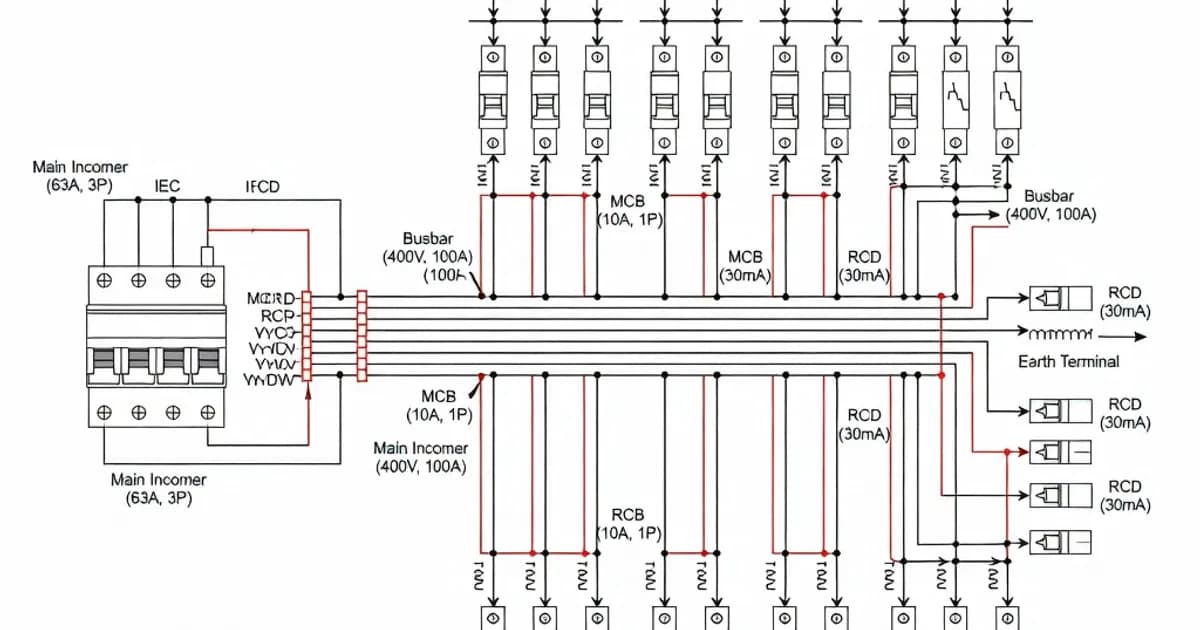
IEC 61439-3: Distribution Boards for Ordinary Persons
IEC 61439-3:2024, Edition 2.0 defines the specific requirements for distribution boards intended to be operated by ordinary persons, often abbreviated as DBO. These are low-voltage assemblies designed for everyday switching, isolation, and the replacement of fuse-links in domestic and similar applications. As noted in the IEC publication and industry guidance, IEC 61439-3 sits within the broader IEC 61439 series and provides the rules needed to ensure that distribution boards remain safe, predictable, and suitable for non-instructed users in buildings and similar installations. [1][3]
For panel builders and specifiers, the significance of IEC 61439-3 is practical as much as regulatory. The standard controls not only the performance of the assembly, but also the limits of the application, the permissible devices, the constructional arrangements, and the verification methods used to demonstrate compliance. In short, it tells manufacturers how to design distribution boards that ordinary persons can operate without exposing them to unacceptable risk. Per IEC 61439-1 and IEC 61439-3, the framework relies on verified design, correct selection of components, and complete documentation rather than on assumption or rule-of-thumb engineering. [3][4]
Overview and scope
IEC 61439-3 applies to distribution boards for ordinary persons in final distribution applications. These boards are enclosed, stationary assemblies used for switching operations and fuse replacement in residential, commercial, and similar environments. The standard covers assemblies used in the generation, transmission, distribution, conversion, and control of electrical energy, as well as associated data-processing and control functions where these are integrated into the board. [1][3]
The standard is specifically intended for use where the operator may not have technical electrical training. That distinction matters because the design must limit access to hazardous live parts, keep operation intuitive, and ensure protective devices are selected and arranged to reduce the likelihood of incorrect use. As documented in IEC 61439-3, the standard recognizes ordinary-person operation as a distinct use case from industrial switchboards operated only by skilled or instructed persons. [3]
Scope limitations and application
IEC 61439-3 is not a universal low-voltage assembly standard. Its application is limited by voltage, current, installation type, and protective-device compatibility. According to the standard, the main scope limits include: nominal voltage to earth not exceeding 300 V AC, outgoing circuits with rated current not exceeding 125 A, and main rated current not exceeding 250 A. The assemblies are enclosed and stationary, and they may be intended for indoor or outdoor use depending on the declared protection degree and installation environment. [1][3]
The device types permitted in these boards are also tightly defined. IEC 61439-3 is aligned with protective devices complying with IEC 60898-1, IEC 61008 series, IEC 61009 series, IEC 62606, IEC 62423, and IEC 60269-3. This means that miniature circuit-breakers, residual current devices, RCBOs, electronic circuit-breakers, photovoltaic-related relays, and fuse-links of the relevant type can be incorporated, provided the assembly is designed and verified accordingly. [3]
In practice, the scope is ideal for distribution boards in homes, apartments, shops, schools, offices, workshops with ordinary-person access, and similar buildings. It is not a substitute for application-specific standards where the assembly is part of a specialized process plant, a heavy industrial switchboard, or a dedicated machine control system. For those applications, other IEC 61439 parts and product standards may be more appropriate. [3]
Key technical specifications
Several technical parameters define whether a board is suitable for IEC 61439-3 application. These parameters influence enclosure selection, thermal design, conductor routing, segregation, and the choice of protective devices. The following table summarizes the most important values commonly encountered in compliant distribution-board designs.
| Parameter | IEC 61439-3 Requirement / Typical Limit | Technical Significance |
|---|---|---|
| Nominal voltage to earth | Up to 300 V AC | Defines the voltage class for ordinary-person distribution boards |
| Outgoing circuit rated current (Inc) | Not exceeding 125 A | Limits final-circuit protection and feeder sizing |
| Main rated current (InA) | Not exceeding 250 A | Sets the upper bound for the assembly’s incoming supply |
| Installation | Enclosed, stationary assembly | Ensures fixed mounting and controlled access |
| Protective device compatibility | IEC 60898-1, IEC 61008, IEC 61009, IEC 62606, IEC 62423, IEC 60269-3 | Ensures proper integration of MCBs, RCCBs, RCBOs, and fuses |
| Typical ambient temperature for verification | 35°C | Used for temperature-rise verification per IEC 61439 verification practice |
Protection rating and enclosure requirements
Ingress protection is a key design decision in IEC 61439-3 assemblies because the board may be installed in a dry room, a damp plant area, or an outdoor location. The research indicates minimum IP ratings commonly specified for different environments: IP42 for indoor locations, IP44 for indoor locations exposed to water leakage risk such as kitchens, pump rooms, or basement carparks, and IP55 for outdoor locations. These values align with the practical need to protect ordinary persons from contact with hazardous parts and to protect the assembly from environmental ingress. [6]
Where the board is installed in areas with moisture, splashing, or contamination risk, the enclosure must provide both adequate protection against ingress and robust mechanical resistance. The enclosure design should also support the declared form of internal separation and the required routine verification tests. In application practice, the declared IP rating should reflect the actual environment rather than the minimum legally possible value. A technically compliant board that is under-rated for its environment is still a poor specification. [6]
Structural requirements and constructional details
Manufacturing practice for IEC 61439-3 boards places emphasis on durability, repeatable assembly, and safe segregation. The research notes that frames, ribs, doors, and covers are typically made of electro-galvanized sheet steel with a minimum thickness of 1.2 mm, while wall mounting should be done using steel anchor bolts rather than wooden or plastic anchors. These details matter because ordinary-person distribution boards must retain alignment, mechanical integrity, and protective enclosure performance throughout their service life. [6]
Segregation is another important structural feature. The board should be designed to Form 2 segregation, separating busbar compartments from functional unit sections to improve safety and reduce the risk of accidental contact or fault propagation. Although the exact internal form depends on the manufacturer’s design, the practical objective is clear: the assembly should confine live parts, reduce the spread of faults, and support safe maintenance and replacement work. This approach is consistent with IEC 61439 constructional principles and with manufacturer guidance from Hager, ABB, and Hensel. [4][5][7]
Busbars are typically specified as hard-drawn, high-conductivity copper, with tinning to prevent galvanic corrosion. The research cites a minimum copper purity of 99.99% and electrical conductivity of 98%. Tinned copper improves long-term reliability, especially where the assembly may be exposed to humidity or where dissimilar metals could otherwise accelerate corrosion. In a distribution board intended for ordinary persons, stable connection quality is not a luxury; it is central to thermal performance and fire safety. [6]
Conductor requirements and internal wiring
Internal conductors in distribution boards must be selected for voltage class, temperature capability, and routing safety. The research specifies cables with nominal voltage ratings of 450 V/750 V and a minimum conductor operating temperature of 105°C, along with color coding in accordance with local regulations. This reflects the need for internal wiring that can tolerate the temperature rise associated with heavily loaded compact assemblies while still providing reliable phase identification and correct termination. [6]
A particularly important practical rule is the handling of non-protected live conductors. Per the research and design guidance, the total length between the main busbar and each associated short-circuit protection device should not exceed 3 m. This helps limit the exposed length of conductors that are not individually protected against short-circuit stress. In panel design terms, the rule encourages compact routing, short feeder runs, and close coupling between incoming supply and protective device. [4]
Neutral and earth bars must be designed with individual terminals for each circuit. No single terminal should accommodate multiple wires unless the specific terminal design explicitly allows it. This requirement supports clear circuit identification, reduces the chance of loose connections, and improves maintainability. For ordinary-person boards, where users may replace fuse-links or operate switches without technical assistance, termination quality is fundamental to safe operation. [6]
Component functions and typical internal devices
IEC 61439-3 assemblies commonly include a main switch, circuit breakers, busbars, residual current devices, fuses, and miniature circuit-breakers. The standard also permits protection devices, control devices, signaling devices, load-shedding relays, energy-management systems, communication devices, and lighting control to be used alone or in combination. [1]
The functional role of each component is straightforward but important:
| Component | Function | Design Note |
|---|---|---|
| Main switch | Provides isolation of the assembly from the supply | Must be clearly identified and accessible |
| Miniature circuit-breaker | Protects final circuits against overload and short circuit | Common in household and similar installations |
| RCCB | Detects residual current and disconnects supply | Used for shock protection and fire risk reduction |
| RCBO | Combines residual-current and overcurrent protection | Useful where compact circuit-level protection is needed |
| Fuses / fuse-links | Provides overcurrent protection by melting under fault conditions | Must match the specified fuse type, such as IEC 60269-3 |
| Busbars | Distribute supply to outgoing devices | Must be rated for current, temperature, and fault withstand |
These components must not be considered in isolation. Their combined thermal loading, short-circuit performance, and installation geometry determine whether the finished assembly is compliant. As shown in manufacturer design manuals from ABB, Hager, and Hensel, product selection must be matched to the board’s verified layout and rated diversity assumptions. [4][5][7]
Applicable protection standards
One of the strengths of IEC 61439-3 is its clear reliance on established component standards. By referencing product standards for protective devices, the assembly standard avoids ambiguity and makes compliance easier to demonstrate. The main referenced standards are: IEC 60898-1 for miniature circuit-breakers used in household and similar installations; IEC 61008 series for RCCBs without integral overcurrent protection; IEC 61009 series for RCBOs; IEC 62606 for electronic circuit-breakers; IEC 62423 for electrical relays used in photovoltaic systems; and IEC 60269-3 for fuse-links used in industrial and similar applications. [3]
In practice, this means a panel builder must verify not only the enclosure and busbar system, but also that each protective device is suitable for its role and is installed within the limits of its product standard. For example, an RCCB selected for a distribution board must meet the performance and marking requirements of IEC 61008, while an RCBO must satisfy IEC 61009. The board designer remains responsible for ensuring those devices operate correctly as part of the complete assembly. [3]
Design verification and engineering checks
IEC 61439 compliance depends on design verification. This is the process by which the manufacturer demonstrates that the chosen construction can safely withstand thermal, dielectric, and mechanical stresses under declared operating conditions. ABB’s IEC 61439 workbook and related manufacturer guidance emphasize temperature-rise calculation, short-circuit withstand verification, and the use of standardized methods such as DIN EN 60890 for assemblies up to 630 A. [4]
Temperature rise verification is especially critical because compact distribution boards can accumulate heat rapidly. The standard verification ambient temperature is commonly taken as 35°C, and the panel designer must ensure that internal component temperatures remain within their permitted limits under rated load. In practice, this affects busbar sizing, enclosure ventilation, spacing between devices, and the derating of components. [4]
Short-circuit withstand strength must also be verified. IEC 61439 requires the assembly to withstand the prospective fault energy it may encounter in service, either through testing, comparison with a reference design, or calculation where permitted. A board that is thermally adequate but not fault-rated is not compliant. Manufacturers therefore need complete coordination data, clear incoming-protective-device assumptions, and documentation proving that the assembly can survive the declared fault level. [4]
Diversity factor is another important design input. The research notes that rated diversity factor elaboration should be supported by incoming and outgoing circuit diagrams and by consideration of whether internal separation, power losses, and the number of outgoing circuits are the same or reduced from a reference arrangement. This is a reminder that diversity is not guesswork: it must be justified from the circuit structure and the expected load profile. [9]
Manufacturer practice and product examples
Major manufacturers have published guidance showing how IEC 61439-3 is applied in real products. ABB provides detailed design and verification support for distribution boards, including temperature-rise calculations and short-circuit withstand strength for assemblies up to 630 A. [4] Hager organizes its low-voltage systems into LV MSB, LV MDB, and sub-distribution boards, with busbar mounting systems, inclined busbars rated to 630 A, and modular cabinet widths that support 10, 24, or 36 module positions. [5]
Hensel’s guidance for ENYSTAR and Mi Power Distribution Boards emphasizes routine verification, inspection reporting, manufacturer marking, and EC conformity declarations for IEC 61439 / EN 61439 assemblies. [7] Eaton similarly references Appendix AA of EN 61439-3, which addresses technical parameters that must be agreed between manufacturer and user. [8] These examples show that compliance is not merely a label on the enclosure; it is a coordinated design and documentation process from concept through delivery.
Comparison with related IEC 61439 parts
IEC 61439-3 is part of a broader family. IEC 61439-1 provides the general rules, while other parts address different assembly types and applications. The key distinction is that IEC 61439-3 is tailored for boards intended to be operated by ordinary persons, which imposes tighter expectations on accessibility, simplicity, and protective device selection. [3]
Compared with industrial switchboards designed for skilled operation, ordinary-person boards usually have more standardized layouts, stricter limitations on circuit ratings, and stronger emphasis on touch protection and simple operation. This distinction is central to the standard’s safety philosophy. The board must be safe not only under electrical fault conditions, but also during routine user interaction such as switching off a circuit or replacing a fuse-link. [1][3]
Current standard documentation and adoption
IEC 61439-3:2024 Edition 2.0 is the current edition, available through the IEC Webstore and national or regional standards distributors. In North America, ANSI also provides access to the standard’s publication record. [1][3] In Europe and other markets, the same requirements are commonly adopted as EN 61439-3 through national standardization systems.
For engineers, this means compliance checks should always reference the current adopted edition in the jurisdiction of sale or installation. The technical content may be harmonized across regions, but the legal status and national annexes can differ. Manufacturers should confirm whether their documentation, labeling, and conformity declarations reflect the locally applicable edition. [3][7]
Design best practices for compliant distribution boards
A well-designed IEC 61439-3 board starts with segregation, thermal planning, and clean circuit architecture. Form 2 segregation is a practical baseline because it separates busbar sections from functional units and reduces the chance of accidental contact during service. Compact conductor routing should keep unprotected live lengths as short as possible, ideally within the 3 m maximum cited in the research guidance. [4][6]
Documentation is equally important. A manufacturer should be able to provide electrical diagrams, rated currents, rated diversity factor assumptions, short-circuit coordination details, routine verification records, and conformity declarations. Hensel’s documentation model is a good example of the level of completeness expected for modern low-voltage assemblies. [7]
Material durability should not be overlooked. Electro-galvanized steel enclosures, tinned copper busbars, and correctly rated terminals contribute to long service life and reduce the chance of corrosion-related failures. In humid or outdoor environments, enclosure selection and corrosion resistance must be matched to the declared IP rating and the installation site. [6]
Conclusion
IEC 61439-3 provides the essential framework for distribution boards operated by ordinary persons. It defines where these boards may be used, what devices they may contain, how they must be constructed, and how compliance must be verified. For panel builders, the standard is not
Related Panel Types
Related Components
Related Standards
Frequently Asked Questions
Ready to Engineer Your Next Panel?
Our team of electrical engineers is ready to design, build, and deliver your custom panel solution — fully compliant with international standards.