MCC Panels

IEC 61439-3 (DBO)

Distribution boards for operation by ordinary persons
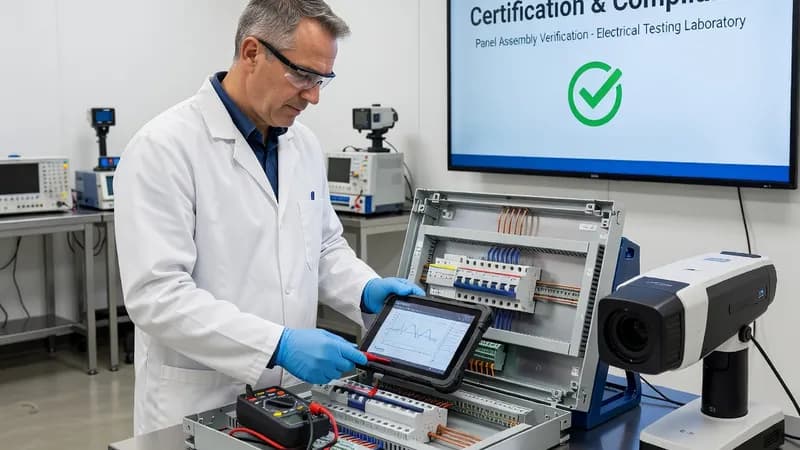
IEC 61439-3 (DBO)

IEC 61439-3 defines the specific requirements for distribution boards intended to be operated by ordinary persons, commonly referred to as DBOs. In practice, this scope includes lighting distribution boards, socket-outlet boards, small power panels, and final-circuit boards used in commercial buildings, healthcare facilities, infrastructure utilities, schools, transportation terminals, and residential complexes. For panel builders, the standard sits alongside IEC 61439-1 and IEC 61439-2, but adds stricter protective measures focused on preventing direct contact, limiting misuse, and ensuring that non-technical users can safely reset protective devices after a trip event. A compliant IEC 61439-3 assembly typically integrates MCCBs or MCBs for outgoing feeders, with upstream ACBs or larger MCCBs used at the main incomer where system demand requires higher fault interruption capacity. Current ratings are generally aligned with distribution-board duty, with outgoing final circuits commonly up to 125 A and board assemblies often designed within the 250 A range, depending on the verified configuration and the manufacturer’s declared performance. Short-circuit withstand capability must be demonstrated through verification under IEC 61439-1, with the assembly’s rated short-circuit current and conditional short-circuit current clearly stated. In many projects, upstream coordination with a service protection device allows higher prospective fault levels while maintaining the DBO’s compliance envelope. The defining safety feature of IEC 61439-3 is accessibility. Live parts must remain protected to at least IP2X or IPXXB, even when the enclosure door is open, so ordinary persons cannot touch energized conductors during routine operation. Internal wiring, terminals, and busbar systems must be arranged to reduce the risk of accidental contact, and functional elements such as protective devices, indicator lamps, meters, and control switches should be laid out so operation is intuitive and restricted to user-facing tasks. Forms of separation are often applied in compact arrangements to segregate functional units and improve serviceability, although the exact configuration must be validated against the temperature-rise and clearances of the selected enclosure system. Testing and verification for DBO panels follows the IEC 61439 framework: design verification for strength of materials, degree of protection, clearances and creepage distances, dielectric properties, temperature-rise limits, short-circuit withstand, and mechanical operation; plus routine verification of wiring, devices, and functional operation before delivery. If the panel is intended for harsh environments, the enclosure may also need evaluation against IEC 60079 for explosive atmospheres or IEC 61641 for internal arc protection in particular low-voltage switchgear compartments, though these are application-specific extensions rather than core DBO requirements. For manufacturers such as Patrion, IEC 61439-3 compliance is especially important for lighting-distribution-board applications in hospitals, shopping centers, office towers, public infrastructure, and utility facilities where maintenance staff and building occupants may interact with the panel. A properly engineered DBO combines certified enclosure design, verified busbar and protective-device coordination, and clear labeling so the end user can safely reset a breaker, isolate a circuit, or identify a fault without specialist intervention. In today’s projects, this standard is not only a compliance requirement; it is a design methodology for making low-voltage distribution safer, more maintainable, and more resilient in everyday use.

Panels Certified to This Standard

Related Industries

Related Knowledge Articles

Frequently Asked Questions

IEC 61439-3 is the product standard for distribution boards intended to be operated by ordinary persons. It applies to lighting, socket-outlet, and small power boards where users may reset protective devices without technical training. Compared with IEC 61439-2, it requires stronger protection against direct contact, more controlled internal layout, and clear operational access. The assembly still follows the IEC 61439-1 design-verification framework for temperature rise, short-circuit withstand, dielectric performance, clearances, creepage distances, and mechanical strength. For manufacturers, this means the board must be engineered so a non-expert can use it safely while the internal live parts remain inaccessible under normal operation.
IEC 61439-3 is typically required for lighting distribution boards, final-circuit boards, socket-outlet panels, and small power distribution boards used by non-technical users. This is especially common in commercial buildings, hospitals, schools, transportation hubs, residential towers, and public infrastructure. If the enclosure is meant for routine reset or switching by facility staff or occupants, the DBO standard is usually the correct route. Panels such as main switchboards, motor control centers, and industrial sub-distribution boards operated only by skilled persons are generally covered by IEC 61439-2 instead. The key distinction is who will operate the board and how accessible the live parts are.
The most important safety requirement is protection against contact with live parts, typically at least IP2X or IPXXB even when the door is open. This prevents ordinary persons from touching energized conductors during operation or reset. The panel must also be arranged to minimize misuse, with clear separation between user-operated devices and internal wiring. In practice, panel builders use molded-case circuit breakers, miniature circuit breakers, and suitably shielded busbar systems to maintain safe access. The standard also relies on IEC 61439-1 verification of temperature rise, dielectric strength, and short-circuit performance so the board remains safe under normal service and fault conditions.
The short-circuit rating is not a single fixed value for all DBO panels; it must be verified by the manufacturer for the exact assembly configuration. In many practical applications, DBOs are designed around prospective short-circuit currents such as 10 kA, or higher when backed by upstream protective devices and verified coordination. The assembly must declare its rated short-circuit current or conditional short-circuit current in accordance with IEC 61439-1. This is important because the busbar system, devices, and enclosure must all withstand the thermal and mechanical stresses of a fault without damage that would compromise safety.
Compliance is established through design verification and routine verification. Design verification covers temperature rise, short-circuit withstand, dielectric properties, protection against electric shock, mechanical operation, and degree of protection, using test, comparison, calculation, or assessment as allowed by IEC 61439-1. Routine verification is then performed on every manufactured board, including wiring checks, dielectric checks where required, device operation, and visual inspection. For a lighting-distribution-board project, this means the manufacturer must prove the exact assembly is safe and repeatable, not just the component selection. This is the normal compliance pathway for reputable panel builders such as Patrion.
They can be installed only if the resulting assembly remains appropriate for ordinary-person operation and still satisfies the DBO requirements. In most cases, VFDs and soft starters are more common in IEC 61439-2 industrial assemblies, but they may appear in small auxiliary or building-services panels if the access, labeling, thermal management, and protective coordination are properly engineered. The presence of power electronics increases heat dissipation and may affect clearances, EMC, and maintenance access. For a DBO application, the panel builder must verify that user-facing operation remains simple and that live parts are still protected to IP2X or IPXXB.
DBO panels are typically built with internal barriers, covered busbars, and segregated functional units to maintain safe access and reduce accidental contact. Forms of separation, such as separating incoming devices from outgoing final circuits, improve serviceability and reduce fault propagation. The enclosure should maintain the declared degree of protection and preserve clearances and creepage distances under IEC 61439-1. In commercial and healthcare installations, a well-designed layout with labeled MCBs or MCCBs, secure neutral and earth bars, and front-access operation helps ensure the board remains safe for ordinary users while still being maintainable by qualified personnel.
The most common industries are commercial buildings, healthcare, infrastructure utilities, education, and residential developments. Hospitals and clinics often require reliable lighting distribution boards with easy reset capability for non-technical staff. Office towers, retail centers, and public facilities need safe final-circuit distribution that can be operated by maintenance personnel or occupants. Utility and transport projects also use DBO panels for auxiliary loads, lighting, and small power distribution. In these sectors, IEC 61439-3 provides a practical compliance route that supports safe everyday operation while aligning with the broader IEC 61439 family of panel assembly requirements.

Ready to Engineer Your Next Panel?

Our team of electrical engineers is ready to design, build, and deliver your custom panel solution — fully compliant with international standards.