Lighting Distribution Board
Final distribution for lighting and small power. MCB/RCBO-based with DALI or KNX integration options.
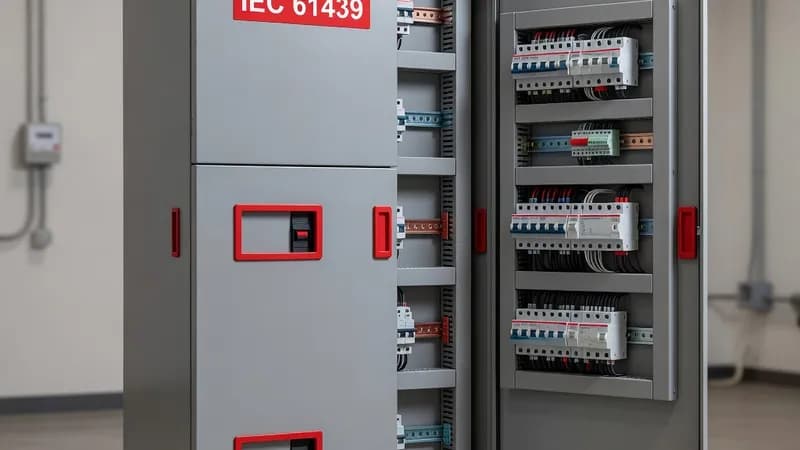
A Lighting Distribution Board is a final distribution assembly engineered for the safe and selective supply of lighting circuits, socket outlets, emergency lighting, and other small power loads in commercial, institutional, and infrastructure projects. For IEC 61439 applications, it is typically designed to IEC 61439-3 as a distribution board intended for ordinary persons, although many projects also require verification against IEC 61439-1 and, where applicable, IEC 61439-2 practices for busbar and assembly performance. Typical incoming ratings range from 63 A to 400 A, with outgoing ways built around MCBs and RCBOs to IEC 60898-1 and IEC 61009-1, and MCCBs where higher sub-feeder capacity or discrimination is required. Short-circuit withstand ratings are commonly specified from 10 kA up to 25 kA or higher, depending on the prospective fault level at the point of installation and the protective device coordination study. Engineering of the enclosure and internal architecture is critical. Lighting boards may be arranged in Forms of internal separation 1, 2, 3, or 4 in accordance with IEC 61439, depending on maintenance philosophy, continuity requirements, and segregation of functional units. Form 2 is often used in office and healthcare environments to separate busbars from outgoing functional units, while Form 3 or Form 4 is selected where circuit segregation, reduced downtime, or safer maintenance access is required. Copper busbar systems, neutral bars, and protective earth bars are selected for thermal performance, fault withstand, and ease of termination, with IP protection ratings commonly IP31, IP42, IP54, or higher for dusty or humid spaces. Modern lighting distribution boards increasingly incorporate smart control and power quality functions. DALI gateways, KNX actuators, contactors, timer relays, and digital input modules support scene control, occupancy-based switching, daylight harvesting, and BMS integration. Metering power analyzers can be added for circuit-level energy monitoring, load profiling, and maintenance diagnostics, while surge protective devices to IEC 61643 protect sensitive controls and lighting electronics against transient overvoltages. In projects with LED drivers, emergency lighting central battery systems, or networked automation, EMC performance and coordinated protection become particularly important. Component selection must consider the application environment and compliance scope. In healthcare facilities, selective coordination and continuity of supply are often prioritized; in commercial towers, space efficiency and metering visibility are key; and in utilities or transport hubs, maintainability and fault isolation drive the design. If the board is installed in harsh or hazardous areas, additional requirements from IEC 60079 may apply, while fire-related integrity or smoke considerations may call for IEC 61641 evaluation depending on the enclosure location and project specification. For North American or dual-marked projects, UL 891 and CSA requirements may also be referenced, but the IEC 61439 design verification remains the primary basis for the panel assembly. A properly engineered Lighting Distribution Board delivered by Patrion in Turkey is not just a breaker enclosure; it is a tested, documented low-voltage assembly with verified temperature rise, dielectric strength, short-circuit performance, clear circuit labeling, maintainable wiring routes, and a control architecture suited to modern building automation. This makes it a practical solution for office buildings, hospitals, airports, schools, hotels, data centers ancillary loads, and infrastructure utilities where reliable lighting continuity and intelligent control are essential.
Components for This Panel
Moulded Case Circuit Breakers (MCCB) selection, integration, and best practices for Lighting Distribution Board assemblies compliant with IEC 61439.
Surge Protection Devices (SPD) selection, integration, and best practices for Lighting Distribution Board assemblies compliant with IEC 61439.
Busbar Systems selection, integration, and best practices for Lighting Distribution Board assemblies compliant with IEC 61439.
Metering & Power Analyzers selection, integration, and best practices for Lighting Distribution Board assemblies compliant with IEC 61439.
Applicable Standards
IEC 61439-3 (DBO) compliance requirements, testing procedures, and design considerations for Lighting Distribution Board assemblies.
IP Protection Ratings compliance requirements, testing procedures, and design considerations for Lighting Distribution Board assemblies.
UL 891 / CSA C22.2 compliance requirements, testing procedures, and design considerations for Lighting Distribution Board assemblies.
Industries Using This Panel
Lighting Distribution Board assemblies engineered for Commercial Buildings applications, addressing industry-specific requirements and compliance standards.
Lighting Distribution Board assemblies engineered for Healthcare & Hospitals applications, addressing industry-specific requirements and compliance standards.
Lighting Distribution Board assemblies engineered for Infrastructure & Utilities applications, addressing industry-specific requirements and compliance standards.
Related Knowledge Articles
Understanding IEC 61439-3 requirements for distribution boards.
Comprehensive overview of all IEC 61439 parts, their scope, and how they apply to different panel types.
Selecting the right IP rating for your panel installation environment.
Frequently Asked Questions
Ready to Engineer Your Next Panel?
Our team of electrical engineers is ready to design, build, and deliver your custom panel solution — fully compliant with international standards.