Short-Circuit Withstand Strength (Icw) in Panel Design
Understanding and verifying short-circuit ratings.
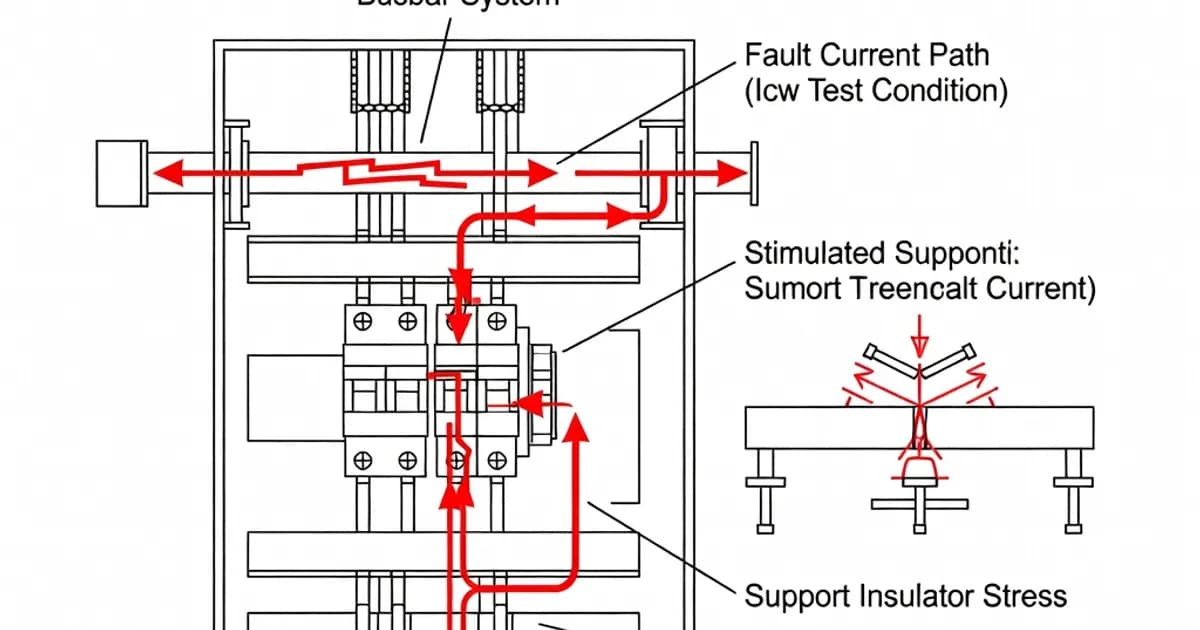
Short-Circuit Withstand Strength (Icw) in Panel Design
Short-circuit withstand strength, usually expressed as Icw, is one of the most important ratings in low-voltage panel design under the IEC 61439 series. It defines the assembly’s ability to withstand the thermal and mechanical effects of a short-circuit current for a specified duration, typically 1 s or 3 s, without unacceptable damage and without losing the functions required for continued service. Per IEC 61439-1 Clause 5.3.5, Icw is a rated characteristic of the assembly, and its verification is addressed in Clause 10.11.
In practical terms, Icw tells the designer whether the busbars, supports, connections, enclosure, and protective conductors can survive a fault until the upstream protective device clears it. It is not a theoretical label. It is a verified performance rating that must be matched to the prospective short-circuit current available at the installation point, or limited by the short-circuit protective device (SCPD). As documented in the IEC 61439 framework, the assembly must remain safe, structurally intact, and electrically functional for the non-faulted circuits after the event.
What Icw actually means in an assembly
Icw is the rated short-time withstand current of the complete assembly. It applies to the main circuit, including neutral and protective conductors where relevant, and it reflects both thermal stress from current heating and dynamic stress from electromechanical forces. IEC 61439-1 also defines the rated peak withstand current Ipk in Clause 5.3.4, which describes the instantaneous peak current the assembly can withstand during the first cycle of the fault.
These two ratings work together. Icw addresses the current magnitude over time, while Ipk addresses the peak magnetic force on bars, supports, and terminations at the moment of fault inception. In practice, a panel may have a high thermal withstand capability but still fail dynamically if busbar support spacing, bracing, or termination strength are inadequate. That is why both ratings matter in panel verification and in real-world coordination with the protective device.
Why Icw matters in panel design
If the available fault current exceeds the assembly’s withstand capability, the consequence can be severe: busbar deformation, insulation damage, welded contacts, enclosure rupture, loss of IP degree, or fire. A compliant design must prevent these outcomes under the rated test conditions. Schneider Electric’s technical guidance emphasizes that short-circuit withstand verification is central to ensuring the switchboard survives fault conditions without losing serviceability of unaffected circuits, while ABB’s IEC 61439 workbook shows how the standard is applied to real assemblies through rating tables, calculations, and verification workflows.
For the panel designer, Icw is therefore not a “nice-to-have” margin. It is a core selection criterion that drives busbar sizing, support spacing, enclosure robustness, device coordination, and overall assembly architecture. A panel intended for a transformer-fed distribution point may require 50 kA, 80 kA, or even 100 kA for 1 second depending on transformer size, impedance, and location in the distribution chain.
IEC 61439 definitions and verification requirements
IEC 61439-1 is the primary standard for low-voltage switchgear and controlgear assemblies. In the third edition, Icw is defined in Clause 5.3.5, Ipk in Clause 5.3.4, and the verification of short-circuit withstand strength is covered in Clause 10.11. The standard requires the manufacturer to verify that the assembly can withstand the declared short-circuit rating using one of three accepted methods: testing, comparison with a reference design, or calculation where permitted.
Clause 9.3 and Clause 10.11 work together to ensure that the assembly not only survives the fault, but does so without compromising safety. The verification must demonstrate that there is no danger from fire or expelled molten material, that enclosures and covers remain secure, and that the assembly retains the required degree of protection and functional integrity for non-faulted circuits. This is why the verification is more than a single current number; it is a performance assessment of the entire construction.
Verification methods allowed by IEC 61439
IEC 61439-1 Clause 10.11 permits three verification approaches:
- Testing to the specified short-circuit level, usually the most robust method for new or critical designs.
- Comparison with a reference design, using a checklist to confirm equivalence in dimensions, materials, supports, spacing, and protective devices.
- Calculation, including the busbar calculation approach in Annex M where applicable.
In practice, testing gives the strongest evidence, but comparison is widely used for families of assemblies and standardized platforms. Calculation is valuable for busbar systems and repeated variants, provided the assumptions are conservative and traceable. As summarized in industry guides, the chosen method must be supported by documentation proving that the assembly configuration is within the verified envelope.
What the verification must show
Per IEC 61439-1 Clause 10.11, the assembly must withstand the fault without unacceptable degradation. Key acceptance points include:
- no fire or ignition from fault energy,
- no emission of molten metal that creates a hazard,
- busbars, supports, and connections remain mechanically secure,
- doors, covers, and hatches stay closed or latched as intended,
- the enclosure retains its declared IP degree after the test,
- non-faulted circuits remain functional where required.
These criteria are not abstract. They are intended to validate the safety performance of a real assembly in a fault scenario. If a design cannot pass them, its Icw claim is not valid for the tested configuration.
Relationship between Icw, Ipk, and the protective device
The short-time withstand rating is only meaningful when the protective device is coordinated with the assembly. The upstream SCPD must limit fault energy so that the current and its duration remain within the assembly’s verified capability. That coordination depends on both thermal energy, often expressed as I²t, and the instantaneous peak current.
IEC 61439-1 notes the relationship between Icw and Ipk in Clause 9.3.3. In practice, Ipk is commonly in the range of roughly 2.2 to 2.5 × √2 × Icw for 50 Hz systems, depending on the network power factor and fault characteristics. This means that a 50 kA Icw assembly may need to tolerate a substantially higher peak current momentarily at fault inception.
Why peak current can be the hidden design challenge
Many failures are not caused by sustained heating alone. They happen because fault currents generate very large electrodynamic forces that try to push busbars apart, bend supports, or loosen terminations. The designer must therefore ensure that the busbar system can handle the peak forces before the protective device clears the fault. That is why the Ipk rating is essential in addition to Icw.
As a rule, the further the short-circuit source is from the panel or the larger the transformer feeding it, the greater the need to verify both thermal and dynamic withstand. A panel that passes the 1-second thermal test may still require stronger supports or tighter spacing if its Ipk exposure is high.
Standards and related documents
The main standards that govern short-circuit withstand strength in low-voltage assemblies are IEC 61439-1 and IEC 61439-2. IEC 61439-1 provides the general rules, definitions, and verification methods. IEC 61439-2 applies to power switchgear and controlgear assemblies and sets additional expectations for assemblies rated up to 3150 A.
In addition, IEC 60947 device standards are essential because the SCPD data used in panel coordination often comes from circuit-breakers, contactors, and protection devices tested to that series. For example, IEC 60947-2 provides the short-circuit performance information for circuit-breakers, which is used to confirm that the protective device will limit fault stress within the assembly’s withstand envelope.
Other related standards include IEC 60529 for ingress protection verification, because an enclosure that opens, warps, or loses sealing after a fault may no longer meet its IP rating. Where surge protective devices are used, DEHN notes that the surge device’s short-circuit current rating must be compatible with the assembly’s Icw, in line with IEC 61439-1 verification expectations.
Relevant IEC 61439 clauses at a glance
| Clause | Topic | Design significance |
|---|---|---|
| 5.3.4 | Rated peak withstand current (Ipk) | Defines dynamic short-circuit capability |
| 5.3.5 | Rated short-time withstand current (Icw) | Defines thermal withstand for a stated duration |
| 9.3 | Protection against electric shock and short-circuit effects | Links protective arrangement to fault endurance |
| 10.11 | Short-circuit withstand strength verification | Sets acceptable verification routes and criteria |
| Annex M | Busbar calculation guidance | Provides calculation method for certain busbar designs |
How Icw is verified in practice
Manufacturers typically verify Icw by testing a representative assembly configuration, then using that configuration as a reference for derivative designs. This is the most common route for modular panel families. For custom panels or heavily modified assemblies, full testing may be needed to substantiate the claimed rating.
The test normally applies the declared short-circuit current for the declared time, such as 1 second. After the test, the assembly is inspected for structural damage, insulation deterioration, deformation, and functionality. Where the panel includes non-faulted outgoing circuits, those circuits must remain operational if the standard or project specification requires it.
Reference design comparison
The comparison method is widely used in engineering practice because it allows a tested “master design” to cover a family of variants. However, the comparison must be disciplined. The substitute design must match the reference in all critical respects, including busbar cross-section, material, support spacing, phase arrangement, enclosure construction, insulation clearances, and SCPD characteristics. Electrical Engineering Portal’s IEC 61439 guidance highlights the importance of a structured checklist for this purpose.
If the new design departs from the reference in a way that could affect short-circuit performance, the comparison is no longer valid. A thicker busbar may be acceptable, but a longer unsupported span, a different alloy, or a weaker mounting arrangement may invalidate the equivalence.
Calculation using Annex M
Annex M can be used for busbar calculation in certain circumstances. This is especially valuable when designing standardized busbar systems with repeatable dimensions and support arrangements. The calculation approach must still be conservative and based on verified physical assumptions. It does not eliminate the need for engineering judgment; it formalizes it.
In practice, calculation is most reliable when it is tied to a tested family of assemblies. For highly customized designs, many manufacturers still prefer type testing because it provides direct evidence and reduces the risk of hidden assumptions.
Design factors that determine Icw performance
Icw performance depends on the complete assembly, not just the busbars. The main design variables are busbar material, cross-section, spacing, support strength, enclosure rigidity, device layout, and the short-circuit limiting performance of the protective device.
Busbar material and geometry
Copper busbars generally provide better conductivity and thermal performance than aluminum for a given footprint, although aluminum may be used where the design is engineered accordingly. Cross-section size, edge distance, and phase spacing all influence withstand strength. Higher spacing can reduce electrodynamic stress, but it must be balanced against panel compactness and creepage/clearance requirements.
Support spacing and mechanical bracing
Busbar supports are critical. Under short-circuit conditions, the current produces strong repulsive and attractive forces between conductors. If supports are too far apart or too weak, the bars can deflect or collide. Industry guidance often targets support spacing around 300 mm or less for many designs, but the actual permissible spacing depends on the verified busbar system and the declared short-circuit rating. As ABB’s workbook and other manufacturer guidance show, the support arrangement must be consistent with the tested or calculated reference design.
Protective device coordination
The SCPD must limit the let-through energy enough to keep the fault within the assembly’s withstand capability. This is why the I²t characteristics of fuses and circuit-breakers are central to panel design. A correctly coordinated protective device can allow a lower-rated busbar system to survive a higher prospective fault current by clearing very rapidly.
For this reason, many manufacturers recommend using devices from the same protective coordination ecosystem when performing reference design verification. That approach simplifies documentation and reduces ambiguity about let-through performance.
Enclosure strength and IP retention
The enclosure must stay mechanically intact during and after the fault. Doors and covers should remain closed or latched, and the IP degree must not be materially reduced by deformation or opening gaps. Schneider Electric’s published guidance specifically notes the importance of preserving the enclosure function after the short-circuit test, because loss of protection can turn a survivable event into a personnel safety hazard.
Comparison of common short-circuit withstand approaches
| Verification method | Best for | Advantages | Limitations |
|---|---|---|---|
| Testing | New designs, high-risk applications, custom panels | Direct evidence, strongest compliance basis | Costly, time-consuming, tied to the tested configuration |
| Reference design comparison | Modular product families, repeat variants | Efficient, practical for standardized systems | Requires strict equivalence and detailed documentation |
| Calculation | Busbar systems and repeatable designs | Flexible, useful for engineering optimization | Depends on conservative assumptions and correct input data |
Typical ratings and product examples
Commercial assemblies often specify Icw ratings in the range of 25 kA to 100 kA for 1 second, depending on the application. Schneider Electric’s Prisma range has published examples at 100 kA for 1 s with an Ipk of 187 kA. ABB’s IEC 61439 materials provide detailed verification workflows and busbar tables, while Siemens, Eaton, and Rittal publish design families that are typically verified in the 50 kA to 100 kA class depending on configuration.
The important point is not the brand name itself, but the verified configuration. A “100 kA” platform may only achieve that rating with a specific busbar arrangement, enclosure size, and protective device pairing. A different cubicle size or busbar extension may have a lower declared Icw. Always read the manufacturer’s technical documentation for the exact assembly variant.
| Manufacturer | Example product family | Published short-circuit withstand example | Technical note |
|---|---|---|---|
| Schneider Electric | Prisma | 100 kA, 1 s; Ipk 187 kA | Verified assembly performance with documented short-circuit testing |
| ABB | System pro M and related assemblies | Up to 50–100 kA depending on configuration | Workbook includes verification and busbar guidance |
| Siemens | SIVACON | Commonly 50–100 kA, 1 s | Uses reference design and system documentation |
| Eaton | xEnergy | Commonly 50–80 kA, 1 s | Short-circuit performance coordinated with SCPDs |
| Rittal | Modular power distribution systems | Up to 100 kA in selected systems | Focus on modular busbar and enclosure integrity |
Common design mistakes and how to avoid them
One of the most common mistakes is to size the panel only from load current and ignore the available fault current. A feeder may carry only 250 A in normal operation, but still require a 50 kA or 65 kA withstand rating because of the transformer and network impedance upstream. Another frequent error is to assume that the protective device will always limit current sufficiently without checking its let-through characteristics.
Designers
Related Panel Types
Primary power distribution from transformer to sub-circuits. Rated up to 6300A. Houses main incoming breaker, bus-section, and outgoing feeders.
High-capacity power distribution for industrial facilities. Controls and distributes incoming power to MCC, APFC, and downstream loads.
Related Components
Related Standards
Frequently Asked Questions
Ready to Engineer Your Next Panel?
Our team of electrical engineers is ready to design, build, and deliver your custom panel solution — fully compliant with international standards.