Smart Panels and Energy Management Systems
Implementing intelligent panel monitoring and energy optimization.
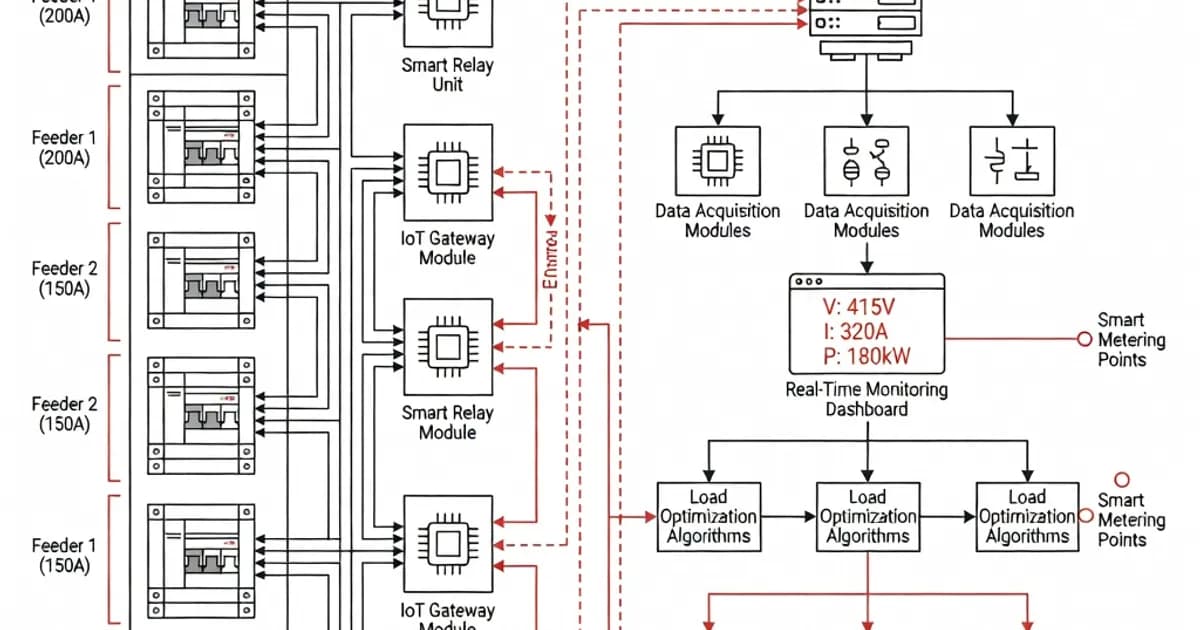
Smart Panels and Energy Management Systems
Smart panels combine IEC 61439-compliant low-voltage switchgear and controlgear assemblies with metering, communication, diagnostics, and software-driven energy management. In practical terms, a smart panel is still first and foremost an electrical assembly: it must satisfy the safety, temperature rise, short-circuit, dielectric, and protective circuit requirements of IEC 61439. The “smart” layer adds measurement and communications, but it does not reduce the manufacturer’s obligation to verify the assembly as a whole. Per IEC 61439-1, the assembly remains responsible for current-carrying capacity, protection against electric shock, resistance to short circuit, and thermal performance under declared conditions. As summarized in ABB’s IEC 61439 presentation and related technical guides, the standard is the foundation for safe low-voltage assemblies up to 1 kV AC, including panelboards and distribution switchboards.
Energy management systems extend this foundation by collecting electrical data from meters, protection relays, power quality analyzers, and intelligent devices, then turning that data into actionable information. This can include load profiling, peak-demand control, energy reporting, alarm handling, and maintenance insights. The critical engineering point is that smart functionality must be designed around the panel’s compliance requirements, not in place of them. The enclosure, busbars, functional units, and protective devices must still be verified against IEC 61439 clauses and the applicable component standards such as IEC 60947 for low-voltage switchgear and controlgear devices.
What IEC 61439 Covers
IEC 61439 establishes the design and verification framework for low-voltage switchgear and controlgear assemblies. The standard addresses assemblies intended to distribute and control electrical energy, typically up to 1000 V AC and 1500 V DC depending on the part and application. UL’s overview of IEC 61439-1 and IEC 61439-6 notes the family structure of the standard, while multiple technical references emphasize its role in defining the assembly’s performance as a complete system rather than as a collection of isolated components.
The most important compliance areas for smart panels are the same areas that govern conventional panels:
- Temperature rise limits for busbars, terminals, protective devices, wiring, and enclosures.
- Short-circuit withstand strength for busbar systems, supports, and protective circuits.
- Clearances and creepage distances based on rated impulse withstand voltage, overvoltage category, and pollution degree.
- Dielectric properties, including power-frequency withstand where applicable.
- Protective circuit continuity and integrity of PE and PEN paths.
- Mechanical operation and degree of protection of the enclosure.
These requirements matter for energy management because smart panels often include additional heat sources: meters, communication gateways, routers, PLCs, power supplies, and sometimes industrial PCs. Any additional internal losses raise the thermal load inside the assembly. Per IEC 61439-1 design verification, the declared rated current and internal arrangement must be proven to remain within permissible temperature limits under the stated operating conditions. Schneider Electric’s discussion of rated current and monitoring under IEC 61439 highlights the same engineering reality: monitoring devices improve visibility, but they also introduce heat, wiring density, and installation constraints that must be addressed in design.
Why Energy Management Belongs in the Panel
Energy management is most effective when measurement is close to the load and directly integrated with the distribution architecture. A panelboard or switchboard can capture feeder-level, branch-level, or outgoing-circuit data at the point where power is distributed. This enables operators to identify demand spikes, low power factor, voltage imbalance, harmonic distortion, and wasted standby consumption.
Smart panels support a number of use cases:
- Submetering for departments, tenants, or production lines.
- Demand control to reduce peak kW charges.
- Power quality monitoring for voltage sags, THD, harmonics, and transients.
- Asset utilization tracking to correlate electrical load with process output.
- Preventive maintenance through temperature, breaker trip, and event monitoring.
These capabilities do not change the basic function of the panel; they enhance visibility and operational decision-making. In modern facilities, a switchboard that cannot communicate status data is often an information bottleneck. However, intelligent monitoring is only valuable if the panel is engineered correctly. Poor CT placement, overloaded auxiliary circuits, or inadequate thermal headroom can undermine both safety and data quality.
Design Verification and Smart Device Integration
IEC 61439 requires design verification by test, comparison, calculation, or a combination of these methods. This is particularly relevant where smart devices are added to an assembly. According to the standard’s framework, the manufacturer must verify the assembly for the declared rating and construction, including internal wiring, ventilation, enclosure arrangement, and device selection. The presence of communication equipment does not eliminate any verification requirement.
Several design verification items have direct implications for smart panel integration:
Temperature Rise Verification
Temperature rise is the most obvious issue. Busbars and functional units must carry rated current without exceeding allowable temperature limits. Multiple sources on IEC 61439 note that temperature rise verification is central to the standard, and calculation may be used in some multi-compartment assemblies up to 1600 A where the standard permits. That means the panel designer must account for not only load current but also the heat generated by meters, gateways, power supplies, and auxiliary relays. In dense smart panels, device spacing and ventilation can be as important as conductor sizing.
Practical design measures include:
- placing high-loss devices away from hot busbar zones;
- segmenting auxiliary power supplies into cooler compartments where possible;
- leaving space for vertical airflow and cable dressing;
- using thermal simulation or validated calculation methods for crowded assemblies;
- confirming the actual dissipation of every add-on device.
Clearances, Creepage, and Insulation
Smart panels often include low-voltage communication wiring alongside power conductors. This does not relax the requirements for insulation coordination. Clearances and creepage distances must still match the voltage stress and environmental conditions of the panel. Where Ethernet, RS-485, Modbus, or BACnet cabling shares the enclosure, the designer must preserve separation, route conductors cleanly, and use appropriately rated terminals and insulation barriers.
Short-Circuit Strength
Energy management hardware should never compromise the panel’s short-circuit rating. Busbar supports, frame design, and device mounting arrangements must withstand the declared fault duty. Even small devices mounted on panels can become hazards if they are installed in ways that obstruct pressure relief, weaken barriers, or interfere with internal compartmentalization. As noted in IEC 61439 guidance documents, short-circuit verification remains one of the key proof points for the completed assembly.
Protective Circuits and Earthing
Smart panels typically rely on a mix of protective earth conductors, shield terminations, and bonded enclosures. The continuity of protective circuits must be maintained across hinged doors, removable plates, and modular add-ons. Poor bonding can create noise issues for communication equipment and safety issues for exposed conductive parts. In a well-designed panel, electromagnetic compatibility and safety reinforcement work together rather than competing.
Common Smart Panel Architecture
A typical smart panel includes the following layers:
| Layer | Typical Function | IEC 61439 Relevance |
|---|---|---|
| Main incoming section | Isolation, main protection, and incoming metering | Must satisfy short-circuit, temperature rise, and dielectric verification |
| Busbar system | Power distribution to outgoing feeders | Critical for current-carrying capacity and fault withstand |
| Outgoing functional units | Feeder breakers, motor starters, contactors, or drives | Must be verified in the declared assembly configuration |
| Metering and sensing | Current transformers, voltage taps, meters, power quality analyzers | Adds heat and wiring complexity; requires secure mounting and segregation |
| Communication layer | Gateways, switches, routers, serial converters | Requires EMC-conscious layout and auxiliary power design |
| Energy management software | Dashboards, alarms, trends, reports, and optimization logic | Outside IEC 61439 scope, but dependent on reliable panel data |
This architecture shows a key distinction: IEC 61439 governs the physical assembly, while the EMS software layer governs how electrical data is interpreted and used. The panel builder must therefore manage both electrical compliance and information integrity.
Communication and Monitoring Considerations
Although IEC 61439 does not prescribe communication protocols, modern panels frequently use Modbus TCP, Modbus RTU, BACnet, PROFINET, Ethernet/IP, or IEC 61850 gateways depending on the facility architecture. Because the standard is focused on the assembly, not the protocol stack, the designer must ensure that communication equipment is installed in a way that does not reduce the assembly’s safety or performance.
Good practice includes:
- keeping power and data conductors physically separated where practical;
- using shielded cables and proper shield termination to control electromagnetic interference;
- installing surge protection where interface exposure requires it;
- providing clean auxiliary power with adequate ride-through and protection;
- allowing service access for meter replacement and network troubleshooting.
For power quality applications, accuracy matters as much as connectivity. CT orientation, ratio selection, burden, and wiring polarity directly affect measurement validity. Misapplied current transformers can create false demand readings, incorrect power factor values, or misleading alarm thresholds. Smart panels are only as reliable as the metering chain behind them.
Thermal Management in Intelligent Panels
Thermal design becomes more demanding as panels become more intelligent. A conventional panel may contain mainly breakers and contactors; a smart panel may also include meters, industrial Ethernet switches, controllers, fans, thermostats, and power supplies. These devices create a parasitic thermal load that must be evaluated against the panel’s free-air and enclosed operating conditions.
Temperature rise verification under IEC 61439-1 is therefore not just a compliance task; it is a system design tool. If the heat load is high, the manufacturer may need to:
- increase enclosure size;
- improve ventilation paths;
- use filter fans or heat exchangers;
- relocate electronic modules away from hot zones;
- split the assembly into separate compartments or sections.
Where design verification by calculation is used, the method must be supported by a valid basis and applicable to the assembly configuration. For higher-density designs, physical testing remains the most defensible approach. This is especially important when smart hardware is added after the original thermal model was established.
Specifications and Selection Criteria
When specifying a smart panel and energy management system, the design brief should cover both electrical compliance and digital functionality. A complete specification helps the manufacturer verify the assembly correctly and reduces the risk of scope gaps.
| Specification Item | Typical Decision Points | Why It Matters |
|---|---|---|
| Rated operational current | Incoming and feeder ratings, diversity, future expansion | Drives busbar sizing and thermal verification |
| Short-circuit withstand rating | Prospective fault current, duration, upstream protection | Protects the assembly under fault conditions |
| Degree of protection | IP rating, dust, moisture, washdown, indoor/outdoor use | Affects enclosure selection and environmental suitability |
| Metering scope | Whole-panel, feeder-level, branch-level, power quality | Determines CT count, wiring density, and data resolution |
| Communications | Protocol, topology, cybersecurity, remote access | Ensures compatibility with EMS/BMS/SCADA platforms |
| Thermal management | Natural convection, fan cooling, heat exchangers | Maintains compliance and device reliability |
| Maintainability | Front access, removable devices, spares strategy | Supports uptime and safe service work |
For applications with arc flash risk or high available fault levels, supplementary safety measures may be required. ABB and related technical guidance reference IEC TR 61641 as a supplement for arc fault containment considerations. While IEC 61439 governs the assembly’s construction and verification, arc-related hazards should be reviewed separately when the project risk profile demands it.
Integration With Other Standards
Smart panel engineering often spans several standards beyond IEC 61439. A well-structured design process considers the full standards ecosystem:
- IEC 60947 for low-voltage switchgear and controlgear devices such as circuit breakers, contactors, disconnectors, and auxiliaries.
- IEC 60529 for enclosure ingress protection ratings.
- IEC TR 61641 for arc fault testing and internal arc considerations where applicable.
- EMC and communications standards relevant to networked meters, PLCs, and gateways.
This multi-standard approach is important because energy management systems frequently combine power equipment with sensitive electronics. The panel builder must preserve electromagnetic compatibility, maintain protective earthing, and ensure that wiring practices do not compromise either safety or data integrity.
Engineering and Operational Benefits
When designed correctly, smart panels provide measurable operational value. They can reduce wasted energy, help facilities manage demand charges, and shorten fault-finding time. Maintenance teams can identify overloaded feeders, unusual current signatures, and voltage anomalies before they become failures. In many facilities, this shifts maintenance from reactive to predictive.
From an IEC 61439 perspective, the key advantage is not simply “connectivity.” It is control. Better data supports better electrical loading decisions, which can extend asset life and improve system efficiency. For example, if panel data shows a feeder running close to its thermal limit during certain production cycles, engineers can rebalance loads or revise operating schedules before the equipment degrades. If power quality data shows rising harmonic distortion, the facility can investigate nonlinear loads, capacitor bank interactions, or transformer heating risks.
That said, the panel must still be designed conservatively. Energy visibility does not compensate for an undersized busbar, inadequate ventilation, or poor device coordination. Smart functions are only useful when the underlying assembly is robust, verifiable, and serviceable.
Practical Design Best Practices
For manufacturers and specifiers of IEC 61439 smart panels, the following practices help align compliance and digital functionality:
- Define the metering architecture early, before the mechanical layout is frozen.
- Allocate thermal margin for communication devices and power supplies.
- Use validated device libraries and verified assembly configurations where possible.
- Document CT ratios, meter accuracy classes, and communication points in the design dossier.
- Keep auxiliary wiring neat, labeled, and segregated from power conductors.
- Verify the final arrangement after all modifications, including late-stage add-ons.
- Plan for firmware updates, network access, and spare part replacement.
These steps reduce commissioning surprises and protect compliance. They also make the panel easier to operate over its service life.
Conclusion
Smart panels and energy management systems represent the digital evolution of low-voltage distribution, but they do not replace the discipline of IEC 61439. The panel still has to carry current safely, withstand faults, maintain dielectric integrity, and preserve protective circuit continuity. The intelligence layer adds metering, communications, diagnostics, and optimization, all of which must be integrated without compromising the assembly’s verified performance.
In practice, the best smart panels are engineered from the start as compliant assemblies with measurement and connectivity built into the design. They are not ordinary panels with a few meters added as an afterthought. They are purpose-built systems where thermal performance, wiring discipline, electromagnetic compatibility, and maintainability all support the digital functions above them. That is the correct way to combine IEC 61439 compliance with modern energy management.
References and Further Reading
Related Panel Types
Related Components
Frequently Asked Questions
Ready to Engineer Your Next Panel?
Our team of electrical engineers is ready to design, build, and deliver your custom panel solution — fully compliant with international standards.