MCC Panels

HMI & SCADA Systems

Touch panels, visualization, remote monitoring, data logging
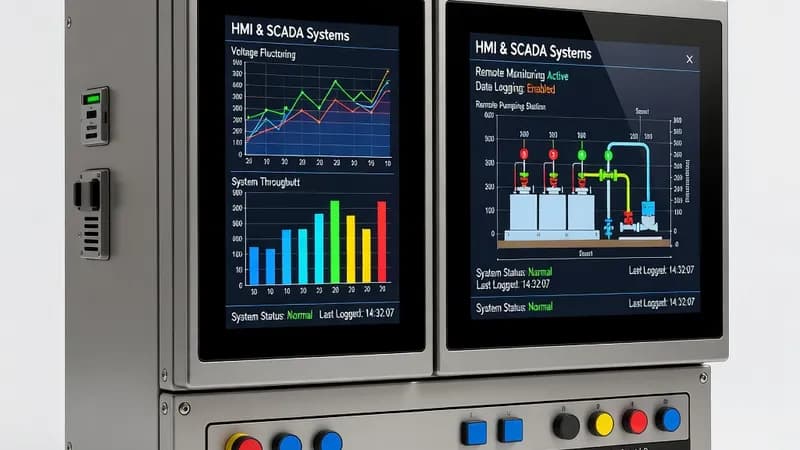
HMI & SCADA Systems

HMI & SCADA systems are the operator-facing and supervisory layer in IEC 61439 panel assemblies, bridging field devices, PLCs, protection relays, metering modules, VFDs, soft starters, and motor starters into a unified control environment. In modern switchboards and automation cubicles, HMI touch panels typically range from 4-inch compact operator terminals to 22-inch industrial widescreen displays and panel PCs, with IP65 front protection, wide-temperature operation, and industrial EMC immunity suitable for plant rooms, utilities, and process facilities. SCADA platforms extend this capability beyond the enclosure, enabling centralized visualization, alarm handling, trend analysis, event logging, energy reporting, and remote diagnostics over secure Ethernet, fiber, or industrial wireless networks. These systems are commonly integrated into PLC automation panels, metering panels, motor control centers, generator synchronization panels, water and wastewater control panels, and custom-engineered IEC 61439 assemblies. Typical connected devices include Siemens SIMATIC HMI and WinCC, Schneider Electric Magelis/Pro-face and EcoStruxure SCADA, Allen-Bradley PanelView and FactoryTalk, ABB CP600 series, Omron NA series, and Weintek cMT terminals. SCADA servers may communicate with Siemens S7, Schneider M340/M580, Rockwell ControlLogix, ABB AC500, or WEG/LS control platforms using OPC UA, Modbus TCP/RTU, PROFINET, EtherNet/IP, PROFIBUS, IEC 60870-5-104, and MQTT for IIoT and cloud applications. From a design perspective, HMI & SCADA systems must be selected with the panel’s thermal load, network architecture, and lifecycle requirements in mind. Panel builders should verify power supply redundancy, UPS-backed ride-through, secure user access, data retention, and compatibility with the panel’s short-circuit and EMC environment. For harsh industrial locations, stainless steel or coated-steel enclosures with proper segregation, cable routing, and shield termination are critical. In IEC 61439 assemblies, these devices are usually installed in auxiliary compartments or doors with appropriate creepage/clearance, segregation from power circuits, and compliance with wiring practices for low-voltage control circuits. When panels include drives or high-frequency switching equipment, HMI/SCADA networks should be separated from power conductors and VFD output cabling to reduce electromagnetic interference. For hazardous or dusty environments, the complete panel may also require additional design coordination with IEC 60079 for explosive atmospheres or IEC 61641 for arc fault containment considerations, depending on the application. Engineering teams should specify the panel’s rated operational voltage, auxiliary supply, communication redundancy, and alarm philosophy early in the project to ensure scalable expansion and maintainability. Properly implemented HMI & SCADA systems improve operator response times, reduce downtime, support predictive maintenance, and provide the data transparency expected in modern industrial facilities and utility infrastructure. In practice, these systems are most common in metering panels for energy monitoring, PLC automation panels for discrete and process control, and custom-engineered panels where multiple subsystems must be supervised from one interface. They are equally valuable in pump stations, HVAC plants, substations, manufacturing lines, and infrastructure projects where real-time visibility, secure remote access, and event traceability are essential.

Panels Using This Component

Related Knowledge Articles

Frequently Asked Questions

HMI and SCADA systems are most commonly installed in IEC 61439 PLC automation panels, metering panels, MCC auxiliary control sections, generator panels, and custom-engineered control panels. In these assemblies, the HMI provides local operator interaction while SCADA handles centralized supervision, alarm management, and historical logging. For metering panels, they are often paired with multifunction meters and power analyzers; for automation panels, they interface with PLCs, VFDs, and remote I/O. Panel builders should ensure the device layout respects segregation requirements, thermal limits, and wiring practices defined under IEC 61439-1 and IEC 61439-2, with proper front-door mounting and cable management.
Common industrial HMI families include Siemens SIMATIC HMI Comfort and Unified Comfort Panels, Schneider Electric Magelis/Pro-face HMIs, Rockwell Allen-Bradley PanelView Plus, ABB CP600 series, Omron NA series, and Weintek cMT products. Selection depends on PLC compatibility, screen size, protocol support, and environmental rating. For example, Siemens and Schneider are widely used where PROFINET, Modbus TCP, or OPC UA integration is required, while Rockwell is often chosen in EtherNet/IP-based architectures. For IEC 61439 panel assemblies, the HMI should have a suitable front IP rating, robust EMC performance, and a mounting method that does not compromise compartment segregation or door integrity.
Yes. SCADA systems routinely collect real-time data from protection relays, multifunction meters, and power quality analyzers installed in LV switchboards and IEC 61439 panels. Devices from ABB, Siemens, Schneider Electric, SEL, and Socomec commonly support Modbus TCP/RTU, IEC 61850 gateways, or OPC UA via a PLC or edge gateway. This allows SCADA to monitor breaker status, trip events, energy consumption, demand peaks, harmonics, and alarm histories. In metering and distribution panels, this is essential for energy management, fault diagnostics, and maintenance planning. Proper network segregation and cybersecurity measures should be implemented when remote access or cloud connectivity is used.
A modern HMI & SCADA system should support OPC UA for interoperability, Modbus TCP for broad device compatibility, PROFINET or EtherNet/IP for PLC integration, and MQTT for IIoT or cloud reporting. Depending on the project, Modbus RTU, PROFIBUS, IEC 60870-5-104, or BACnet may also be required. The best protocol mix depends on the installed PLCs, meters, protection relays, and VFDs. In IEC 61439 panel assemblies, protocol planning should be aligned with the control philosophy, network topology, and cybersecurity policy before fabrication. This avoids costly redesigns and ensures scalable expansion for future monitoring points.
Screen size should be selected based on operator workflow, alarm density, and the number of controlled assets. Compact 4-inch to 7-inch HMIs are suitable for simple machine panels or local setpoint adjustment, while 9-inch to 15-inch displays are preferred for PLC automation panels and multi-device monitoring. Larger 12-inch to 22-inch panel PCs are often used in SCADA-rich applications requiring trend analysis, mimic diagrams, and detailed alarm lists. For IEC 61439 assemblies, the available door space, cutout dimensions, cable routing, and internal heat dissipation must also be considered. A larger screen is not always better if the panel is subject to vibration, heat, or limited operator access.
Key considerations include heat management, EMC control, grounding, segregation from power circuits, and service access. HMI panels mounted on doors should maintain the enclosure’s ingress protection and allow sufficient clearance behind the door for cables and connectors. Ethernet and signal cables should be separated from VFD output cables and high-current conductors. Shielded cables should be terminated correctly to reduce noise, particularly in panels with drives, soft starters, or switching power supplies. If the panel includes remote access or data logging, engineers should also specify UPS backup and secure user authentication. These practices support compliance with IEC 61439-1/2 and reliable operation in industrial environments.
Yes, but the complete panel design must match the environment. For dusty, humid, or outdoor locations, the HMI should have an appropriate front IP rating and an enclosure material suited to corrosion or UV exposure. In hazardous areas, additional requirements may apply under IEC 60079 for explosive atmospheres, depending on the zone classification and installation concept. For panels where arc fault resilience is a concern, IEC 61641 may also be relevant to the overall assembly design. In all cases, temperature control, cable sealing, and component selection are critical. Industrial HMIs from Siemens, Schneider, ABB, and Pro-face are commonly available in ruggedized variants for demanding conditions.
The highest-value applications include metering panels for energy visibility, PLC automation panels for process control, MCC panels for motor status and diagnostics, pump station controls, HVAC plants, substations, and production lines requiring centralized supervision. HMI and SCADA reduce downtime by giving operators immediate access to alarms, trends, and device status, while also supporting maintenance teams with event history and runtime data. In multi-panel facilities, SCADA becomes especially valuable because it consolidates information from multiple IEC 61439 assemblies into one interface. This improves operational awareness, helps optimize energy consumption, and supports predictive maintenance strategies across the plant.

Ready to Engineer Your Next Panel?

Our team of electrical engineers is ready to design, build, and deliver your custom panel solution — fully compliant with international standards.