Soft Starter vs VFD: When to Use Which
Comparing soft starters and VFDs for motor starting applications.
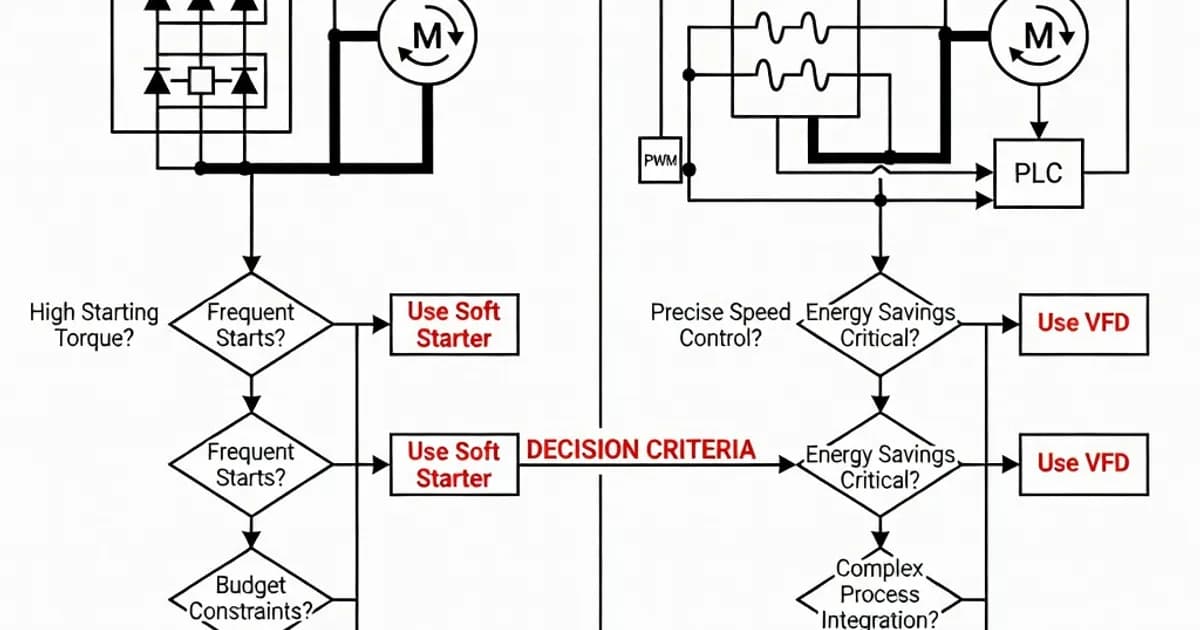
Soft Starter vs VFD: When to Use Which
Soft starters and variable frequency drives (VFDs) are both used to improve motor starting in low-voltage assemblies, but they solve different problems. A soft starter reduces inrush current and mechanical stress by ramping voltage during startup. A VFD controls both motor voltage and frequency, which means it can control speed, torque, and energy consumption throughout operation. In IEC 61439-compliant panel assemblies, the right choice depends not only on motor behavior, but also on thermal performance, short-circuit withstand, EMC, enclosure protection, and the overall verified design of the assembly.
As a practical rule, use a soft starter when the load runs at constant speed after startup and you only need a gentler start. Use a VFD when the process benefits from speed regulation, energy savings, process control, or advanced protection and diagnostics. Per IEC 61439-1 and IEC 61439-2, the panel builder must verify the assembly for temperature rise, dielectric properties, short-circuit performance, and other design requirements before putting the panel into service.
What a Soft Starter Does
A soft starter is a thyristor-based motor starting device that limits the voltage applied to the motor during startup. By reducing the applied voltage and increasing it gradually over a programmed ramp, it lowers locked-rotor current and reduces torque shock on couplings, belts, pumps, and gearboxes. In many applications, soft starters limit starting current to roughly 2 to 4 times rated current, compared with about 6 to 8 times rated current for direct-on-line starting.
Soft starters are best suited to fixed-speed loads that do not need speed control after start. Typical examples include centrifugal pumps, fans, compressors, and some mixers. Once the motor reaches full speed, many soft starters transfer to bypass contactors so the power semiconductors are no longer carrying load current, improving efficiency and reducing heat dissipation in the enclosure.
In IEC 61439 assemblies, this thermal benefit is important. Clause 10.10 of IEC 61439-2 requires temperature-rise verification for enclosed assemblies. If the enclosure contains soft starters, the manufacturer must show that heat losses remain within the verified limits for the arrangement, wiring, ventilation, and internal separation used. This is especially important where multiple motor starters are grouped together in one cubicle.
When a Soft Starter Is the Better Choice
- Constant-speed process loads with no need for speed control after start
- Applications where lower cost and lower complexity are priorities
- Motors with high starting torque stress, such as pumps with water hammer risk
- Installations where reduced inrush current is needed but harmonic mitigation is not a major concern
- Panels where bypass operation is acceptable and thermal load must be minimized
Typical ramp times for soft starters are often in the 5 to 30 second range, depending on motor size, inertia, and load characteristics. Soft starters do not regulate speed during normal operation, so they do not provide process control beyond the start and stop sequence.
What a VFD Does
A variable frequency drive controls motor speed by varying the frequency and voltage supplied to the motor. This gives the drive full control over acceleration, deceleration, operating speed, and torque response. Unlike a soft starter, a VFD is not limited to the startup phase; it becomes part of the process control system. That makes it the correct choice whenever the motor must run at different speeds to match load demand.
VFDs are widely used on conveyors, HVAC fans, pumps, extruders, hoists, compressors, and other processes where variable speed improves throughput, reduces energy consumption, or improves control accuracy. In centrifugal loads, reducing speed can deliver significant energy savings because power demand falls dramatically with speed. VFDs also provide advanced features such as PID control, torque limiting, stall prevention, communication interfaces, and extensive diagnostics.
From a panel-design perspective, VFDs add more electrical and thermal design complexity than soft starters. They generate switching harmonics, may require line reactors or filters, and can create electromagnetic compatibility concerns inside the assembly. Per IEC 61439, the designer must confirm that the chosen arrangement satisfies temperature rise, dielectric coordination, creepage and clearance requirements, and, where relevant, EMC performance and short-circuit withstand ratings.
When a VFD Is the Better Choice
- Processes requiring variable speed or torque control
- Applications where energy savings justify the higher initial cost
- Systems needing soft start and soft stop, plus continuous speed control
- Installations requiring process optimization, feedback control, or communication with automation systems
- Loads where precise acceleration and deceleration reduce mechanical wear
Modern VFDs commonly provide control ranges from near zero speed up to and beyond base speed, depending on motor and application. Sensorless vector control and closed-loop control can deliver strong torque performance at low speed, which is not possible with a soft starter.
Soft Starter vs VFD: Key Technical Differences
The right selection becomes clearer when the two technologies are compared side by side. The table below summarizes the practical differences most relevant to low-voltage panel design.
| Aspect | Soft Starter | VFD |
|---|---|---|
| Primary function | Reduce starting current and mechanical stress | Control speed, torque, and starting behavior |
| Starting current | Typically 2-4 x In | Typically 0-1.5 x In depending on settings and load |
| Speed control after start | No | Yes, full variable-speed operation |
| Efficiency in steady state | Very high in bypass mode, often close to 99% | Typically 96-98% at the drive level, before system effects |
| Harmonics | Generally low | Higher, often requiring mitigation |
| Thermal impact in panel | Moderate, reduced further with bypass | Higher due to inverter losses and filtering components |
| Cost | Lower | Higher |
| IEC 61439 focus | Temperature rise, enclosure ventilation, dielectric coordination | Temperature rise, EMC, short-circuit withstand, cable routing |
Standards and IEC 61439 Considerations
IEC 61439-1 and IEC 61439-2 define the rules for low-voltage switchgear and controlgear assemblies. These standards replaced IEC 60439 and are now the central reference for verified assembly design. The standard assigns responsibilities between the specifier and the original assembly manufacturer, and it requires verification by design rules, testing, or a valid comparison with a reference design.
For soft starters and VFDs, several IEC 61439 requirements are particularly important. Clause 10.10 addresses temperature rise. Clause 7.1 covers dielectric properties, including impulse withstand voltage. Clause 13 addresses EMC-related considerations where applicable to the assembly design. Clause 9 covers clearances and creepage distances. In practice, the panel manufacturer must not simply install a device and assume the assembly is compliant; the complete arrangement must be verified as a system.
For example, if the assembly is rated for a 690 V system, the impulse withstand voltage, or Uimp, must be suitable for the installation environment and expected transient overvoltages. As noted in ABB and Schneider Electric IEC 61439 guidance, the verified design must also account for heat dissipation from all functional units, not only the incoming feeder. This becomes especially relevant in panels with multiple VFDs, where losses are significantly higher than in a soft-starter panel with bypass contactors.
Short-circuit withstand is another key point. The assembly must have an appropriate Icw, and protective devices must coordinate with downstream equipment. In high-fault-level industrial networks, this may mean selecting circuit breakers and busbar systems with sufficient withstand and interruption ratings, as well as confirming the thermal and mechanical endurance of internal wiring, terminals, and busbar supports.
Why Temperature Rise Matters So Much
Soft starters and VFDs both generate heat, but VFDs usually introduce more continuous thermal burden because of their inverter losses and, in some cases, line filters and braking components. IEC 61439 temperature-rise verification ensures that the ambient temperature inside the enclosure does not exceed the tested limits for the selected components and layout. This is not a theoretical exercise: excessive heat shortens component life, causes nuisance trips, and can invalidate the assembly’s declared ratings.
In a compact enclosure with multiple drives, internal separation, airflow paths, gland plate design, and component spacing all matter. As described in manufacturer guides from ABB, Schneider Electric, and Hager, the assembly must be engineered around the worst-case thermal profile, not just the nameplate current of the motor.
Electrical Performance and Harmonics
Soft starters create far less harmonic distortion than VFDs because they are used only during the transient startup period and then typically bypassed. Their main effect is on the starting current waveform during ramp-up. Once the bypass engages, the motor is connected directly to the line and the electrical stress is minimal.
VFDs, by contrast, switch power electronics at high frequency and can inject harmonics into the supply system. Depending on the drive topology and network impedance, harmonic distortion may need to be addressed with line reactors, DC chokes, passive filters, or active harmonic filters. In many industrial installations, a well-designed VFD system can achieve low total harmonic distortion, often below 5% when mitigation is applied and the upstream system is properly engineered.
This is relevant to IEC 61439 because harmonics increase heating in conductors, busbars, and neutral paths. For that reason, panel design may require full neutral sizing in some cases, particularly where non-linear loads are concentrated. Research guidance also highlights the need to consider conductor cross-section for neutral sizing in smaller conductors, especially when harmonic content is significant.
EMC and Cable Routing for VFD Panels
VFD installations require careful attention to electromagnetic compatibility. Output cables can radiate noise, and improper routing can create interference with control circuits, communication lines, or adjacent equipment. Good practice is to separate power and signal wiring, use shielded motor cables where appropriate, bond shields correctly, and follow the drive manufacturer’s installation instructions.
Per IEC 61439 design practice, the enclosure arrangement should support clean segregation of high-frequency drive circuits from sensitive control electronics. This often means dedicated cable compartments, separate trunking, and internal partitions. In multi-drive panels, these measures improve both EMC performance and serviceability.
Typical Application Selection
The simplest way to choose between the two is to ask one question: does the process need speed control after the motor reaches full speed?
If the answer is no, a soft starter is usually the better fit. It gives the motor a controlled start, reduces mechanical stress, and keeps the assembly simpler, cooler, and cheaper. If the answer is yes, a VFD is the correct technology because it controls the motor as part of the process, not just at startup.
Common Soft Starter Applications
- Water and wastewater pumps
- Centrifugal fans and blowers
- Compressors with constant-speed operation
- Simple conveyor starts where speed is fixed after acceleration
- Applications where water hammer, belt shock, or coupling stress must be reduced
Common VFD Applications
- HVAC systems with variable airflow or pressure control
- Conveyors with changing throughput requirements
- Process pumps where flow modulation saves energy
- Mixers, extruders, and machine tools needing speed regulation
- Any application requiring torque control at low speed
Panel Design Implications Under IEC 61439
From the perspective of an IEC 61439 assembly, the choice between a soft starter and a VFD affects cabinet size, heat load, protection devices, internal wiring, and test or verification strategy. A soft-starter panel is usually simpler to design because the device can be bypassed after startup and it generates less continuous heat. A VFD panel typically requires more generous thermal design, better ventilation, and tighter control of cable routing and EMC.
As documented in IEC 61439 application guidance from ABB and Schneider Electric, the manufacturer should base the design on a verified reference configuration whenever possible. If a panel is expanded, modified, or populated with different functional units, the original verification may no longer apply unless the new arrangement is demonstrably equivalent in temperature rise, dielectric coordination, short-circuit withstand, and enclosure class.
Internal separation can also matter. In industrial panels, using forms of separation such as Form 2b or Form 3b can help localize faults and improve maintainability. This is especially useful where a VFD section needs to be isolated from control power, PLCs, or adjacent motor starters. For higher fault energy environments, internal arc considerations may also be relevant, even though IEC 61641 is separate from IEC 61439.
Protection coordination should not be overlooked. For both soft starters and VFDs, the upstream circuit breaker must coordinate with the drive’s input protection recommendations and the short-circuit withstand capability of the panel. The correct selection depends on the prospective fault current at the installation point and the drive manufacturer’s allowable protection device combinations.
Brand Examples and Product Positioning
Major manufacturers follow the same basic application split, even though product names and performance ranges differ. Siemens, ABB, Schneider Electric, Eaton, and others all offer both soft starters and VFDs for low-voltage industrial use. Their documentation consistently positions soft starters for controlled starting and VFDs for speed control and efficiency.
For example, Siemens SINAMICS drives are commonly used where variable-speed control is required, while Siemens soft starter families are aimed at reducing stress during motor starting. ABB’s soft starters and ACS series drives follow the same logic. Schneider Electric’s Altistart range focuses on soft starting, while Altivar drives are used for variable-speed operation. Eaton and other suppliers present similar distinctions in their product catalogs and IEC 61439 panel solutions.
These product families also reflect differing panel requirements. Soft starter panels often emphasize compactness and thermal simplicity. VFD panels may need larger enclosures, auxiliary fans, filters, braking resistors, line reactors, and more elaborate cable segregation. That extra infrastructure can materially affect the panel’s verified design and its temperature-rise validation under IEC 61439-2.
How to Specify the Right Device
When writing a specification, define the process requirement first, then the electrical and assembly requirements. Do not begin with a brand or model number. A good specification should state whether the application needs only reduced starting current or full speed control, the motor rating, the supply voltage, the available fault level, the enclosure type, the ambient temperature, and any EMC or harmonic limits.
For a soft starter, specify the motor size, start mode, ramp time, bypass requirement, and any stop profile needed for process control. For a VFD, specify speed range, overload class, control mode, communications, braking requirements, and harmonic mitigation. In both cases, the panel assembly should be designed and verified to IEC 61439, including the required IP rating and any special environmental conditions.
It is also wise to specify instrumentation. For VFD panels especially, metering of current, voltage, power factor, and harmonic distortion helps with commissioning and long-term maintenance. For soft starter panels, monitoring motor current and thermal conditions can still provide useful protection and diagnostics.
Practical Decision Guide
Choose a soft starter if your motor will operate at constant speed, your main goal is to reduce starting current, and you want the lowest cost and lowest thermal burden in the panel. Choose a VFD if you need speed control, torque control, process optimization, or energy savings that depend on speed variation.
In many industrial projects, the decision is straightforward once the process is understood. A pump that always runs full speed after startup is usually a soft-starter candidate. A pump that must track flow demand is usually a VFD candidate. The same is true for fans, conveyors, and compressors: if the process varies, the drive should vary with it.
From an IEC 61439 standpoint, the “best” choice is the one that meets the process requirement while allowing the assembly to be verified cleanly for temperature rise, dielectric properties, short-circuit withstand, EMC, and enclosure performance. The most technically elegant solution is not necessarily the most sophisticated one; it is the one that is correct for the application and verifiable in the finished panel.
References and Further Reading
Related Panel Types
Enclosed soft starter assemblies for reduced voltage motor starting with torque control, ramp-up/down profiles, and bypass contactor options.
Enclosed VFD assemblies with input protection, line reactors, EMC filters, output reactors, and bypass options.
Related Components
Frequently Asked Questions
Ready to Engineer Your Next Panel?
Our team of electrical engineers is ready to design, build, and deliver your custom panel solution — fully compliant with international standards.