Soft Starter Panel
Enclosed soft starter assemblies for reduced voltage motor starting with torque control, ramp-up/down profiles, and bypass contactor options.
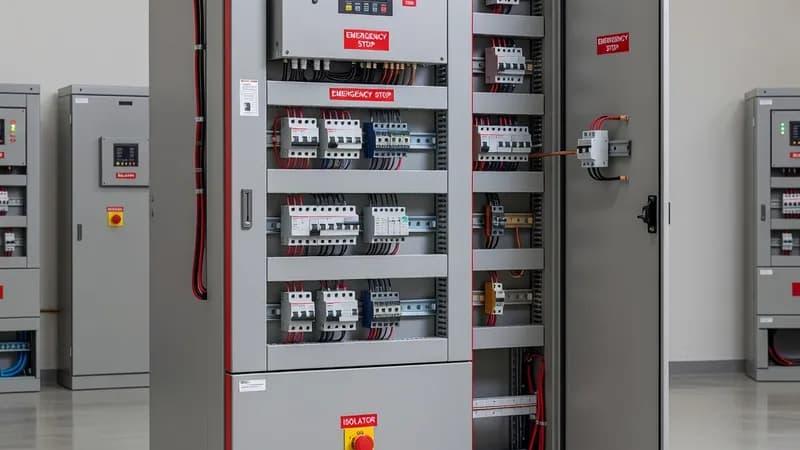
A Soft Starter Panel is a purpose-built low-voltage motor control assembly designed for controlled acceleration and deceleration of squirrel-cage induction motors using solid-state reduced-voltage starting. Built in accordance with IEC 61439-1 and IEC 61439-2, these assemblies integrate a soft starter, incoming protection, motor protection, bypass switching, control power, and optional communication modules into a single tested panel architecture. Typical implementations range from 7.5 kW to 800 kW at 400 V, with higher-voltage variants for 690 V systems and current ratings commonly from 16 A up to 1600 A depending on duty and enclosure size. The main objective is to limit starting current, reduce mechanical shock on pumps, fans, compressors, crushers, conveyors, and mixers, and avoid supply dips that can affect other plant loads. The power section of a soft starter panel usually includes an MCCB or ACB as the incomer, line and bypass contactors, semiconductor thyristor/SCR modules inside the soft starter, motor overload or electronic protection relay functions, and a busbar system sized and verified for the declared short-circuit withstand current. Depending on the application, the panel may be configured with Forms 1, 2, 3, or 4 internal separation to improve maintainability and fault containment. For large process drives, engineers often select form of separation 3b or 4b to isolate outgoing feeders and simplify service while maintaining operational continuity in multi-motor systems. Soft starter technology is distinct from variable frequency drives. A soft starter controls motor voltage during start and stop through phase-angle control, typically limiting starting current to about 2 to 4 times full-load current, rather than the 6 to 8 times associated with direct-on-line starting. Many panels include a bypass contactor that closes once full speed is reached, removing heat dissipation from the semiconductor stack and improving efficiency during continuous running. This is especially valuable in high-duty applications such as water and wastewater pumping stations, HVAC systems, cement plants, and material handling lines. Design and verification must consider IEC 61439 temperature rise limits, dielectric properties, clearances and creepage, short-circuit performance, and circuit robustness. Component selection should align with IEC 60947-2 for circuit breakers, IEC 60947-4-1 for contactors and motor-starters, and IEC 60947-4-2 for soft starters and semiconductor controllers where applicable. Panels installed in hazardous areas or adjacent to explosive atmospheres may require additional evaluation against IEC 60079 and, where used as an enclosure-related safeguard against ignition of dust, IEC 61641 arc-resistant considerations are sometimes specified by project standards. EMC performance is addressed through IEC 61000 measures such as proper segregation of control wiring, shield termination, surge protection devices, and filtering for PLC, HMI, and fieldbus compatibility. For industrial-manufacturing, oil-and-gas, mining-metals, pharmaceuticals, and food-and-beverage facilities, a well-engineered Soft Starter Panel offers a practical balance of reduced starting stress, compact footprint, and lower lifecycle cost than full VFD-based solutions when continuous speed control is not required. Optional features include bypass timer logic, motor thermistor inputs, earth-fault protection, power metering, Modbus or Profibus communication, and IP-rated enclosures for harsh environments. When designed and type-tested correctly, the result is a reliable IEC 61439 assembly suited to repetitive starts, critical pumping duties, and process equipment that benefits from controlled torque rather than variable speed operation.
Components for This Panel
Soft Starters selection, integration, and best practices for Soft Starter Panel assemblies compliant with IEC 61439.
Moulded Case Circuit Breakers (MCCB) selection, integration, and best practices for Soft Starter Panel assemblies compliant with IEC 61439.
Contactors & Motor Starters selection, integration, and best practices for Soft Starter Panel assemblies compliant with IEC 61439.
Busbar Systems selection, integration, and best practices for Soft Starter Panel assemblies compliant with IEC 61439.
Protection Relays selection, integration, and best practices for Soft Starter Panel assemblies compliant with IEC 61439.
Applicable Standards
IEC 61439-2 (PSC) compliance requirements, testing procedures, and design considerations for Soft Starter Panel assemblies.
EMC Compliance (IEC 61000) compliance requirements, testing procedures, and design considerations for Soft Starter Panel assemblies.
IP Protection Ratings compliance requirements, testing procedures, and design considerations for Soft Starter Panel assemblies.
ATEX / IECEx Certification compliance requirements, testing procedures, and design considerations for Soft Starter Panel assemblies.
Industries Using This Panel
Soft Starter Panel assemblies engineered for Industrial Manufacturing applications, addressing industry-specific requirements and compliance standards.
Soft Starter Panel assemblies engineered for Oil & Gas applications, addressing industry-specific requirements and compliance standards.
Soft Starter Panel assemblies engineered for Water & Wastewater applications, addressing industry-specific requirements and compliance standards.
Soft Starter Panel assemblies engineered for Mining & Metals applications, addressing industry-specific requirements and compliance standards.
Soft Starter Panel assemblies engineered for Food & Beverage applications, addressing industry-specific requirements and compliance standards.
Soft Starter Panel assemblies engineered for Pharmaceuticals applications, addressing industry-specific requirements and compliance standards.
Related Knowledge Articles
Comparing soft starters and VFDs for motor starting applications.
Selecting coordinated MCCB-contactor-overload combinations.
Comprehensive overview of all IEC 61439 parts, their scope, and how they apply to different panel types.
Frequently Asked Questions
Ready to Engineer Your Next Panel?
Our team of electrical engineers is ready to design, build, and deliver your custom panel solution — fully compliant with international standards.