Variable Frequency Drives (VFD)
Motor speed control, energy savings, 0.37kW–500kW+
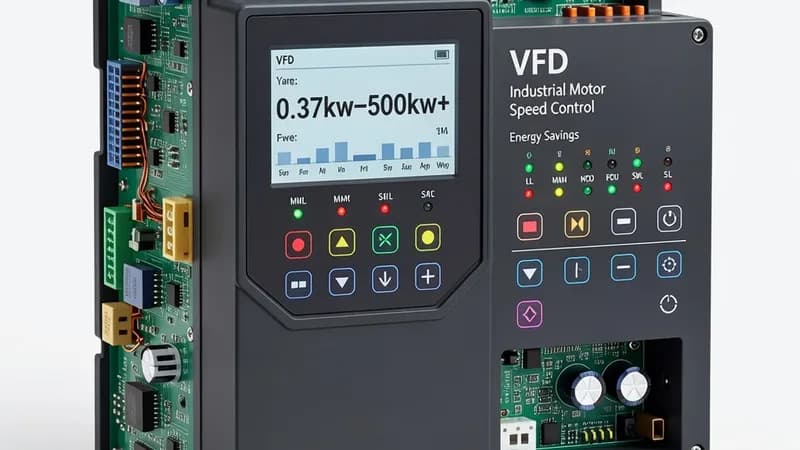
Variable Frequency Drives (VFDs) are precision power-electronic motor controllers used to vary the speed, torque, and acceleration of three-phase AC motors by adjusting output frequency and voltage. In modern IEC 61439 panel assemblies, they are commonly implemented as dedicated feeder modules, standalone drive cubicles, or integrated sections within motor control centers (MCCs), especially in HVAC, water and wastewater, process plants, conveyors, cranes, material handling, and utility applications. Typical power coverage ranges from 0.37 kW to 500 kW and above, with 380 to 480 V AC as the most common low-voltage class and 690 V AC solutions used for larger motors or reduced-current distribution architectures. Widely deployed product families include ABB ACS580 and ACS880, Siemens SINAMICS G120 and G120X, Schneider Electric Altivar ATV630 and ATV930, Danfoss VLT HVAC Drive FC 102 and VLT AutomationDrive FC 302, and Allen-Bradley PowerFlex 525, 753, and 755 series. A correctly engineered VFD panel begins with the supply-side protective device and coordination study. Incoming protection is usually provided by MCCBs or fuse-switch combinations selected and coordinated to IEC 60947-2 and IEC 60947-3. Depending on the network and drive type, line reactors, DC chokes, harmonic filters, or active front-end solutions may be required to reduce THDi, limit inrush, and improve compatibility with upstream transformers and standby generators. On the output side, shielded motor cable, dV/dt filters, sine filters, and output reactors are often necessary for long cable runs, inverter-duty motors, or applications with high switching stress. EMC performance depends on correct 360-degree shield bonding, segregated power and control wiring, proper gland selection, and installation in accordance with the manufacturer’s instructions and IEC 61800-3 principles. When the VFD is incorporated into an IEC 61439 assembly, the panel builder must verify temperature rise, dielectric performance, short-circuit withstand strength, creepage and clearance distances, and busbar/functional unit arrangement. Depending on maintainability and fault containment requirements, the assembly may use Form 1, Form 2, Form 3, or Form 4 internal separation. The relevant framework is primarily IEC 61439-1 and IEC 61439-2 for low-voltage switchgear and controlgear assemblies, with IEC 61439-3 relevant for distribution boards and IEC 61439-6 for busbar trunking interfacing and related distribution systems. For special environments, IEC 60079 may apply in hazardous areas, while IEC 61641 is referenced when arc fault containment or internal arcing resilience is a design requirement. Modern VFDs frequently include built-in PID control, multi-pump logic, multi-speed selection, safe torque off (STO) per IEC 61800-5-2, braking choppers, STO-certified safety chains, and communication interfaces such as PROFINET, EtherNet/IP, Modbus TCP, PROFIBUS, and BACnet depending on the application. Many drives also offer onboard diagnostics, energy metering, condition monitoring, and integrated PLC functions, reducing the need for separate control hardware. For engineers and EPC contractors, key selection criteria include motor full-load current, overload class, duty cycle, ambient temperature, altitude, enclosure IP rating, cooling method, starting torque, braking demand, and load type such as variable torque, constant torque, or high-inertia duty. In real-world installations, VFDs are most valuable in pumps, fans, compressors, chillers, blowers, mixers, extruders, crushers, and conveyor systems, where soft starting lowers mechanical stress and speed control delivers measurable energy savings, especially in variable-torque loads. Panel builders must also consider heat dissipation, cabinet ventilation, filtered fan systems, and segregation from sensitive control components such as PLCs, protection relays, and communication modules. For this reason, VFD sections are often built as dedicated compartments inside MCC panels or custom-engineered automation panels to improve serviceability, reduce interference, and maintain compliance with IEC 61439 performance requirements.
Panels Using This Component
Centralized motor control with starters, contactors, overloads, and VFDs in standardized withdrawable/fixed functional units.
Enclosed VFD assemblies with input protection, line reactors, EMC filters, output reactors, and bypass options.
Bespoke panel assemblies for non-standard requirements — special ratings, unusual form factors, multi-function combinations.
Related Knowledge Articles
How to size and select VFDs for panel integration.
Engineering VFD panels for reliable motor speed control.
Comparing soft starters and VFDs for motor starting applications.
Frequently Asked Questions
Ready to Engineer Your Next Panel?
Our team of electrical engineers is ready to design, build, and deliver your custom panel solution — fully compliant with international standards.