MCC Panels

Soft Starters

Reduced voltage motor starting, torque control, bypass options
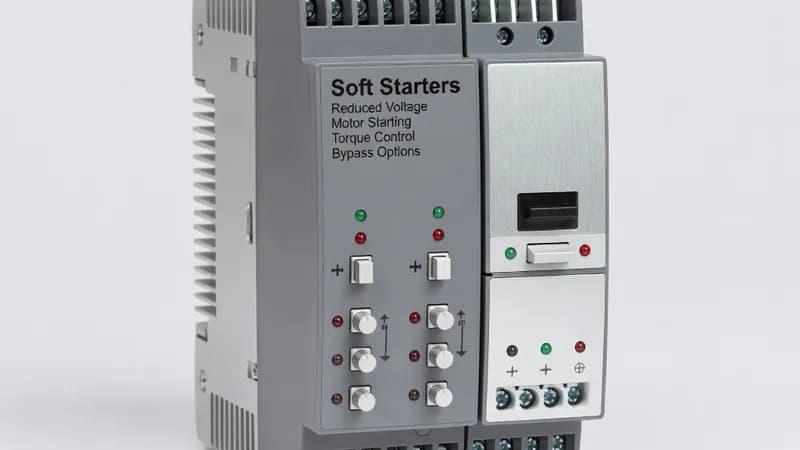
Soft Starters

Soft starters are solid-state motor starting devices used to reduce the mechanical and electrical stress associated with direct-on-line starting of AC induction motors. In IEC 61439 panel assemblies, they are typically integrated as part of a feeder or motor starter section and are selected for pumps, compressors, fans, conveyors, crushers, mixers, and HVAC applications where controlled acceleration is required but continuous variable speed is not necessary. Most designs use anti-parallel thyristors (SCRs) in each phase to regulate applied voltage during start and, in many cases, during soft stop. After acceleration, an internal or external bypass contactor is commonly engaged to reduce thermal dissipation and improve efficiency. Typical soft starter functions include adjustable start voltage, ramp-up time, current limit, kick-start, torque control, and pump stop logic for water hammer reduction. Current-limiting performance is usually specified as a multiple of motor full-load current, often in the range of 3 to 4 times FLC for standard process loads, with higher settings available depending on motor inertia and supply conditions. Equipment ratings commonly cover 7.5 kW to 800 kW and above at 400 V, 415 V, 690 V, or 1000 V systems, with short-circuit coordination dependent on the upstream protective device and the manufacturer’s tested combinations. Selection must consider motor nameplate current, starting duty, ambient temperature, altitude, enclosure ventilation, and the required coordination type under IEC 60947. For panel builders, soft starters must be coordinated with MCCBs, fuses, contactors, overload relays, control transformers, and protection relays where applicable. In motor control center applications, they are often installed in withdrawable or fixed compartments with forms of separation such as Form 2b, Form 3b, or Form 4 where segregation of functional units, busbars, and terminals is required by project specifications. Thermal management is critical because SCR losses occur during acceleration; therefore enclosure sizing, derating, and ventilation must be assessed in accordance with IEC 61439-1 and IEC 61439-2. For specialized environments, the overall assembly may also need provisions aligned with IEC 61439-3 for distribution boards, IEC 61439-6 for busbar trunking interfaces, IEC 60079 for hazardous areas, or IEC 61641 where arc fault containment testing is specified. Common product families include ABB PSTX and PSTX Softstarter ranges, Siemens SIRIUS 3RW5, Schneider Electric Altistart ATS480 and ATS48, Eaton S811+ and S801, and AuCom CSX and EMX4. These products offer built-in motor protection, communication options such as Modbus, PROFIBUS, or Ethernet-based interfaces, and advanced diagnostics for integration into SCADA and PLC systems. In real-world installations, soft starters are widely used in MCC panels, pump control panels, packaged HVAC panels, and custom-engineered skids where reduced starting current helps limit voltage dip, improve network stability, and extend mechanical life of belts, couplings, gearboxes, and pipework. Proper application engineering ensures the selected device matches the motor duty, starting profile, and panel short-circuit withstand requirements while remaining compliant with the project’s IEC documentation set.

Panels Using This Component

Related Knowledge Articles

Frequently Asked Questions

A soft starter reduces motor starting current and mechanical stress by controlling voltage during acceleration and, optionally, deceleration. It does not provide continuous speed control after start, unlike a VFD. In IEC 61439 assemblies, soft starters are preferred when the process only needs reduced-voltage starting, such as pumps, fans, and conveyors with fixed operating speed. VFDs are used when speed, torque, or energy optimization is required during running. From a panel perspective, soft starters generally create less harmonic concern than VFDs, but they still require thermal assessment, coordination with MCCBs or fuses, and compliance with IEC 60947-4-2 for the device itself and IEC 61439-1/-2 for the assembly. Common product lines include ABB PSTX, Siemens 3RW5, and Schneider Altistart ATS480.
Sizing starts with the motor full-load current at the actual system voltage, not just the kW rating. The soft starter must be selected for the motor current, starting duty, and load inertia, with additional margin for high ambient temperature, altitude, or repeated starts. For heavy-duty loads, a larger frame size may be needed even if the motor kW seems modest. Also check the coordination with upstream protection, bypass contactor rating, and any required short-circuit current rating of the panel. In practice, manufacturers such as ABB, Eaton, Siemens, Schneider Electric, and AuCom publish selection tables based on motor amperes, starting frequency, and duty class. For IEC 61439 panels, the panel builder must confirm thermal performance and the assembly’s rated current and short-circuit withstand values.
Not always, but a bypass contactor is very common and often recommended. During starting, the thyristors dissipate heat; once the motor reaches full speed, the bypass contactor closes and carries the running current, reducing losses and improving efficiency. This is especially important in enclosed IEC 61439 panels with multiple motor feeders or limited ventilation. Some soft starters have built-in internal bypass, while others require an external bypass contactor selected to IEC 60947-4-1 duty category and the motor current. For high-duty applications such as pumps, compressors, and conveyors, bypass is usually the preferred arrangement. Panel builders should verify thermal derating, coordination, and spare space for the contactor, overload relay, and control wiring.
Soft starters are most common in motor control center panels, custom-engineered process panels, pump control panels, HVAC control panels, and packaged machine skids. In MCCs, they are often used as dedicated motor starter feeders for medium and large motors. In pump panels, they help reduce water hammer and piping stress, especially with soft-stop functions. In HVAC systems, they are widely applied to chilled water pumps, condenser pumps, cooling tower fans, and large air handlers. They are also used in conveyors, crushers, mixers, and compressor packages. For IEC 61439 assemblies, the panel layout must account for heat dissipation, segregation form, incoming feeder coordination, and the required short-circuit rating of the complete assembly.
The panel assembly itself is designed to IEC 61439-1 and the relevant part of the series, usually IEC 61439-2 for power switchgear and controlgear assemblies. The soft starter device is typically evaluated to IEC 60947-4-2, while associated switching and protection devices such as MCCBs, contactors, and overload relays fall under IEC 60947-2 and IEC 60947-4-1. If the panel is intended for hazardous locations, IEC 60079 requirements may also apply. For installations where arc fault containment is specified, IEC 61641 is relevant. Panel builders must verify temperature rise, dielectric performance, creepage and clearance, and short-circuit withstand for the complete assembly, not just the individual soft starter.
Yes, soft starters are often a good choice for generator-backed or weak-grid systems because they reduce inrush current compared with direct-on-line starting. This helps limit voltage dip and improves ride-through for other loads on the same source. However, the starting profile must be engineered carefully: the current limit, ramp time, and load inertia must be matched to the available source impedance and generator kVA. If the current limit is set too low, the motor may not accelerate; if too high, the source may still sag excessively. In IEC 61439 panels, the panel builder should coordinate the soft starter with upstream protection, generator capability, and any automatic transfer system to ensure reliable starting under worst-case conditions.
Internal bypass means the bypass contacts are built into the soft starter housing, which simplifies wiring and saves panel space. External bypass uses a separate contactor mounted in the panel, giving more flexibility for serviceability, device selection, and coordination. Internal bypass is common in compact product families such as Schneider Altistart and Siemens SIRIUS models, while larger systems may use external bypass with ABB or Eaton solutions depending on application and frame size. From a panel design standpoint, external bypass may improve thermal separation and allow easier replacement, but it requires more cabinet space and wiring. The choice should be based on current rating, duty cycle, maintenance strategy, and the IEC 61439 thermal verification of the complete assembly.
Key considerations include heat dissipation, ventilation, phase conductor sizing, upstream short-circuit protection, control circuit protection, and assembly segregation. Soft starters generate heat during ramp-up, so the enclosure must be sized and derated accordingly under IEC 61439-1/-2. The panel builder should confirm the rated operational current, short-circuit coordination, and motor duty class. If the assembly uses forms of separation such as Form 3b or Form 4, the soft starter compartment, terminals, and busbar zones must be arranged to maintain the specified segregation. Also important are EMC practices for control wiring, proper earthing, and space for communication modules or bypass contactors. In high-risk environments, additional requirements may arise from IEC 60079 or IEC 61641.

Ready to Engineer Your Next Panel?

Our team of electrical engineers is ready to design, build, and deliver your custom panel solution — fully compliant with international standards.