Motor Control Center (MCC) Design Guide
Comprehensive guide to MCC design and engineering.
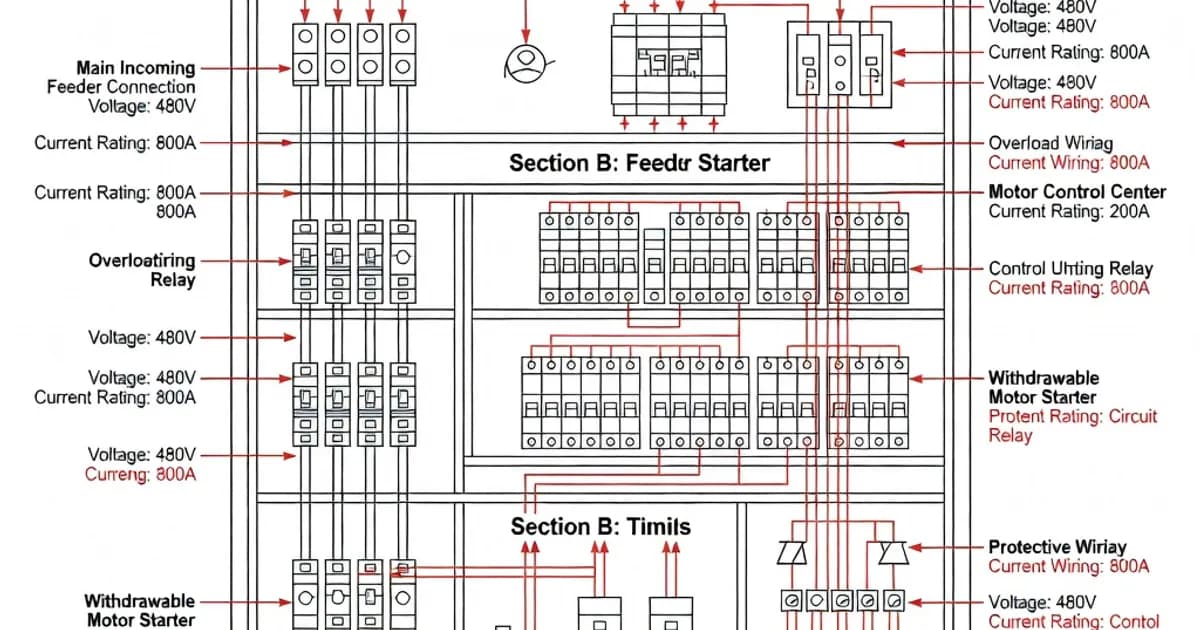
Motor Control Center (MCC) Design Guide
Motor Control Centers, or MCCs, are low-voltage switchgear and controlgear assemblies used to distribute power and control industrial motors. In IEC terminology, MCCs fall under the IEC 61439 series and must be designed, verified, assembled, and documented to meet the requirements for low-voltage assemblies rather than treated as simple collections of components. Per IEC 61439-1 and IEC 61439-2, the finished assembly—not just its individual devices—must be proven safe for its intended electrical, thermal, mechanical, and dielectric performance.
The shift from IEC 60439 to IEC 61439 was a major change in the industry. IEC 61439 replaced the older framework in 2014 and introduced a more rigorous concept of design verification, clearer responsibilities between original manufacturers and assembly manufacturers, and stronger expectations for documentation and conformity assessment. For MCC applications, IEC 61439-2 is the key application-specific part, while IEC 61439-1 establishes the general rules that apply across all low-voltage assemblies. Guidance for specification is also available in IEC/TR 61439-0. [5]
Overview and Regulatory Framework
A compliant MCC is more than a metal enclosure with starters, breakers, and contactors inside. It is a verified assembly intended to safely perform under defined service conditions, with rated currents, short-circuit withstand, temperature rise limits, and protective-circuit continuity all assessed as a system. This is why MCC procurement documents and vendor manuals increasingly refer to “totally type-tested assemblies” or equivalent IEC 61439 design verification evidence. [3]
IEC 61439 divides responsibility clearly. The original manufacturer establishes the verified design and provides the basis for the assembly. The assembly manufacturer then builds the final panel, applies the correct devices and busbar system, carries out routine verification, and issues the required conformity documentation. This division is crucial in MCC projects where field modifications, custom feeder combinations, and plant-specific operating conditions are common. [4]
From a specification standpoint, MCCs are typically used for industrial motor loads where availability, maintainability, and expandability matter. Common applications include process plants, water and wastewater systems, mining, petrochemical installations, and manufacturing lines. In these environments, front-access maintenance, modularity, and section isolation are often as important as the electrical ratings themselves.
Key Technical Specifications
Assembly Structure and Construction
IEC-compliant MCCs are generally built as rigid, free-standing assemblies fabricated from formed sheet steel. The enclosure is designed for dead-front operation, meaning live parts are not accessible from the front during normal use. This reduces the risk of accidental contact during operation and maintenance. Rockwell Automation’s procurement guidance for IEC MCCs describes these assemblies as enclosed, dead-front systems with front access and a modular structure intended for service continuity and future expansion. [3]
Modularity is a defining feature of MCC design. Columns are typically bolted together so that additional sections can be added later with minimal disruption. This is not merely a convenience feature; it is a practical design strategy for facilities that expect motor loads to grow over time. The ability to add vertical sections or extend busbar runs without redesigning the entire lineup is one of the main reasons MCCs are preferred over standalone motor starters in large industrial installations. [3]
Electrical components are normally isolated from the front side of the enclosure, and the assembly is configured so that operators interact with controls, indicators, and withdrawable units rather than exposed conductors. Some systems also offer dual-front arrangements, where two columns are joined at the rear with separate power bus systems and identical phasing. This configuration can support compact layouts and higher equipment density, but it requires careful design verification to preserve segregation, ventilation, and maintainability. [3]
Busbar and Conductor Requirements
The busbar system is the backbone of the MCC. In practice, main busbars are usually copper and must be mechanically braced to withstand the prospective short-circuit forces that occur under fault conditions. The assembly manufacturer must verify short-circuit withstand strength and the mechanical integrity of the bus supports as part of the IEC 61439 design verification process. [7]
IEC 61439 also places specific emphasis on non-protected live conductors. These conductors must be selected and installed so that short-circuits between phases, or between phase and earth, are avoided. One critical constraint is that non-protected live conductors must not exceed 3 meters between the main busbar and the associated short-circuit protective device (SCPD), unless the design justification demonstrates equivalent protection. This requirement is essential in MCC feeder design, where feeder tap-offs, stabs, and starter compartments can create vulnerable conductor runs. [1]
Enclosure Protection Rating
The enclosure protection rating must suit the installation environment. Research sources for MCC design note a minimum protection level of IP55 in many industrial applications, especially where dust, moisture, or washdown exposure is expected. IEC 60529 defines the IP code, and the actual required rating must be specified based on site conditions rather than assumed. For indoor clean environments, a lower rating may be acceptable, while harsher process areas may require higher ingress protection and additional corrosion resistance. [7]
The enclosure also has to pass the suite of IEC 61439 design verification checks. In common industry guidance, MCC verification is often described through seven key verification items, including temperature rise, dielectric properties, short-circuit withstand, protective-circuit effectiveness, and clearances and creepage distances. These checks establish that the assembled panel remains safe and functional under service and fault conditions. [7]
Typical MCC Specification Comparison
| Design Feature | Typical MCC Requirement | IEC 61439 Relevance |
|---|---|---|
| Construction | Rigid, free-standing, dead-front, sheet-steel enclosure | Assembly mechanical strength and accessibility control |
| Busbar material | Copper busbars with verified short-circuit bracing | Short-circuit withstand and thermal performance |
| Conductor length | Non-protected conductors limited to 3 m to SCPD | Protection against fault propagation |
| Modularity | Bolted columns with future expansion capability | Design continuity and serviceability |
| Ingress protection | Often IP55 for industrial duty | Environmental suitability |
| Verification | Type-tested or design-verified assembly | IEC 61439 design verification compliance |
Design Verification Methods
IEC 61439 requires design verification, and it allows that verification to be achieved by one or more of three equivalent methods: testing, calculation, or comparison with a previously verified design. The standard does not treat these as shortcuts; instead, it requires evidence that the assembly meets the applicable performance requirements under its declared ratings. [4]
1. Verification by Testing
Testing remains the most direct and robust method. The assembly, or a representative configuration, is subjected to defined conditions to confirm temperature rise, dielectric withstand, short-circuit performance, and other relevant characteristics. This is the preferred approach when the MCC design uses novel arrangements, high current densities, unusual enclosure layouts, or custom ventilation paths that cannot be confidently covered by standard design rules.
2. Verification by Calculation
Calculation-based verification is allowed when the standard provides sufficient basis for the analysis. In practice, this method is often used for thermal assessment and for configurations where losses, enclosure dimensions, and internal segregation can be modeled with reasonable confidence. Industry guidance notes that for some multi-compartment assemblies, calculation-based temperature-rise verification is limited to rated currents up to 1600 A. Where assumptions are used, they must be conservative, and components may need derating, such as a 20% device derating in constrained cases, depending on the method and manufacturer guidance. [4]
3. Verification by Comparison with a Reference Design
Design comparison is acceptable when the new assembly is demonstrably equivalent to, or more conservative than, a reference design that has already been verified. This method is valuable in modular MCC platforms, where standard sections are repeated across projects. However, the comparisons must be rigorous. The new design must match or improve on the reference in all critical respects, including functional unit grouping, overall dimensions, internal separation, power losses per section, and the number of outgoing circuits. If any of these parameters are made more demanding, the prior verification cannot simply be reused without additional evidence. [4]
Temperature Rise and Thermal Design
Temperature rise is one of the most important design verifications in MCC engineering because motor starters, feeders, variable frequency drives, and control devices all generate heat. IEC 61439 requires the assembly to remain within permissible temperature limits when operating at rated current or at rated current multiplied by the rated diversity factor, as applicable. The design must prevent hazardous external temperatures that could cause burns or damage nearby equipment. [4]
Thermal design is particularly important in vertical MCC sections with multiple compartments and limited ventilation. Heat from starters, overload relays, VFDs, and control transformers can accumulate rapidly if the internal arrangement is too dense. Good design practice includes maintaining clear airflow paths, limiting the simultaneous heat load in a section, and using verified diversity assumptions based on the actual duty profile of the installation.
Per IEC 61439-2, loading assumptions become especially important when many motor starters are grouped in a single panel. Guidance referenced in industry material suggests an assumed loading factor of 0.6 when more than 10 motor starters are installed in one panel. This helps avoid oversizing the thermal load calculation for a system that is unlikely to operate all feeders simultaneously at full current. [5]
Short-Circuit Performance and Protective Circuits
Short-circuit withstand is a core safety requirement. The MCC busbars, supports, incoming feeder, outgoing units, and protective circuits must all remain safe under the declared prospective short-circuit current. This includes not only the main bus system but also the conductors connecting the bus to each protective device. The 3-meter limit on non-protected conductors is important here because conductor length directly affects fault exposure and energy let-through. [1]
Protective circuits also require continuity and bonding verification. Any exposed conductive parts, doors, removable sections, and metallic structures must remain effectively connected to the protective conductor system. If a fault occurs, the protective path must be able to carry the fault current long enough to allow the SCPD to operate. This is one reason why panel assembly quality, torque control, and correct bonding hardware are critical in IEC 61439 compliance. [9]
Component Selection and Configuration
MCCs are usually built from standardized functional units such as feeder breakers, contactor starters, soft starters, and variable frequency drives. The component set must be selected from devices that comply with the relevant IEC 60947 product standards. However, component compliance alone does not guarantee assembly compliance. The final arrangement, spacing, thermal loading, and protective coordination all remain the responsibility of the panel designer and assembler. [5]
Modular internal equipment arrangements are widely used because they simplify project engineering and future maintenance. Hager’s IEC 61439 guide, for example, illustrates modular configurations that support 10, 24, and 36 module options, showing how standardized internal formats can be adapted to different circuit counts while maintaining design discipline. [8]
Approved component families from major manufacturers such as Siemens, Schneider Electric, Rockwell Automation, and Eaton are frequently used because they come with published performance data and established system compatibility. Even so, the final assembly still needs documented verification for the specific line-up and operating conditions.
Documentation, Marking, and Responsibility
IEC 61439 is explicit about documentation and traceability. The completed MCC should have routine verification records, a manufacturer’s marking, and an EC declaration of conformity where applicable. Hensel’s technical guidance emphasizes that the assembly manufacturer must maintain evidence of routine verification and provide the documentation necessary to demonstrate conformity. [9]
Specifiers should not accept vague statements such as “built to IEC standards” without supporting evidence. A proper MCC submittal should identify the applicable IEC 61439 parts, state the rated current, rated short-circuit withstand, form of internal separation where relevant, IP rating, environmental assumptions, and any special operating conditions such as altitude, temperature, humidity, vibration, or corrosive atmospheres. GAMBICA’s BS EN 61439 Edition 2 guide is aimed specifically at specifiers, designers, and purchasers, reflecting the practical need for clear procurement language and complete technical data. [10]
Industry Best Practices for MCC Design
Good MCC design combines compliance with maintainability. A well-designed line-up should support safe operation, fast fault isolation, minimal downtime, and future expansion. In practice, the best assemblies share several traits:
- Front-access maintenance: Reduces the need for rear access and allows installation against walls where site conditions permit.
- Logical sectioning: Separates feeders and control groups to localize thermal load and simplify troubleshooting.
- Verified ventilation: Ensures the internal heat load stays within verified limits under worst-case operating assumptions.
- Clear labeling and circuit identification: Supports safe maintenance and operational clarity.
- Expansion-ready bus systems: Allows future sections to be added without compromising the original verification basis.
- Routine verification discipline: Confirms workmanship, torque, bonding, and enclosure integrity before shipment.
Related Panel Types
Related Components
Related Standards
Frequently Asked Questions
Ready to Engineer Your Next Panel?
Our team of electrical engineers is ready to design, build, and deliver your custom panel solution — fully compliant with international standards.