Automatic Transfer Switch (ATS) Panel for Commercial Buildings
Automatic Transfer Switch (ATS) Panel assemblies engineered for Commercial Buildings applications, addressing industry-specific requirements and compliance standards.
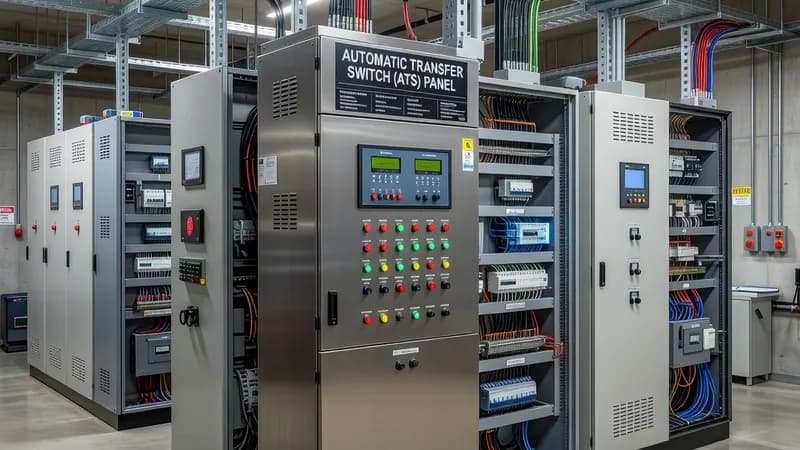
Overview
Automatic Transfer Switch (ATS) Panel assemblies for commercial buildings are engineered to maintain uninterrupted supply to essential electrical loads where even brief power loss can disrupt safety, comfort, revenue, and building operations. Typical applications include fire pumps, life safety and emergency lighting circuits, smoke extraction fans, elevator and escalator auxiliaries, HVAC chillers and pumps, security and access control systems, telecom rooms, tenant critical loads, and data/IT spaces. In a commercial environment, the ATS panel is commonly installed as part of the main LV distribution architecture, interfacing with MDBs, emergency boards, generator switchboards, or UPS-backed essential buses to ensure source continuity during utility outages, brownouts, or maintenance transfers. Technically, these panels are designed in accordance with IEC 61439-2 for power switchgear and controlgear assemblies, with verification of temperature rise, dielectric properties, short-circuit withstand strength, protective circuit integrity, clearances and creepage, and mechanical operation. Transfer switching equipment is selected and coordinated to IEC 60947-6-1, while incomers and feeders may employ ACBs and MCCBs compliant with IEC 60947-2, switch-disconnectors per IEC 60947-3, and control devices and auxiliaries to IEC 60947-5-1. For commercial projects with adjacent plant rooms or mixed-risk spaces, additional considerations may include IEC 61641 arc fault containment testing and IEC 60079 where hazardous atmospheres are present in service areas such as fuel handling or specialized utility zones. A commercial ATS panel can be configured from 100 A up to 6300 A, depending on building size and redundancy philosophy, with short-circuit ratings commonly specified from 25 kA to 100 kA or higher based on fault level studies and utility constraints. Open-transition transfer is the most common for standard commercial buildings, while closed-transition or delayed-transition schemes may be used where load interruption must be minimized and utility approval permits momentary paralleling. For critical systems, the panel may include bypass-isolation, manual override, source selector controls, and priority load shedding logic. Transfer logic is often implemented using a PLC, intelligent relay, or dedicated ATS controller with voltage, frequency, phase sequence, and phase loss supervision, generator start/stop outputs, engine fail alarms, and event logging. Commercial buildings increasingly require integration with building management systems and energy platforms. Accordingly, ATS panels are frequently supplied with Modbus RTU/TCP, BACnet, or dry-contact interfaces for remote monitoring of source status, breaker position, alarm conditions, and transfer history. In premium facilities, ATS operation may also be coordinated with VFD-driven HVAC plants, soft starters for pumps and fans, and capacitor banks or harmonic filters to avoid transfer instability, nuisance tripping, and inrush-related voltage dips. Where fire and smoke systems are involved, selective coordination and circuit segregation are essential to maintain life safety operation under emergency conditions. Environmental design is equally important. Panels for indoor plantrooms are typically built to IP31, IP42, or IP54, with anti-condensation heaters, filtered ventilation, corrosion-resistant busbar supports, and tropicalized wiring for basements, coastal sites, or high-humidity mechanical rooms. Thermal performance must account for enclosure losses, ambient temperatures above 40°C, and constrained ventilation in compact electrical risers. Forms of internal separation such as Form 2b, Form 3b, and Form 4 are often specified to improve personnel safety, simplify maintenance, and limit disturbance during service interventions. For EPC contractors, consultants, and facility managers, a properly engineered ATS panel is not just a transfer device but a coordinated building resilience system. Patrion designs and manufactures IEC-compliant ATS panels in Turkey for commercial buildings, with custom layouts, maintainable access, generator interface logic, and factory routine testing aligned with IEC 61439 verification requirements.
Key Features
- Automatic Transfer Switch (ATS) Panel configured for Commercial Buildings requirements
- Industry-specific environmental ratings and protections
- Compliance with sector-specific standards and regulations
- Optimized component selection for industry applications
- Integration with industry-standard control and monitoring systems
Specifications
| Property | Value |
|---|---|
| Panel Type | Automatic Transfer Switch (ATS) Panel |
| Industry | Commercial Buildings |
| Base Standard | IEC 61439-2 |
| Environment | Industry-specific ratings |
Other Panels for Commercial Buildings
Primary power distribution from transformer to sub-circuits. Rated up to 6300A. Houses main incoming breaker, bus-section, and outgoing feeders.
Final distribution for lighting and small power. MCB/RCBO-based with DALI or KNX integration options.
Automatic capacitor switching for reactive power compensation. Thyristor or contactor-switched, detuned or standard configurations.
Energy metering, power quality analysis, and multi-circuit monitoring with communication gateways.
Prefabricated busbar distribution per IEC 61439-6. Sandwich or air-insulated, aluminum or copper.
Fixed or automatic capacitor bank assemblies for bulk reactive power compensation in industrial and utility applications.
Bespoke panel assemblies for non-standard requirements — special ratings, unusual form factors, multi-function combinations.
Other Industries Using Automatic Transfer Switch (ATS) Panel
MCC, PCC, VFD panels, MDB, APFC, automation panels, soft starters, harmonic filters, capacitor banks — full range
High-reliability MDB, PCC, ATS (STS), metering, APFC, BTS, DC distribution
ATS (critical power), MDB, generator control, lighting, metering, APFC
MDB, metering, APFC, ATS, PLC, DC distribution, capacitor banks
Marine-certified panels, MCC, generator sync, ATS, PLC, classification society compliance
MDB, ATS, metering, BTS, lighting distribution, DC distribution
Frequently Asked Questions
Ready to Engineer Your Next Panel?
Our team of electrical engineers is ready to design, build, and deliver your custom panel solution — fully compliant with international standards.