Harmonic Filter Panel
Active or passive harmonic filtering to mitigate THD from non-linear loads. Tuned LC filters, active filters, or hybrid configurations.
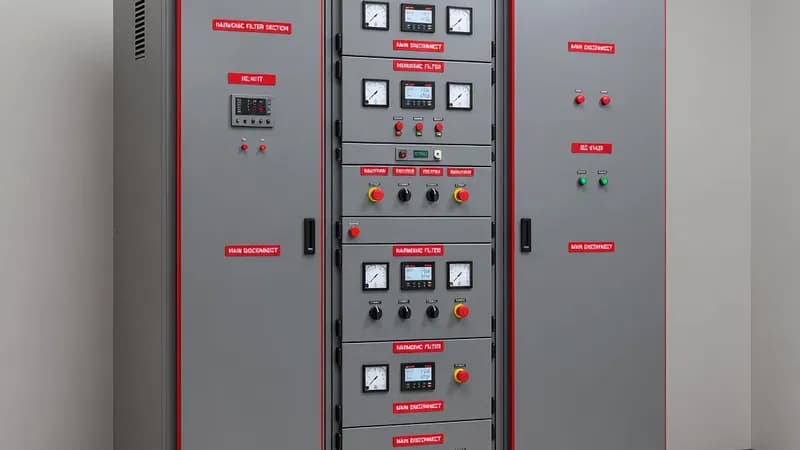
A Harmonic Filter Panel is a purpose-engineered low-voltage assembly built to mitigate current and voltage distortion generated by non-linear loads such as VFDs, soft starters, UPS systems, rectifiers, battery chargers, welding plants, arc furnaces, and LED lighting networks. Designed and verified in accordance with IEC 61439-1 and IEC 61439-2, the panel integrates passive, active, or hybrid harmonic mitigation technologies to keep total harmonic distortion within utility, equipment, and internal power-quality limits. Typical construction includes capacitor banks, detuned reactors, tuned LC branches, active harmonic filter modules, moulded-case circuit-breakers, air circuit-breakers where higher feeder ratings are required, contactors, protection relays, surge protective devices, metering power analyzers, and forced ventilation or air-conditioning when thermal dissipation is significant. Passive harmonic filter solutions commonly use detuned capacitor banks designed around 189 Hz or 7% reactors to avoid resonance with upstream transformer and network impedance. Tuned filter branches are often engineered for the 5th, 7th, 11th, and 13th harmonic orders, depending on the load spectrum and short-circuit level at the point of common coupling. Active filters use IGBT-based power electronics with current transformers and digital controllers to inject counter-harmonic currents in real time, making them effective where load diversity changes frequently. Hybrid panels combine fixed passive stages for bulk reactive compensation with active modules for dynamic compensation and residual harmonic suppression. Engineering of the enclosure and busbar system must consider rated current, prospective short-circuit withstand, temperature rise, and cable derating. Harmonic Filter Panels are commonly built for ratings from 50 A to 4000 A and short-circuit levels from 25 kA to 100 kA, subject to verified design and component selection. Internal separation may be Form 1, Form 2b, Form 3b, or Form 4, depending on the need to segregate functional units, maintainability, and operational continuity. The assembly shall also comply with relevant equipment standards such as IEC 60947 for switching and protective devices, IEC 61000 for EMC and power-quality measurement practices, IEC 61641 where arc fault considerations are specified for enclosed LV assemblies, and IEC 60079 where installations interface with hazardous areas or require additional restrictions. In real-world applications, these panels are widely used in industrial manufacturing plants with multiple VFDs, in mining and metals facilities with heavy rectifier loads, in food and beverage lines with continuous process drives, and in pharmaceutical plants where power-quality stability protects automation and validation-critical equipment. For EPC contractors and facility managers, the key design objectives are low losses, stable bus voltage, controlled capacitor inrush, effective thermal management, coordinated protection, and measurable reduction of THDi at the PCC. Properly engineered harmonic filter assemblies improve transformer loading, extend equipment life, reduce nuisance tripping, and support compliance with utility harmonic limits and internal quality targets.
Components for This Panel
Capacitor Banks & Reactors selection, integration, and best practices for Harmonic Filter Panel assemblies compliant with IEC 61439.
Moulded Case Circuit Breakers (MCCB) selection, integration, and best practices for Harmonic Filter Panel assemblies compliant with IEC 61439.
Metering & Power Analyzers selection, integration, and best practices for Harmonic Filter Panel assemblies compliant with IEC 61439.
Protection Relays selection, integration, and best practices for Harmonic Filter Panel assemblies compliant with IEC 61439.
Contactors & Motor Starters selection, integration, and best practices for Harmonic Filter Panel assemblies compliant with IEC 61439.
Applicable Standards
IEC 61439-2 (PSC) compliance requirements, testing procedures, and design considerations for Harmonic Filter Panel assemblies.
EMC Compliance (IEC 61000) compliance requirements, testing procedures, and design considerations for Harmonic Filter Panel assemblies.
IP Protection Ratings compliance requirements, testing procedures, and design considerations for Harmonic Filter Panel assemblies.
Industries Using This Panel
Harmonic Filter Panel assemblies engineered for Industrial Manufacturing applications, addressing industry-specific requirements and compliance standards.
Harmonic Filter Panel assemblies engineered for Mining & Metals applications, addressing industry-specific requirements and compliance standards.
Harmonic Filter Panel assemblies engineered for Food & Beverage applications, addressing industry-specific requirements and compliance standards.
Harmonic Filter Panel assemblies engineered for Pharmaceuticals applications, addressing industry-specific requirements and compliance standards.
Related Knowledge Articles
Engineering VFD panels for reliable motor speed control.
Designing panels to minimize electrical losses.
Comprehensive overview of all IEC 61439 parts, their scope, and how they apply to different panel types.
Frequently Asked Questions
Ready to Engineer Your Next Panel?
Our team of electrical engineers is ready to design, build, and deliver your custom panel solution — fully compliant with international standards.