MCC Panels

Harmonic Filter Panel for Industrial Manufacturing

Harmonic Filter Panel assemblies engineered for Industrial Manufacturing applications, addressing industry-specific requirements and compliance standards.
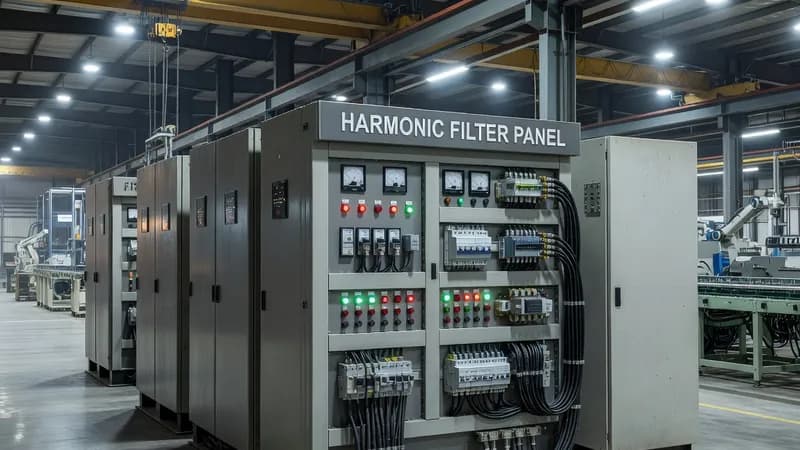
Harmonic Filter Panel for Industrial Manufacturing

Overview

Harmonic Filter Panel assemblies for Industrial Manufacturing are engineered to mitigate current and voltage distortion caused by nonlinear loads such as VFDs, DC drives, servo amplifiers, UPS systems, welding machines, and large rectifier-based process equipment. In modern factories, these loads can elevate THDi, overheat transformers and cables, trip protection devices, and reduce the service life of capacitors, PLCs, and sensitive instrumentation. A properly designed harmonic filter panel restores power quality, protects upstream switchgear, and helps industrial plants maintain stable operation under varying load profiles. These assemblies are typically designed in accordance with IEC 61439-2 for power switchgear and controlgear assemblies, with component selection aligned to IEC 60947 for circuit-breakers, contactors, overload relays, and switching devices. Where the installation interfaces with utility supply, harmonics compliance is often evaluated against IEC 61439-1 system requirements and site power quality criteria such as IEEE 519, while enclosure protection may follow IEC 60529. In hazardous or dusty production areas, additional considerations may include IEC 60079 for explosive atmospheres and IEC 61641 for arc fault test requirements in low-voltage assemblies with internal arcing risk. Typical constructions include passive harmonic filter banks, detuned capacitor banks with series reactors, active harmonic filters, and hybrid solutions. In industrial manufacturing plants with high installed VFD capacity, detuned APFC panels are frequently combined with MCCBs or ACBs, fused steps, capacitor contactors, discharge resistors, and power factor regulators. For larger process lines, active harmonic filters are used alongside protection relays and power meters to continuously inject compensating currents and adapt to changing load conditions. Panels may be built with busbar systems rated from 400 A to 6300 A, with short-circuit withstand ratings typically from 25 kA to 100 kA at 415 V, depending on the upstream fault level and selected protective devices. Form of separation is a key engineering decision in manufacturing facilities. Depending on maintenance strategy and operational criticality, assemblies may be configured to IEC 61439 forms such as Form 2, Form 3b, or Form 4 to improve segregation between functional units, minimize downtime, and improve safety during inspection. Enclosures are commonly specified for indoor industrial duty with IP31, IP42, IP54, or higher, and materials may include powder-coated steel, galvanized sheet steel, or stainless steel for corrosive environments such as food, chemical, or metal-processing plants. Real-world applications include molding lines, packaging plants, textile mills, automated warehouses, steel finishing lines, and general process manufacturing plants where harmonics from VFDs and servo drives are concentrated. Integration with SCADA, PLC, Ethernet gateways, and Modbus-enabled power meters allows facility managers to monitor THD, kvar demand, capacitor step status, breaker loading, and alarm conditions in real time. For EPC contractors and panel builders, a well-specified Harmonic Filter Panel reduces nuisance tripping, improves transformer utilization, and supports compliance-driven commissioning in demanding industrial environments.

Key Features

  • Harmonic Filter Panel configured for Industrial Manufacturing requirements
  • Industry-specific environmental ratings and protections
  • Compliance with sector-specific standards and regulations
  • Optimized component selection for industry applications
  • Integration with industry-standard control and monitoring systems

Specifications

PropertyValue
Panel TypeHarmonic Filter Panel
IndustryIndustrial Manufacturing
Base StandardIEC 61439-2
EnvironmentIndustry-specific ratings

Other Panels for Industrial Manufacturing

Main Distribution Board (MDB)

Primary power distribution from transformer to sub-circuits. Rated up to 6300A. Houses main incoming breaker, bus-section, and outgoing feeders.

Power Control Center (PCC)

High-capacity power distribution for industrial facilities. Controls and distributes incoming power to MCC, APFC, and downstream loads.

Motor Control Center (MCC)

Centralized motor control with starters, contactors, overloads, and VFDs in standardized withdrawable/fixed functional units.

Power Factor Correction Panel (APFC)

Automatic capacitor switching for reactive power compensation. Thyristor or contactor-switched, detuned or standard configurations.

Automatic Transfer Switch (ATS) Panel

Automatic changeover between mains and generator/UPS. Open or closed transition, with or without bypass.

Variable Frequency Drive (VFD) Panel

Enclosed VFD assemblies with input protection, line reactors, EMC filters, output reactors, and bypass options.

Metering & Monitoring Panel

Energy metering, power quality analysis, and multi-circuit monitoring with communication gateways.

PLC & Automation Control Panel

Process and machine control panels housing PLCs, I/O modules, relays, HMIs, and communication infrastructure.

Busbar Trunking System (BTS)

Prefabricated busbar distribution per IEC 61439-6. Sandwich or air-insulated, aluminum or copper.

Soft Starter Panel

Enclosed soft starter assemblies for reduced voltage motor starting with torque control, ramp-up/down profiles, and bypass contactor options.

Capacitor Bank Panel

Fixed or automatic capacitor bank assemblies for bulk reactive power compensation in industrial and utility applications.

Custom Engineered Panel

Bespoke panel assemblies for non-standard requirements — special ratings, unusual form factors, multi-function combinations.

Other Industries Using Harmonic Filter Panel

Frequently Asked Questions

A harmonic filter panel reduces current and voltage harmonics generated by nonlinear loads such as VFDs, soft starters, servo drives, welding equipment, and rectifier-based systems. In industrial manufacturing, these disturbances can cause overheating, nuisance trips, capacitor failure, and poor power factor performance. Depending on the application, the panel may use passive detuned reactors, tuned filters, active harmonic filters, or hybrid topologies. The assembly is typically designed to IEC 61439-2, with switching and protection devices selected to IEC 60947. For plants with significant VFD penetration, the goal is often to keep THDi and bus voltage distortion within acceptable limits and stabilize the electrical network for production-critical loads.
The primary standard is IEC 61439-2 for low-voltage switchgear and controlgear assemblies. The overall assembly requirements are defined in IEC 61439-1, while component-level devices such as MCCBs, ACBs, contactors, fuses, and overload relays are selected to IEC 60947. If the installation is in a hazardous area, IEC 60079 may apply to the surrounding environment. For arc safety and internal fault behavior, IEC 61641 is often referenced when specifying panels for critical industrial sites. In practice, EPC contractors also evaluate site harmonic performance against IEEE 519 or utility-specific power quality limits, especially where large VFD systems or harmonic filter banks are being commissioned.
The choice depends on load profile, harmonic spectrum, and operating variability. Passive filters, often detuned capacitor banks with series reactors, are cost-effective for stable, predictable loads such as multiple VFDs running similar duty cycles. Active harmonic filters are better where the load mix changes frequently, because they dynamically inject compensating current and can address multiple harmonic orders. Many industrial manufacturing plants use hybrid configurations to combine reactive power compensation with harmonic mitigation. Selection should be based on measured site harmonics, transformer loading, short-circuit level, and future expansion. IEC 61439 verification and device coordination to IEC 60947 remain essential regardless of topology.
The required short-circuit withstand rating depends on the prospective fault current at the installation point and the coordination philosophy. Industrial manufacturing panels are commonly designed for ratings such as 25 kA, 36 kA, 50 kA, 65 kA, or 100 kA at 415 V, but the correct value must be derived from the site study. The assembly must satisfy IEC 61439 verification for short-circuit withstand, thermal performance, and protective circuit integrity. Upstream protection is usually provided by MCCBs or ACBs, sometimes with fuse protection for capacitor steps or filter branches. Accurate fault-level data from the utility or main switchboard is essential before finalizing the harmonic filter panel design.
A harmonic filter panel is often installed upstream of multiple VFD feeders or at the main distribution level to reduce harmonic currents injected by the drives. In many manufacturing plants, each VFD may already include line reactors or DC chokes, but that alone may not meet the plant’s power quality target. The panel can include passive filters, active filters, power analyzers, and protection relays to coordinate with drive loads. Proper integration requires checking feeder loading, transformer impedance, capacitor resonance risk, and startup transients from soft starters and large motors. In IEC 61439-compliant assemblies, the busbar, protective devices, and wiring are selected to handle continuous harmonic current and elevated thermal stress.
Typical enclosure ratings for indoor industrial environments include IP31, IP42, and IP54, depending on dust, moisture, and washdown exposure. In harsher manufacturing areas such as food processing, metalworking, or chemical plants, stainless steel or coated galvanized enclosures are often preferred. Ventilation may be natural, fan-assisted, or heat-exchanger-based because harmonic filters and reactors generate significant losses. The enclosure design must maintain component temperature rise within IEC 61439 limits. If the panel is installed near corrosive atmospheres or in classified zones, additional environmental and safety requirements may apply under IEC 60079 and plant-specific regulations.
Yes, but the panel must be engineered carefully because power factor correction and harmonic mitigation are linked. Detuned capacitor banks inside harmonic filter panels can improve displacement power factor while avoiding resonance with the supply network. In industrial manufacturing facilities with VFD-heavy loads, a conventional capacitor bank alone can amplify harmonics and create overvoltage conditions. A properly designed harmonic filter panel uses reactors, tuned steps, or active filtering to improve kvar support without destabilizing the system. Many panels also include automatic power factor regulators, power meters, and protection relays so the plant can monitor PF, THD, and capacitor step status in real time.
An APFC panel is primarily used to correct reactive power and improve power factor by switching capacitor steps. A harmonic filter panel is designed to suppress harmonic distortion, and in many industrial manufacturing plants it may also include power factor correction as part of a broader power quality strategy. If the plant has VFDs, UPS systems, or other nonlinear loads, a standard APFC panel may be insufficient and can even create resonance problems. Harmonic filter panels therefore use detuned reactors, active filters, or hybrid arrangements to protect the system. Both types of panels can be built to IEC 61439-2, but the internal architecture and coordination requirements are different.
A harmonic study is strongly recommended whenever the plant has multiple VFDs, large rectifier loads, nonlinear welding equipment, or a history of capacitor failures and nuisance trips. The study identifies the dominant harmonic orders, existing THDi, transformer loading, bus impedance, and resonance points. It is especially important for EPC projects and brownfield retrofits where the new panel will interface with existing MDBs, PCCs, or MCCs. The study results determine whether passive, active, or hybrid filtering is appropriate and help define breaker ratings, reactor values, capacitor step sizing, and thermal management. This ensures the harmonic filter panel can be verified and commissioned in line with IEC 61439 and plant power quality targets.

Ready to Engineer Your Next Panel?

Our team of electrical engineers is ready to design, build, and deliver your custom panel solution — fully compliant with international standards.