Lighting Distribution Board for Commercial Buildings
Lighting Distribution Board assemblies engineered for Commercial Buildings applications, addressing industry-specific requirements and compliance standards.
Overview
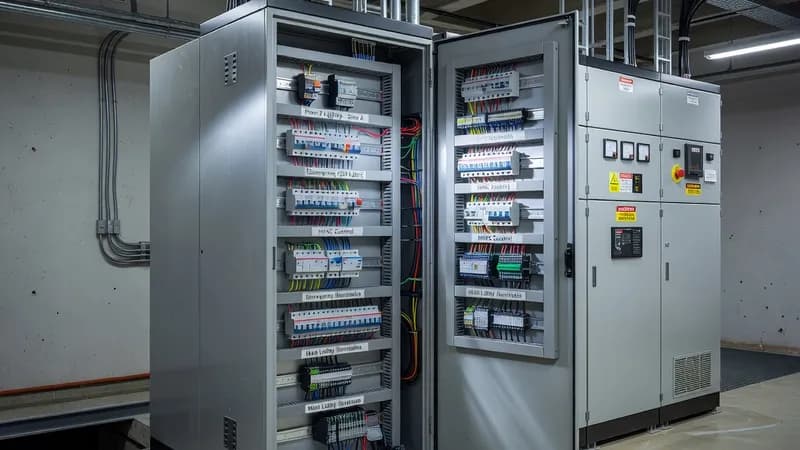
Lighting Distribution Board assemblies for commercial buildings are engineered to provide safe, selective, and maintainable distribution of final lighting circuits from the main low-voltage system to tenant floors, retail areas, car parks, lobbies, corridors, and external façade lighting. In contemporary office towers, shopping centers, hospitals, hotels, and mixed-use developments, these boards are typically designed and verified to IEC 61439-2 for low-voltage switchgear and controlgear assemblies. Where the lighting distribution board is intended for operation by ordinary persons in accessible areas, IEC 61439-3 may also apply, especially for distribution boards with standardized outgoing ways and user-friendly protective devices. In multi-building campuses, the upstream main distribution equipment is frequently an IEC 61439-1 verified assembly, with coordination studies confirming compatibility between incomers, busbars, and downstream lighting panels. A commercial lighting DB commonly incorporates MCCBs or MCBs for incomer and outgoing protection, residual current devices where personnel protection or local codes require them, modular metering for circuit and energy monitoring, surge protection devices for transient overvoltage resilience, and contactors for time-based or BMS-controlled lighting groups. Depending on the control philosophy, the assembly may also include soft starters for associated auxiliary loads, VFDs for façade or architectural lighting support systems, and protection relays for critical feeder supervision. In larger facilities, ACB-fed main switchboards distribute to floor-level lighting DBs with rated currents typically from 63 A to 630 A, although riser or campus applications may extend beyond this range. Final circuit devices are selected to suit LED inrush current, cable derating, diversity, and discrimination requirements. Short-circuit withstand ratings are commonly specified from 10 kA to 50 kA, but the final value must be matched to the prospective fault level and verified assembly design documentation. Commercial buildings place strong emphasis on operational continuity, energy efficiency, and maintainability. Lighting DBs are often integrated with building management systems through dry contacts, Modbus RTU/TCP gateways, or intelligent meters to support occupancy-based control, load shedding, after-hours monitoring, and tenant submetering. For LED loads, panel design must account for harmonic distortion, neutral conductor loading, and nuisance tripping, particularly where large numbers of electronic drivers are connected on the same feeder. Control components selected from IEC 60947 families, such as IEC 60947-4-1 contactors and IEC 60947-5-1 control devices, are widely used for reliable switching duty in repetitive lighting operations. Environmental conditions vary significantly by location inside the building. Basement car parks, plant rooms, loading bays, and service corridors may require IP54 to IP65 enclosures, epoxy-coated steel, stainless steel hardware, or anti-condensation heaters. Outdoor façade lighting panels and roof-mounted feeder boards need UV-resistant seals, corrosion protection, and careful cable entry design to preserve the declared protection degree. In high-occupancy public buildings, internal arc containment can be an important specification, and IEC 61641 may be requested for verification of resistance to internal arcing effects. If the installation borders hazardous zones such as fuel transfer or process areas, IEC 60079 requirements must be considered for any explosion-risk interfaces. Typical configurations include floor lighting distribution boards, tenant fit-out panels, retail zone boards, façade lighting panels, emergency lighting sections, and car park lighting DBs. Forms of separation are usually selected as Form 2, Form 3, or Form 4 to improve personnel safety, minimize outage impact during maintenance, and allow phased tenant fit-outs without fully de-energizing the board. For EPC contractors and facility managers, the key deliverables are a coordinated single-line diagram, load schedule, thermal verification, short-circuit study, component datasheets, and circuit labeling aligned with the project documentation package. A properly engineered Lighting Distribution Board for commercial buildings improves uptime, simplifies tenant modifications, supports energy management strategies, and ensures compliance with IEC-based assembly practices across the lifecycle of the asset.
Key Features
- Lighting Distribution Board configured for Commercial Buildings requirements
- Industry-specific environmental ratings and protections
- Compliance with sector-specific standards and regulations
- Optimized component selection for industry applications
- Integration with industry-standard control and monitoring systems
Specifications
| Property | Value |
|---|---|
| Panel Type | Lighting Distribution Board |
| Industry | Commercial Buildings |
| Base Standard | IEC 61439-2 |
| Environment | Industry-specific ratings |
Other Panels for Commercial Buildings
Primary power distribution from transformer to sub-circuits. Rated up to 6300A. Houses main incoming breaker, bus-section, and outgoing feeders.
Automatic capacitor switching for reactive power compensation. Thyristor or contactor-switched, detuned or standard configurations.
Automatic changeover between mains and generator/UPS. Open or closed transition, with or without bypass.
Energy metering, power quality analysis, and multi-circuit monitoring with communication gateways.
Prefabricated busbar distribution per IEC 61439-6. Sandwich or air-insulated, aluminum or copper.
Fixed or automatic capacitor bank assemblies for bulk reactive power compensation in industrial and utility applications.
Bespoke panel assemblies for non-standard requirements — special ratings, unusual form factors, multi-function combinations.
Other Industries Using Lighting Distribution Board
Frequently Asked Questions
Ready to Engineer Your Next Panel?
Our team of electrical engineers is ready to design, build, and deliver your custom panel solution — fully compliant with international standards.