MCC Panels

Motor Control Center (MCC) — Marine Classification (DNV/Lloyd's/BV)

Marine Classification (DNV/Lloyd's/BV) compliance requirements, testing procedures, and design considerations for Motor Control Center (MCC) assemblies.
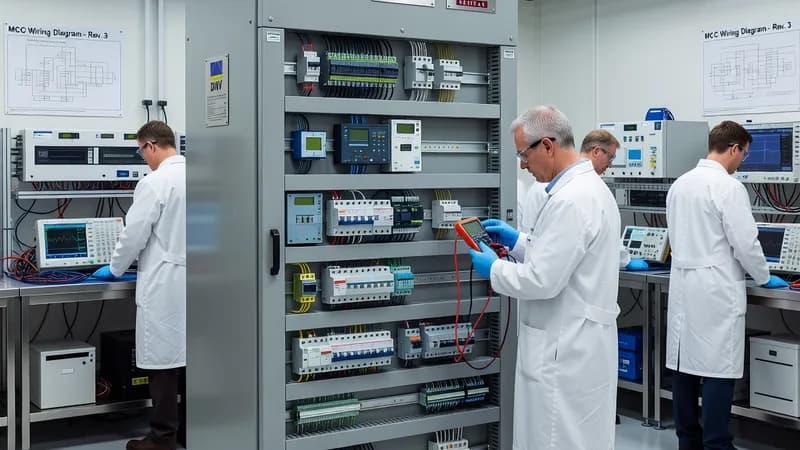
Motor Control Center (MCC) — Marine Classification (DNV/Lloyd's/BV)

Overview

Marine Classification (DNV, Lloyd’s Register, and Bureau Veritas) compliance for a Motor Control Center (MCC) is not a generic “marine-grade” claim; it is a design-verified, document-controlled, and test-supported conformity pathway for switchboard and controlgear assemblies intended for ships, offshore units, floating production systems, and other classed installations. For MCC panels, the compliance objective is to demonstrate that the assembly can withstand the electrical, mechanical, thermal, environmental, and vibration stresses expected in marine service while maintaining segregation, protection coordination, and maintainability. In practice, the MCC is engineered in line with IEC 61439-1 and IEC 61439-2 for low-voltage switchgear assemblies, with component selection aligned to IEC 60947 for ACBs, MCCBs, contactors, motor protection circuit breakers, overload relays, and auxiliary control devices. For hazardous or exposed compartments, requirements may also intersect with IEC 60079 for explosive atmospheres and IEC 61641 for arc fault containment testing where the specification calls for enhanced operator safety. A class-compliant MCC typically incorporates feeder modules, DOL starters, reversing starters, star-delta combinations, soft starters, and VFD-driven motor feeders, with rated operational currents commonly ranging from 125 A up to 6300 A depending on the main busbar design and incomer arrangement. Short-circuit withstand capability must be declared and verified by design rules or testing, often in the range of 35 kA, 50 kA, 65 kA, or higher at 1 second, depending on the project and upstream fault level. Form of internal separation is selected to support maintainability and fire containment, typically Form 2b, Form 3b, or Form 4 in accordance with IEC 61439, with segregation of busbars, functional units, and terminals especially important for uninterrupted marine operations. Classification society review usually focuses on documentation completeness, material traceability, corrosion resistance, insulation coordination, and installation environment. Stainless steel or marine-coated enclosures, vibration-resistant mounting systems, captive fasteners, tinned copper busbars, anti-condensation heaters, thermostatic ventilation, and IP ratings suitable for the machinery space are common design measures. EMC considerations are critical when MCCs include VFDs, PLC I/O, communication gateways, or protection relays for engine room automation and pump control. Cable entry, gland plates, earthing/bonding continuity, and touch-safe barriers must be engineered to satisfy class survey expectations and the shipyard’s installation methods. Verification for DNV, Lloyd’s Register, or Bureau Veritas may include routine testing, temperature-rise verification, dielectric withstand, protective circuit continuity, operational functional checks, and witness testing where required by the project. Depending on the classification route, the MCC can be supported by type approval, design appraisal, or project-specific certification, with final dossiers containing single-line diagrams, bill of materials, GA drawings, calculations, test reports, material certificates, and nameplate data. For EPC contractors and marine OEMs, the practical value of compliance is reduced survey risk, faster acceptance at yard, and a panel assembly that is traceable from component selection through final commissioning and re-certification.

Key Features

  • Marine Classification (DNV/Lloyd's/BV) compliance pathway for Motor Control Center (MCC)
  • Design verification and testing requirements
  • Documentation and certification procedures
  • Component selection for standard compliance
  • Ongoing compliance maintenance and re-certification

Specifications

PropertyValue
Panel TypeMotor Control Center (MCC)
StandardMarine Classification (DNV/Lloyd's/BV)
ComplianceDesign verified
CertificationAvailable on request

Other Standards for Motor Control Center (MCC)

Other Panels Certified to Marine Classification (DNV/Lloyd's/BV)

Frequently Asked Questions

For an MCC, DNV, Lloyd’s Register, or Bureau Veritas compliance means the assembly has been designed, documented, and verified for marine or offshore service according to the relevant class rules and IEC 61439 requirements. It is not only a component choice issue; the entire assembly must demonstrate suitability for vibration, corrosion, temperature rise, short-circuit duty, protection against electric shock, and maintainability. In most projects, the base electrical design follows IEC 61439-1/-2, while individual devices such as ACBs, MCCBs, contactors, overload relays, and VFDs comply with IEC 60947 series requirements. The class society may request type approval, design appraisal, witness testing, or a project-specific certificate depending on the scope of supply and vessel classification basis.
The primary electrical assembly standard is IEC 61439-1 and IEC 61439-2 for low-voltage switchgear and controlgear assemblies. Individual devices inside the MCC generally comply with IEC 60947-1 and the applicable product parts, such as IEC 60947-2 for circuit-breakers, IEC 60947-4-1 for contactors and motor starters, and IEC 60947-4-2 for soft starters where used. If the MCC is installed in hazardous marine areas, IEC 60079 may also become relevant. For arc risk mitigation, IEC 61641 can be used when the specification requires internal arc containment testing. Classification societies then overlay their own marine requirements for vibration, insulation, material traceability, and environmental endurance.
Typical tests include dielectric withstand, protective circuit continuity, temperature-rise verification, operational functional checks, and verification of rated short-circuit withstand strength. Depending on the class route, the surveyor may also require vibration-related evidence, enclosure ingress suitability, and inspection of busbar supports, terminal arrangements, and earthing continuity. If the MCC includes VFDs or soft starters, additional EMC and thermal checks are often necessary. For assemblies with enhanced safety requirements, internal arc tests to IEC 61641 may be requested by the project or class specification. The exact test package depends on whether the panel is covered by a type-approved design or a project-specific certification dossier.
Yes, VFDs and soft starters are commonly integrated into marine-classified MCCs for pumps, fans, compressors, and thrusters where process control or energy efficiency is needed. The key is proper thermal design, EMC control, segregation from sensitive control wiring, and device selection suitable for marine ambient conditions. Drives and soft starters should be selected in line with IEC 60947-4-2 and manufacturer marine approvals where applicable. In practice, the MCC may require filtered cable routing, shielded motor cables, dedicated ventilation, and separation from other functional units to manage heat and electromagnetic interference. Class societies also expect clear documentation of overload protection, coordination with upstream protective devices, and fault-handling behavior during commissioning and survey review.
Marine MCCs are usually built with corrosion-resistant enclosures such as powder-coated marine steel or stainless steel, depending on location and class requirements. Internal busbars are often tinned copper to improve corrosion resistance, and all fixings should be selected for vibration resistance and long-term serviceability. Anti-condensation heaters, drip shields, sealed cable entries, and appropriately rated IP protection help the assembly perform in humid engine-room or deckhouse environments. Earthing and bonding are critical, and many projects require supplementary bonding conductors and verified continuity points. The choice of materials and surface treatment should be documented in the build file, because class surveyors often review traceability and suitability for the intended shipboard environment.
The required short-circuit rating depends on the upstream system fault level and the distribution architecture, not on the marine class alone. In marine MCC applications, the assembly may need declared short-circuit withstand ratings such as 35 kA, 50 kA, 65 kA, or higher for 1 second, with matching peak withstand values and coordinated protective devices. The rating must be demonstrated by design verification under IEC 61439 or by validated calculation and component coordination evidence, and the upstream protective devices such as ACBs or MCCBs must be selected accordingly. For class approval, the documentation should clearly state the rated operational current, prospective fault level, and the verification method used.
Post-installation compliance is maintained through controlled modifications, periodic inspection, and documentation updates. Any change to feeder ratings, protective devices, busbar arrangements, or enclosure ventilation should be reviewed against the original design verification basis and class documentation. Routine maintenance typically includes thermal inspection, torque checks, insulation testing where appropriate, verification of protective relay settings, and functional testing of starters, contactors, and interlocks. If the MCC is subject to recertification or survey, the manufacturer or panel integrator should provide updated drawings, parts lists, and test records. Using standard component families with proven IEC 60947 compliance helps simplify lifecycle maintenance and spare-parts management.
Not always, but it is often beneficial. Some class societies accept project-specific design approval and witness testing, while others or the end user may require type approval for repeated production of the same MCC architecture. Type approval can reduce approval time for standardized feeder sections, incomers, or starter modules because the core design has already been assessed against the relevant rules and IEC 61439 verification requirements. However, project-specific details such as fault level, enclosure rating, environmental class, and installation method still need confirmation. The correct route depends on the ship owner, EPC contract, and the classification society’s acceptance process.
A complete certification dossier usually includes the single-line diagram, GA layout, bill of materials, device datasheets, busbar sizing calculations, short-circuit and temperature-rise verification, protection coordination data, IP and corrosion protection details, wiring schematics, and routine test reports. Depending on the class society, material certificates, nameplate information, and evidence of component approvals may also be required. For MCCs with VFDs, soft starters, or protection relays, control logic and EMC-related documentation can be important as well. Clear traceability from the approved design to the manufactured panel is essential for survey acceptance and future re-certification.

Ready to Engineer Your Next Panel?

Our team of electrical engineers is ready to design, build, and deliver your custom panel solution — fully compliant with international standards.