Motor Control Center (MCC) — ATEX / IECEx Certification
ATEX / IECEx Certification compliance requirements, testing procedures, and design considerations for Motor Control Center (MCC) assemblies.
Overview
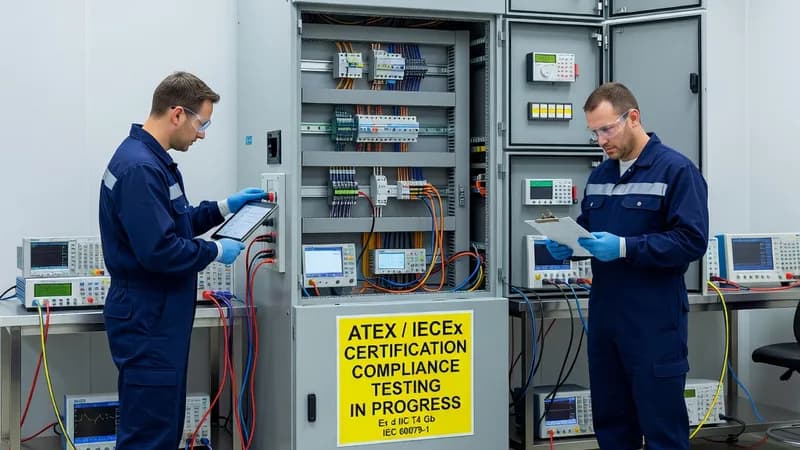
ATEX / IECEx certification compliance for a Motor Control Center (MCC) is a specialized hazardous-area engineering task that combines low-voltage assembly design with explosive-atmosphere conformity requirements. In most projects, the MCC itself is installed in a safe area or a non-hazardous electrical room and then serves Ex-rated process equipment located in Zone 1, Zone 2, or dust Zone 21/22 areas. The compliance path therefore starts with hazardous area classification, equipment selection, and a clear determination of whether the assembly is a standard low-voltage MCC, a pressurized/purged system, or an enclosure with associated protective interfaces for field equipment. The electrical assembly portion of the design must be verified to IEC 61439-1 and IEC 61439-2, with additional application-dependent references to IEC 61439-3 for distribution boards and IEC 61439-6 for busbar trunking interfaces where the MCC is fed from or connected to compact distribution systems. For hazardous atmospheres, the relevant framework is IEC 60079 and the ATEX Directive 2014/34/EU, with IECEx certification following the international scheme. Depending on the protection concept, the design may need to address IEC 60079-0 for general requirements, IEC 60079-1 for flameproof enclosures, IEC 60079-2 for pressurization, IEC 60079-7 for increased safety, IEC 60079-11 for intrinsic safety, and IEC 60079-31 for dust ignition protection by enclosure. If the project requires internal arc resilience, IEC 61641 is often specified as a supplementary test reference. Modern MCC lineups may include ACB incomers up to 6300 A, MCCB feeders, contactor starters, overload relays, motor protection circuit breakers, VFDs, soft starters, protection relays, PLCs, and communication gateways. In ATEX / IECEx projects, each device must be assessed for thermal impact, fault behavior, and compatibility with the declared ambient temperature and the intended temperature class. VFDs and soft starters are particularly sensitive because they generate heat and can influence enclosure temperature rise, cable derating, and ventilation strategy. Where Ex i instrumentation is integrated, galvanic isolators, Zener barriers, and dedicated segregated wiring routes are required to maintain the entity parameters and prevent accidental energy transfer into hazardous circuits. A compliant MCC design also depends on forms of separation and segregation inside the enclosure. Power feeders, control wiring, and intrinsically safe circuits must be physically separated using barriers, wire-ways, and clearly defined cable entry zones. Depending on the required operational robustness, forms of internal separation consistent with IEC 61439 may be implemented to limit fault propagation between functional units. If the MCC uses a purged enclosure, the pressurization arrangement must meet IEC 60079-2 requirements for purge duration, pressure supervision, alarms, interlocks, and loss-of-pressure shutdown logic. For dusty environments, enclosure sealing, dust ingress control, and surface temperature management become critical to maintaining certification validity. Verification is not limited to a single type test. The certification file typically includes design verification results for temperature rise, dielectric withstand, short-circuit withstand, clearances and creepage distances, IP degree, mechanical strength, protective circuit continuity, and terminal suitability. Short-circuit performance must be aligned with the available fault level at the installation point, with ratings expressed as Icw, Icc, or conditional short-circuit current as applicable. Routine tests, wiring checks, functional tests, and inspection of protective measures are required before shipment, and the technical dossier must include drawings, BOMs, certificates, nameplate data, risk assessments, and test records. For EPC contractors, plant owners, and panel builders, maintaining compliance is an ongoing process. Any change to enclosure type, ventilation, component brand, protection concept, or cable entry system can trigger re-verification and potentially re-certification. Patrion designs and manufactures MCC panels in Turkey with a documentation-led approach that supports ATEX / IECEx projects from concept review through FAT, commissioning support, and lifecycle change control.
Key Features
- ATEX / IECEx Certification compliance pathway for Motor Control Center (MCC)
- Design verification and testing requirements
- Documentation and certification procedures
- Component selection for standard compliance
- Ongoing compliance maintenance and re-certification
Specifications
| Property | Value |
|---|---|
| Panel Type | Motor Control Center (MCC) |
| Standard | ATEX / IECEx Certification |
| Compliance | Design verified |
| Certification | Available on request |
Other Standards for Motor Control Center (MCC)
Power switchgear and controlgear assemblies — main compliance standard
Type approval for marine and offshore installations
Internal arc classification and containment
Earthquake resistance verification for critical facilities
North American switchboard safety standards
Other Panels Certified to ATEX / IECEx Certification
Enclosed VFD assemblies with input protection, line reactors, EMC filters, output reactors, and bypass options.
Process and machine control panels housing PLCs, I/O modules, relays, HMIs, and communication infrastructure.
Bespoke panel assemblies for non-standard requirements — special ratings, unusual form factors, multi-function combinations.
Enclosed soft starter assemblies for reduced voltage motor starting with torque control, ramp-up/down profiles, and bypass contactor options.
Frequently Asked Questions
Ready to Engineer Your Next Panel?
Our team of electrical engineers is ready to design, build, and deliver your custom panel solution — fully compliant with international standards.