Motor Control Center (MCC) — IEC 61439-2 (PSC)
IEC 61439-2 (PSC) compliance requirements, testing procedures, and design considerations for Motor Control Center (MCC) assemblies.
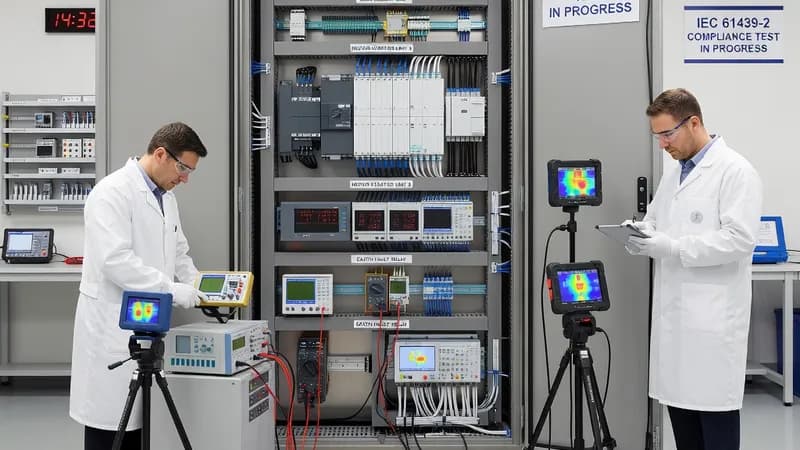
Overview
Motor Control Center (MCC) assemblies built in accordance with IEC 61439-2 are classified as low-voltage power switchgear and controlgear assemblies (PSC assemblies) intended for motor feeder distribution, control, and protection in industrial plants and infrastructure facilities. For EPC contractors, consulting engineers, and facility managers, compliance means a verified assembly design, not just the use of branded components. The standard requires the manufacturer to demonstrate design verification for temperature rise, dielectric withstand, short-circuit withstand, protective circuit continuity, clearances and creepage distances, and mechanical operation of functional units. In practice, MCCs are engineered with incomers using ACBs or MCCBs, outgoing feeders using MCCBs, contactors, overload relays, motor protection circuit breakers, soft starters, VFDs, and protection relays to coordinate starting, running, and fault isolation of motors ranging from fractional kW drives to large process motors. IEC 61439-2 is applied together with IEC 61439-1, which defines general rules for all assembly types and provides the framework for type verification and routine verification. Depending on the project scope, related assembly standards may also be relevant: IEC 61439-3 for distribution boards serving non-professional operation, IEC 61439-6 for busbar trunking interfaces, IEC 60079 where hazardous-area coordination is required, and IEC TR 61641 where arc fault resistance is specified by the customer or local code. The installed devices must individually comply with the IEC 60947 series, including IEC 60947-1 for general rules, IEC 60947-2 for circuit-breakers, IEC 60947-4-1 for contactors and motor starters, and IEC 60947-5-1 for control circuit devices. A compliant MCC is typically rated for busbar currents from 400 A up to 6300 A, with feeder ratings selected according to motor full-load current, starting duty, diversity, and ambient temperature. Short-circuit ratings must be declared as Icw, Icc, or Ipk depending on the assembly design and protective device coordination. Where variable frequency drives, soft starters, or harmonic-producing loads are used, thermal losses and ventilation strategy become critical, and the assembly may require derating, segregated compartments, or forced ventilation to keep conductor and device temperatures within limits. Withdrawal design, plug-in modules, and fixed units must maintain functional integrity under repeated operation and safe isolation for maintenance. Forms of separation are a key design decision in MCC engineering. Form 1, Form 2, Form 3, and Form 4 arrangements influence personnel safety, maintainability, and the ability to service one motor feeder while the rest of the board remains energized. In process industries, water treatment plants, mining operations, and critical utility facilities, Form 3b or Form 4b is commonly specified to improve continuity of service and reduce outage scope during maintenance. The declared IP degree, compartment arrangement, cable routing, and busbar chamber segregation must all align with the verified form of separation and the enclosure system. Design verification for IEC 61439-2 can be achieved by testing, comparison with a verified reference design, or assessment by calculation and engineering rules where permitted. The technical dossier should include wiring schematics, thermal calculations, short-circuit calculations, material specifications, component conformity documents, routine test records, and a declaration of conformity. Routine verification on every delivered MCC includes inspection of wiring, function tests, dielectric tests where applicable, and checks of protective conductor continuity and mechanical operation. For modifications, feeder additions, or device substitutions, the original verification basis must be reassessed before the assembly is returned to service. Patrion manufactures IEC 61439-2 design-verified MCC panels for process industries, commercial facilities, utilities, and critical infrastructure applications, with engineering support for device coordination, thermal management, short-circuit compliance, and certification documentation. For projects requiring selective coordination, arc-flash mitigation, hazardous-area alignment, or re-certification after retrofit, Patrion can support the full compliance pathway from concept design to final release.
Key Features
- IEC 61439-2 (PSC) compliance pathway for Motor Control Center (MCC)
- Design verification and testing requirements
- Documentation and certification procedures
- Component selection for standard compliance
- Ongoing compliance maintenance and re-certification
Specifications
| Property | Value |
|---|---|
| Panel Type | Motor Control Center (MCC) |
| Standard | IEC 61439-2 (PSC) |
| Compliance | Design verified |
| Certification | Available on request |
Other Standards for Motor Control Center (MCC)
Explosive atmosphere compliance for hazardous areas
Type approval for marine and offshore installations
Internal arc classification and containment
Earthquake resistance verification for critical facilities
North American switchboard safety standards
Other Panels Certified to IEC 61439-2 (PSC)
Primary power distribution from transformer to sub-circuits. Rated up to 6300A. Houses main incoming breaker, bus-section, and outgoing feeders.
High-capacity power distribution for industrial facilities. Controls and distributes incoming power to MCC, APFC, and downstream loads.
Automatic capacitor switching for reactive power compensation. Thyristor or contactor-switched, detuned or standard configurations.
Automatic changeover between mains and generator/UPS. Open or closed transition, with or without bypass.
Enclosed VFD assemblies with input protection, line reactors, EMC filters, output reactors, and bypass options.
Genset start/stop sequencing, synchronization, load sharing, and paralleling controls.
Energy metering, power quality analysis, and multi-circuit monitoring with communication gateways.
Process and machine control panels housing PLCs, I/O modules, relays, HMIs, and communication infrastructure.
Bespoke panel assemblies for non-standard requirements — special ratings, unusual form factors, multi-function combinations.
Enclosed soft starter assemblies for reduced voltage motor starting with torque control, ramp-up/down profiles, and bypass contactor options.
Active or passive harmonic filtering to mitigate THD from non-linear loads. Tuned LC filters, active filters, or hybrid configurations.
DC power distribution for battery systems, solar installations, telecom, and UPS applications. MCCB/fuse-based DC protection.
Fixed or automatic capacitor bank assemblies for bulk reactive power compensation in industrial and utility applications.
Frequently Asked Questions
Ready to Engineer Your Next Panel?
Our team of electrical engineers is ready to design, build, and deliver your custom panel solution — fully compliant with international standards.