Soft Starter Panel for Industrial Manufacturing
Soft Starter Panel assemblies engineered for Industrial Manufacturing applications, addressing industry-specific requirements and compliance standards.
Overview
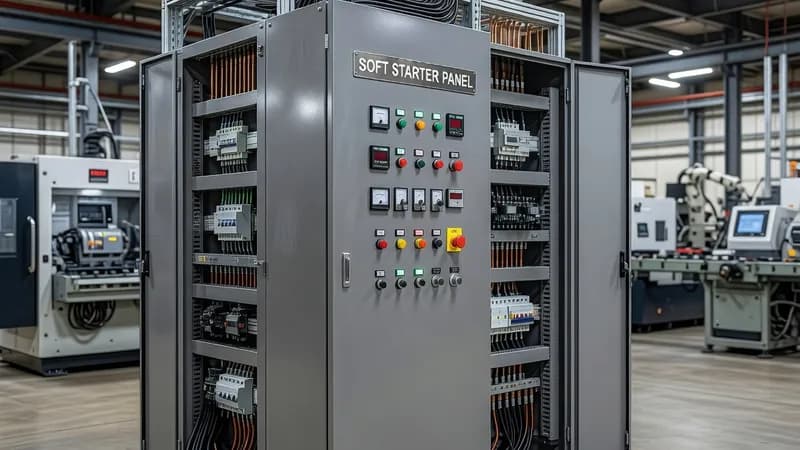
Soft Starter Panel assemblies for industrial manufacturing are engineered to control high-inertia motors while reducing mechanical stress, voltage dip, and inrush current during start-up. In factories, process plants, and discrete manufacturing lines, these panels are commonly applied to pumps, compressors, conveyors, mixers, crushers, fans, and material-handling systems where controlled acceleration is essential to protect gearboxes, belts, couplings, and driven equipment. A properly designed soft starter panel typically integrates a soft starter from an IEC 60947-4-2 compliant range, such as Siemens SIRIUS, Schneider Electric Altistart, ABB PSTX, or similar devices, combined with MCCBs or ACBs, contactors, overload protection, control relays, and motor protection relays depending on the duty and coordination strategy. For industrial manufacturing applications, the panel construction should comply with IEC 61439-1 and IEC 61439-2 for low-voltage switchgear assemblies, with verification of temperature rise, dielectric properties, clearances, creepage distances, and short-circuit withstand strength. Where the soft starter panel is supplied as part of a motor control center, IEC 61439-3 may be relevant for distribution boards or final assemblies; for utility-connected systems or transformer-fed incomers, IEC 61439-6 can apply where busbar trunking interfaces are incorporated. In hazardous manufacturing zones, additional assessment against IEC 60079 may be required, and for arc-flash mitigation and internal arc containment, IEC 61641 is often specified by EPC contractors and facility owners. Industrial manufacturing environments often expose panels to dust, metallic particulate, oil mist, vibration, elevated ambient temperatures, and frequent washdown or humidity changes. As a result, enclosure selection should consider IP54, IP55, or IP65 ratings where appropriate, along with corrosion-resistant powder coating, gland plates, filtered ventilation, anti-condensation heaters, thermostats, and door-mounted HMI or status mimic panels. For harsher sites, stainless steel enclosures or segregated compartments improve longevity and maintainability. Form of separation is another key design parameter: Form 2, Form 3, or Form 4 internal separation per IEC 61439 can improve operational safety and reduce downtime during maintenance by isolating functional units, busbars, and terminals. Soft starter panels in manufacturing facilities are often specified with bypass contactors to minimize heat loss after ramp-up, reducing panel temperature and extending component life. Advanced systems may include Modbus RTU, Modbus TCP, Profibus, Profinet, EtherNet/IP, or BACnet connectivity for integration into PLCs, SCADA platforms, and energy management systems. Protection relays and motor monitoring functions can provide phase loss, phase imbalance, locked rotor, undervoltage, overtemperature, and ground fault alarms, while current transformers and multifunction meters support diagnostics and load analysis. Typical ratings range from 11 kW to 500 kW and beyond, with busbar systems and feeder devices selected to suit rated operational currents from 25 A to 1600 A or higher, depending on the distribution architecture. For industrial manufacturing lines, the engineering objective is not only motor starting performance but also production continuity, selectivity, and maintainability. A well-designed soft starter panel reduces nuisance tripping, improves equipment life, and supports safe restart after power disturbances. Patrion designs and manufactures IEC-compliant panel assemblies in Turkey for OEMs, EPC contractors, and plant operators who need robust, application-specific control panels with verified short-circuit ratings, documented component coordination, and reliable integration into modern manufacturing infrastructure.
Key Features
- Soft Starter Panel configured for Industrial Manufacturing requirements
- Industry-specific environmental ratings and protections
- Compliance with sector-specific standards and regulations
- Optimized component selection for industry applications
- Integration with industry-standard control and monitoring systems
Specifications
| Property | Value |
|---|---|
| Panel Type | Soft Starter Panel |
| Industry | Industrial Manufacturing |
| Base Standard | IEC 61439-2 |
| Environment | Industry-specific ratings |
Other Panels for Industrial Manufacturing
Primary power distribution from transformer to sub-circuits. Rated up to 6300A. Houses main incoming breaker, bus-section, and outgoing feeders.
High-capacity power distribution for industrial facilities. Controls and distributes incoming power to MCC, APFC, and downstream loads.
Centralized motor control with starters, contactors, overloads, and VFDs in standardized withdrawable/fixed functional units.
Automatic capacitor switching for reactive power compensation. Thyristor or contactor-switched, detuned or standard configurations.
Automatic changeover between mains and generator/UPS. Open or closed transition, with or without bypass.
Enclosed VFD assemblies with input protection, line reactors, EMC filters, output reactors, and bypass options.
Energy metering, power quality analysis, and multi-circuit monitoring with communication gateways.
Process and machine control panels housing PLCs, I/O modules, relays, HMIs, and communication infrastructure.
Prefabricated busbar distribution per IEC 61439-6. Sandwich or air-insulated, aluminum or copper.
Active or passive harmonic filtering to mitigate THD from non-linear loads. Tuned LC filters, active filters, or hybrid configurations.
Fixed or automatic capacitor bank assemblies for bulk reactive power compensation in industrial and utility applications.
Bespoke panel assemblies for non-standard requirements — special ratings, unusual form factors, multi-function combinations.
Other Industries Using Soft Starter Panel
Ex-rated panels, MCC, PCC, VFD, generator control, soft starters, ATEX/IECEx compliance
MCC, VFD panels, PLC automation, APFC, generator control, soft starters
Rugged MCC, PCC, VFD panels, generator panels, soft starters, harmonic filters
Washdown-rated panels (IP65+), MCC, VFD, APFC, PLC, soft starters, harmonic filters
Cleanroom-compatible panels, MCC, VFD, APFC, PLC, soft starters, harmonic filters
Frequently Asked Questions
Ready to Engineer Your Next Panel?
Our team of electrical engineers is ready to design, build, and deliver your custom panel solution — fully compliant with international standards.