Capacitor Bank Panel
Fixed or automatic capacitor bank assemblies for bulk reactive power compensation in industrial and utility applications.
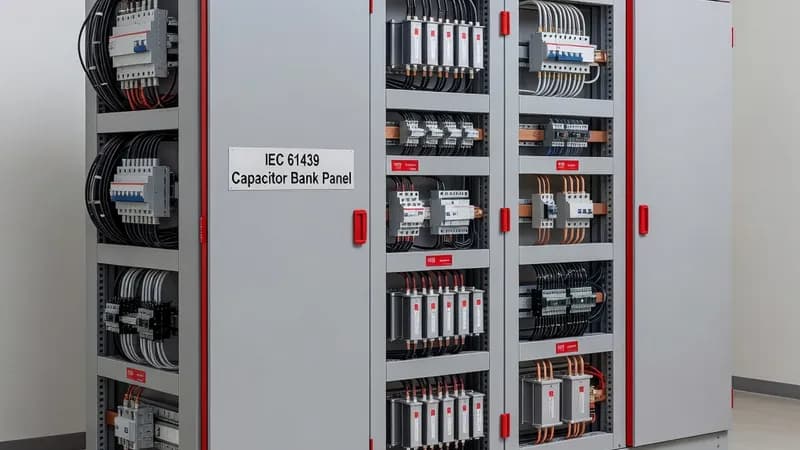
A Capacitor Bank Panel is an IEC 61439 low-voltage assembly engineered to supply fixed or automatically controlled reactive power compensation for power factor correction, voltage support, and reduction of utility penalty charges. In industrial plants, commercial complexes, data centers, and renewable-energy substations, these panels are typically built around capacitor units rated from 50 kVAr up to multi-megavolt-ampere-reactive banks, commonly integrated at 400 V, 415 V, 440 V, 480 V, or 690 V systems. Depending on the application, the panel may use fixed capacitor steps, contactor-switched steps, or thyristor-switched modules for fast dynamic compensation where load fluctuation is severe. In heavy-duty systems, detuned reactors are frequently installed to shift the resonance frequency and mitigate harmonic amplification caused by VFDs, soft starters, rectifier front ends, and UPS loads. A properly engineered capacitor bank assembly is designed in accordance with IEC 61439-1 and IEC 61439-2, with verification of temperature rise, short-circuit withstand, dielectric properties, clearances, creepage distances, and protective circuit integrity. Where used in public LV networks or utility interface applications, IEC 61439-3 or IEC 61439-6 may also be relevant depending on the enclosure and distribution function. Component selection is critical: capacitor-duty contactors with early-make auxiliary poles and damping resistors reduce inrush stress, while MCCBs or fuse-switch disconnectors provide overcurrent and short-circuit protection. Protection relays, power-factor controllers, and multifunction meters are used to supervise kvar output, harmonics, current imbalance, overtemperature, and undervoltage conditions. For installations exposed to polluted electrical environments, EMC design practices aligned with IEC 61000 are important to ensure reliable control and metering performance. Mechanical and thermal design are as important as electrical design. Capacitors generate heat due to dielectric losses, so forced ventilation, segregation of heat-sensitive electronics, and suitable enclosure sizing are required. Typical enclosures are offered in IP31, IP42, IP54, or higher depending on site conditions, dust, and humidity. Internal separation may be arranged in Forms 1, 2, 3b, or 4b under IEC 61439 to improve maintainability and reduce the risk of fault propagation between functional units. Busbar systems are commonly rated from 630 A to 6300 A or higher, with short-circuit ratings defined by the available fault level and the upstream protective device. In metal-enclosed variants intended for harsh industrial areas, additional design considerations may include arc fault mitigation, capacitor discharge timing, and, where required, compliance with IEC 61641 for internal arc effects or IEC 60079 for hazardous-area adjacency. Patrion’s capacitor bank panels are typically engineered as tested assemblies with real-world use in HVAC plants, steel mills, water treatment facilities, malls, solar PV plants, and utility substations where stable power factor and reduced losses directly improve operating efficiency.
Components for This Panel
Capacitor Banks & Reactors selection, integration, and best practices for Capacitor Bank Panel assemblies compliant with IEC 61439.
Contactors & Motor Starters selection, integration, and best practices for Capacitor Bank Panel assemblies compliant with IEC 61439.
Moulded Case Circuit Breakers (MCCB) selection, integration, and best practices for Capacitor Bank Panel assemblies compliant with IEC 61439.
Busbar Systems selection, integration, and best practices for Capacitor Bank Panel assemblies compliant with IEC 61439.
Protection Relays selection, integration, and best practices for Capacitor Bank Panel assemblies compliant with IEC 61439.
Metering & Power Analyzers selection, integration, and best practices for Capacitor Bank Panel assemblies compliant with IEC 61439.
Applicable Standards
IEC 61439-2 (PSC) compliance requirements, testing procedures, and design considerations for Capacitor Bank Panel assemblies.
EMC Compliance (IEC 61000) compliance requirements, testing procedures, and design considerations for Capacitor Bank Panel assemblies.
IP Protection Ratings compliance requirements, testing procedures, and design considerations for Capacitor Bank Panel assemblies.
UL 891 / CSA C22.2 compliance requirements, testing procedures, and design considerations for Capacitor Bank Panel assemblies.
Industries Using This Panel
Capacitor Bank Panel assemblies engineered for Commercial Buildings applications, addressing industry-specific requirements and compliance standards.
Capacitor Bank Panel assemblies engineered for Industrial Manufacturing applications, addressing industry-specific requirements and compliance standards.
Capacitor Bank Panel assemblies engineered for Renewable Energy applications, addressing industry-specific requirements and compliance standards.
Related Knowledge Articles
Sizing power factor correction equipment for LV installations.
Designing and sizing APFC panels for optimal reactive power compensation.
Comprehensive overview of all IEC 61439 parts, their scope, and how they apply to different panel types.
Frequently Asked Questions
Ready to Engineer Your Next Panel?
Our team of electrical engineers is ready to design, build, and deliver your custom panel solution — fully compliant with international standards.