MCC Panels

Capacitor Bank Panel for Industrial Manufacturing

Capacitor Bank Panel assemblies engineered for Industrial Manufacturing applications, addressing industry-specific requirements and compliance standards.
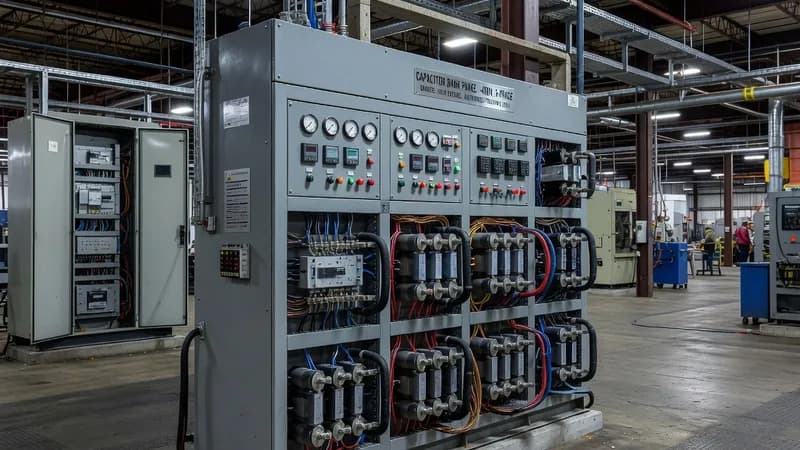
Capacitor Bank Panel for Industrial Manufacturing

Overview

Capacitor Bank Panel assemblies for Industrial Manufacturing are engineered to improve power factor, reduce reactive energy penalties, and stabilize plant voltage in facilities with mixed motor loads, welding equipment, HVAC systems, compressors, conveyors, extrusion lines, and VFD-heavy process areas. In modern plants, the panel is rarely a standalone capacitor rack; it is often integrated into an MDB, PCC, or dedicated APFC board with automatic stepped compensation, detuned reactors, APFC relays, capacitor contactors, and networked metering for continuous monitoring of kvar demand, THDv, and cos φ. For plants with significant non-linear loads, fixed or automatic capacitor banks are typically paired with harmonic filter reactors or tuned filters to prevent resonance and premature capacitor failure. Design and verification should align with IEC 61439-1 and IEC 61439-2 for low-voltage switchgear assemblies, with component devices selected to IEC 60947 series. In industrial manufacturing sites that require metering and compensation at the main incomer, the assembly may include ACBs or MCCBs as incomers, feeder protection devices, surge protective devices, and protection relays for capacitor overtemperature, unbalance, and overcurrent conditions. Where the panel is installed near process equipment, enclosure selection should consider ingress protection, corrosion resistance, dust loading, and ambient temperature rise. Typical industrial environments may require IP31, IP42, IP54, or higher, with derating applied for elevated ambient temperatures and poor ventilation. A robust Capacitor Bank Panel for manufacturing facilities commonly uses stepped banks from 25 kvar to several hundred kvar, with overall panel ratings ranging from 100 A to 1600 A or more, depending on plant size and utility penalties. Short-circuit withstand capability must be coordinated with the upstream network and validated by design verification, including temperature rise, dielectric properties, short-circuit current rating, and clearances/creepage. Depending on the project scope, the assembly may also be designed in Forms of Internal Separation 1 through 4 to isolate capacitor stages, control compartments, and busbars for improved maintainability and arc fault containment. In facilities with hazardous dust, flammable atmospheres, or solvent use, supplementary requirements may apply under IEC 60079 for explosion-protected areas and IEC 61641 for internal arcing considerations. For the manufacturing sector, integration with PLCs, BMS/SCADA, Modbus RTU/TCP, or Ethernet gateways enables alarm logging, stage switching optimization, maintenance diagnostics, and energy reporting. Patrion’s engineering team in Turkey designs Capacitor Bank Panels with practical manufacturing-floor considerations in mind: harmonic distortion levels, load diversity, power quality targets, maintenance access, and lifecycle cost. The result is a panel that improves utility performance, protects downstream assets, and supports high-availability production lines with dependable, standards-compliant reactive power compensation.

Key Features

  • Capacitor Bank Panel configured for Industrial Manufacturing requirements
  • Industry-specific environmental ratings and protections
  • Compliance with sector-specific standards and regulations
  • Optimized component selection for industry applications
  • Integration with industry-standard control and monitoring systems

Specifications

PropertyValue
Panel TypeCapacitor Bank Panel
IndustryIndustrial Manufacturing
Base StandardIEC 61439-2
EnvironmentIndustry-specific ratings

Other Panels for Industrial Manufacturing

Main Distribution Board (MDB)

Primary power distribution from transformer to sub-circuits. Rated up to 6300A. Houses main incoming breaker, bus-section, and outgoing feeders.

Power Control Center (PCC)

High-capacity power distribution for industrial facilities. Controls and distributes incoming power to MCC, APFC, and downstream loads.

Motor Control Center (MCC)

Centralized motor control with starters, contactors, overloads, and VFDs in standardized withdrawable/fixed functional units.

Power Factor Correction Panel (APFC)

Automatic capacitor switching for reactive power compensation. Thyristor or contactor-switched, detuned or standard configurations.

Automatic Transfer Switch (ATS) Panel

Automatic changeover between mains and generator/UPS. Open or closed transition, with or without bypass.

Variable Frequency Drive (VFD) Panel

Enclosed VFD assemblies with input protection, line reactors, EMC filters, output reactors, and bypass options.

Metering & Monitoring Panel

Energy metering, power quality analysis, and multi-circuit monitoring with communication gateways.

PLC & Automation Control Panel

Process and machine control panels housing PLCs, I/O modules, relays, HMIs, and communication infrastructure.

Busbar Trunking System (BTS)

Prefabricated busbar distribution per IEC 61439-6. Sandwich or air-insulated, aluminum or copper.

Soft Starter Panel

Enclosed soft starter assemblies for reduced voltage motor starting with torque control, ramp-up/down profiles, and bypass contactor options.

Harmonic Filter Panel

Active or passive harmonic filtering to mitigate THD from non-linear loads. Tuned LC filters, active filters, or hybrid configurations.

Custom Engineered Panel

Bespoke panel assemblies for non-standard requirements — special ratings, unusual form factors, multi-function combinations.

Other Industries Using Capacitor Bank Panel

Frequently Asked Questions

A Capacitor Bank Panel is used to correct low power factor, reduce reactive power charges, and support voltage stability in manufacturing plants with inductive loads such as motors, compressors, pumps, and conveyors. In practice, it is often installed as part of an MDB, PCC, or APFC system and can be fixed or automatically stepped using an APFC relay. For industrial facilities with variable production loads, automatic compensation is preferred because kvar demand changes throughout the shift. The panel should be designed and verified under IEC 61439-1/2, with component devices such as capacitor contactors, fuses, MCCBs, and detuned reactors selected in line with IEC 60947 requirements.
Harmonic filters are critical when a manufacturing plant has VFDs, soft starters, rectifier loads, or welding equipment that generate significant harmonic distortion. Without proper filtering, capacitors can resonate with the supply network, leading to overheating, nuisance tripping, blown fuses, or capacitor failure. Detuned reactor-based banks are a common solution, typically tuned below the 5th harmonic to protect the capacitors while improving power factor. In higher-distortion installations, tuned passive filters or active harmonic mitigation may be required. The final design should be based on measured or estimated THDv/THDi, transformer size, short-circuit level, and load profile, with assembly verification under IEC 61439.
The primary assembly standard is IEC 61439-1 and IEC 61439-2 for low-voltage switchgear and controlgear assemblies. The devices inside the panel typically comply with IEC 60947, including MCCBs, contactors, switch-disconnectors, and protection relays where applicable. If the manufacturing plant is in a hazardous area, IEC 60079 requirements may apply to surrounding equipment and installation zones. For arc-risk assessment and internal arcing considerations, IEC 61641 is relevant in certain panel specifications. The standards require proper design verification for temperature rise, dielectric performance, short-circuit withstand, clearances, and creepage distances. These are essential for capacitor bank panels operating in industrial environments with continuous duty and frequent switching.
A properly engineered industrial capacitor bank panel usually includes capacitor fuses or MCCBs for each stage, capacitor duty contactors, discharge resistors, APFC control relay, detuned reactors where harmonic distortion is present, and temperature monitoring inside the enclosure. Depending on the system architecture, the incomer may be protected by an ACB or MCCB. Additional options include surge protective devices, door-mounted metering, ventilation fans with thermostatic control, and communication modules for SCADA or BMS integration. Protection coordination is important because capacitor inrush currents and repetitive switching stresses differ from ordinary feeder circuits. The selected devices should be coordinated to IEC 60947 and verified within the IEC 61439 assembly design.
The enclosure rating depends on dust levels, moisture, washdown practices, and ambient conditions in the factory. In clean electrical rooms, IP31 or IP42 may be sufficient, while dusty or partially exposed areas may require IP54 or higher. Where ambient temperature is elevated, the panel needs thermal derating, increased ventilation, or air conditioning to maintain capacitor life and contactor reliability. If the manufacturing process involves oil mist, conductive dust, or corrosive atmospheres, materials, coatings, and filter maintenance become important. The enclosure selection must also support the assembly’s temperature rise limits and maintain the required clearances and creepage distances under IEC 61439 verification rules.
The short-circuit rating is determined by the prospective fault current at the installation point, the upstream transformer impedance, cable lengths, and the protection philosophy of the switchboard. The panel must be designed so the busbar system, switching devices, fuses, and internal wiring can withstand the declared short-circuit current for the required duration, typically 1 second unless otherwise specified. In capacitor bank panels, the capacitor stage inrush current and back-to-back switching effects must also be considered. Design verification under IEC 61439 includes short-circuit withstand checks, and the final rating should match the worst-case fault level at the point of connection, not just the nominal load current.
Yes. Industrial manufacturing plants commonly integrate capacitor bank panels with SCADA, BMS, or energy management systems using Modbus RTU, Modbus TCP, Ethernet gateways, or dry-contact alarms. This allows operators to monitor power factor, active and reactive power, step status, capacitor temperature, alarms, and maintenance conditions from a central control room. Integration is particularly useful in plants with variable production schedules because it helps identify load shifts, abnormal kvar demand, and harmonic-related issues. When integrated properly, the panel supports predictive maintenance and power quality optimization without requiring manual inspection of each stage.
Typical configurations include fixed capacitor banks for steady loads, automatic stepped APFC banks for variable production loads, and detuned banks for installations with VFDs and other non-linear equipment. Panels may be arranged as standalone floor-standing enclosures, wall-mounted units for smaller kvar ratings, or integrated sections inside MDBs and PCCs. Common stage sizes range from 5 kvar to 50 kvar per step, but the exact arrangement depends on transformer capacity, load profile, and utility power factor penalties. For industrial manufacturing, the best configuration is usually one that balances switching frequency, thermal performance, and harmonic immunity while remaining serviceable in a live plant environment.

Ready to Engineer Your Next Panel?

Our team of electrical engineers is ready to design, build, and deliver your custom panel solution — fully compliant with international standards.