Main Distribution Board (MDB) — IP Protection Ratings
IP Protection Ratings compliance requirements, testing procedures, and design considerations for Main Distribution Board (MDB) assemblies.
Overview
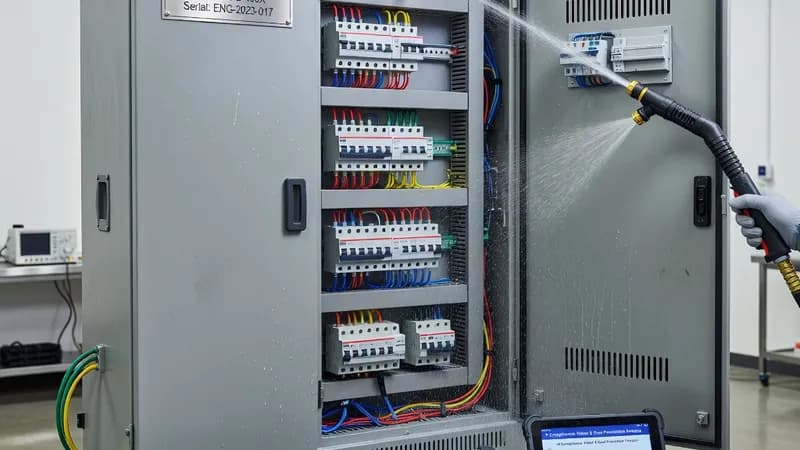
Main Distribution Board (MDB) assemblies designed for IP Protection Ratings compliance must be engineered as complete, verified enclosures, not as a simple enclosure accessory upgrade. For low-voltage switchgear and controlgear assemblies, the relevant framework is IEC 61439-1 and IEC 61439-2, with the enclosure degree of protection evaluated according to IEC 60529. In practical terms, an MDB may be specified at IP31, IP42, IP54, IP55, IP65, or higher depending on the installation environment, exposure to dust, washdown, condensation, or outdoor service. Compliance is achieved through coordinated design of enclosure panels, doors, gaskets, cable entry systems, ventilation devices, internal segregation, and mounting hardware so that the final assembly maintains its declared protection level throughout its service life. Design verification for an IP-rated MDB includes checks for accessibility to live parts, integrity of sealing surfaces, door locking arrangements, gland plate interface quality, and resistance to mechanical impacts that could compromise the protection index. Where the assembly includes ACBs, MCCBs, feeder pillars, busbar chambers, metering sections, protection relays, or motor control sections with VFDs and soft starters, the enclosure must preserve the declared IP rating while also maintaining thermal performance and serviceability. Higher enclosure protection often requires trade-offs with heat dissipation, so engineers may incorporate filtered forced ventilation, labyrinth air paths, heat exchangers, or climate control devices, but each option must be assessed so it does not reduce the certified IP level. Internal segregation in accordance with IEC 61439 forms of separation, such as Form 2, Form 3, and Form 4 arrangements, must be compatible with the sealing strategy and cable compartment layout. Testing typically includes verification for dust ingress and water ingress using the methods defined by IEC 60529. Depending on the declared rating, the assembly may undergo dust-protected or dust-tight tests, dripping water tests, hose-down tests, or temporary immersion tests. In addition to the IP verification, the MDB still has to satisfy the electrical performance requirements of IEC 61439, including temperature rise, dielectric properties, short-circuit withstand strength, and clearances and creepage distances. This is especially important where the board is rated for currents from 250 A up to 6300 A and short-circuit levels such as 25 kA, 36 kA, 50 kA, 65 kA, or 100 kA for 1 second, depending on the application and protective devices used. For outdoor substations, utility intake rooms, process plants, and water treatment facilities, MDBs with high IP ratings are commonly required to protect against dust, rain, high-pressure washdown, and corrosive atmospheres. Where the installation is in hazardous areas or near explosive dust zones, enclosure selection must also be evaluated with IEC 60079 requirements where applicable. In addition, panels installed near industrial combustion or battery rooms may need supplementary consideration against internal fault effects per IEC 61641. Patrion manufactures MDB assemblies in Turkey with design verification, documentation packs, and certification support available on request, enabling EPC contractors, panel builders, and facility owners to align their project deliverables with the required IP classification and IEC compliance path. A robust compliance package should include declared IP rating, test reports, type test or design verification references, bill of materials, gasket and enclosure specifications, cable gland compatibility data, and maintenance instructions. Since IP performance can be degraded by field modifications, periodic inspection of door seals, gland entries, corrosion protection, fastener torque, and paint integrity is essential to preserve the original compliance level after installation and throughout the asset lifecycle.
Key Features
- IP Protection Ratings compliance pathway for Main Distribution Board (MDB)
- Design verification and testing requirements
- Documentation and certification procedures
- Component selection for standard compliance
- Ongoing compliance maintenance and re-certification
Specifications
| Property | Value |
|---|---|
| Panel Type | Main Distribution Board (MDB) |
| Standard | IP Protection Ratings |
| Compliance | Design verified |
| Certification | Available on request |
Other Standards for Main Distribution Board (MDB)
Power switchgear and controlgear assemblies — main compliance standard
North American switchboard safety standards
Internal arc classification and containment
Earthquake resistance verification for critical facilities
Other Panels Certified to IP Protection Ratings
Automatic capacitor switching for reactive power compensation. Thyristor or contactor-switched, detuned or standard configurations.
Enclosed VFD assemblies with input protection, line reactors, EMC filters, output reactors, and bypass options.
Energy metering, power quality analysis, and multi-circuit monitoring with communication gateways.
Final distribution for lighting and small power. MCB/RCBO-based with DALI or KNX integration options.
Prefabricated busbar distribution per IEC 61439-6. Sandwich or air-insulated, aluminum or copper.
Process and machine control panels housing PLCs, I/O modules, relays, HMIs, and communication infrastructure.
Bespoke panel assemblies for non-standard requirements — special ratings, unusual form factors, multi-function combinations.
Enclosed soft starter assemblies for reduced voltage motor starting with torque control, ramp-up/down profiles, and bypass contactor options.
Active or passive harmonic filtering to mitigate THD from non-linear loads. Tuned LC filters, active filters, or hybrid configurations.
DC power distribution for battery systems, solar installations, telecom, and UPS applications. MCCB/fuse-based DC protection.
Fixed or automatic capacitor bank assemblies for bulk reactive power compensation in industrial and utility applications.
Frequently Asked Questions
Ready to Engineer Your Next Panel?
Our team of electrical engineers is ready to design, build, and deliver your custom panel solution — fully compliant with international standards.