MCC Panels

Main Distribution Board (MDB) — Seismic Qualification (IEEE 693/IBC)

Seismic Qualification (IEEE 693/IBC) compliance requirements, testing procedures, and design considerations for Main Distribution Board (MDB) assemblies.
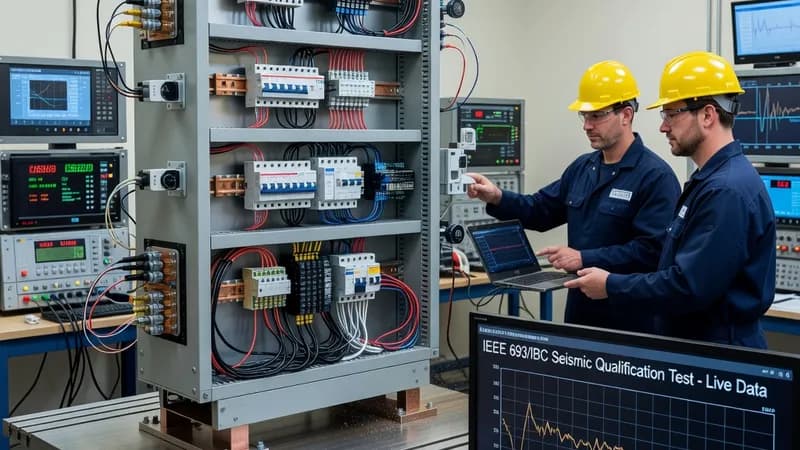
Main Distribution Board (MDB) — Seismic Qualification (IEEE 693/IBC)

Overview

Seismic Qualification for Main Distribution Board (MDB) assemblies under IEEE 693 and the International Building Code (IBC) is a design-and-verification discipline aimed at keeping critical power distribution operational after an earthquake. For EPC contractors, panel builders, and facility owners, the compliance objective is not only to prevent catastrophic failure, but also to preserve continuity of service for hospitals, data centers, airports, utilities, refineries, and emergency response facilities. A compliant MDB must be engineered as a robust assembly, with verified mechanical anchoring, busbar bracing, enclosure integrity, component retention, and cable termination stability under defined seismic spectra and installation conditions. IEEE 693 establishes performance requirements for electrical equipment subjected to earthquake motion, typically using high, moderate, or low performance levels depending on mission criticality. For MDBs, the practical pathway usually combines design review, analytical evaluation, and prototype or representative qualification testing. The assembly must demonstrate that main busbars, neutral bars, earthing conductors, ACBs, MCCBs, feeder breakers, shunt trips, protection relays, metering devices, contactors, terminal blocks, and control wiring remain intact and functional after seismic input. In many projects, the design verification package also references IEC 61439-1 and IEC 61439-2 for assembly construction, temperature rise, dielectric performance, short-circuit withstand, and internal separation. Where the MDB feeds life-safety systems or critical infrastructure, coordination with IEC 61439-6 for busbar trunking interfaces and IEC 60947 device ratings is often required. A properly qualified MDB should define its short-circuit rating, rated operational current, and form of internal separation, such as Form 2b, Form 3b, or Form 4, without relying on field improvisation. Seismic performance depends heavily on the stiffness of the chassis, cabinet thickness, mounting base, and the use of anti-vibration hardware, thread-locking systems, and mechanical stops for withdrawable units or drawer-mounted auxiliaries. Large incomers with ACBs, often rated from 630 A to 6300 A, require reinforced support frames and busbar restraints to prevent phase-to-phase displacement. Feeder sections using MCCBs, contactor starters, VFD incomers, soft starters, and protection relays must be arranged so their mass distribution does not amplify resonant response. In outdoor or industrial installations, the assembly may also need environmental robustness aligned with IEC 61439-3 or enclosure requirements that support the project’s IP rating. Testing and certification commonly involve shaker-table qualification, structural calculations, and witness documentation showing the exact configuration, component part numbers, mounting geometry, and tightening torques used during evaluation. Any deviation from the tested design, such as a different breaker frame, busbar cross-section, cable entry arrangement, or foundation bolt pattern, may require re-verification. For projects in hazardous areas or severe industrial settings, related compliance considerations may include IEC 60079 for explosive atmospheres and IEC 61641 for arc fault containment, because seismic design must not compromise arc resilience or enclosure integrity. For the end user, compliance is not a one-time document. Ongoing maintenance should include inspection of anchorage, torque checks, busbar supports, relay settings, and replacement of damaged anti-seismic components after modification, transport, or site events. Patrion designs and manufactures MDB assemblies in Turkey with engineering documentation tailored to seismic qualification pathways, supporting project-specific evidence packages, design verification records, and certification on request for critical power distribution applications.

Key Features

  • Seismic Qualification (IEEE 693/IBC) compliance pathway for Main Distribution Board (MDB)
  • Design verification and testing requirements
  • Documentation and certification procedures
  • Component selection for standard compliance
  • Ongoing compliance maintenance and re-certification

Specifications

PropertyValue
Panel TypeMain Distribution Board (MDB)
StandardSeismic Qualification (IEEE 693/IBC)
ComplianceDesign verified
CertificationAvailable on request

Other Standards for Main Distribution Board (MDB)

Other Panels Certified to Seismic Qualification (IEEE 693/IBC)

Frequently Asked Questions

Qualification normally requires a defined seismic performance level, a documented mounting and anchorage design, and evidence that the complete MDB assembly can withstand the required earthquake demand without loss of structural integrity or critical function. For MDBs, the qualification package usually includes the enclosure, busbars, ACBs or MCCBs, protection relays, control wiring, and all internal supports. IEEE 693 is commonly used for utility and critical infrastructure equipment, while the IBC drives building code acceptance for installations. In practice, compliance is demonstrated through analysis, shake-table testing, or a combination of both, with test evidence tied to the exact construction details. Any later change in breaker type, busbar layout, or baseframe design may require re-verification before the MDB can still be claimed as compliant.
No. Seismic qualification complements, but does not replace, IEC 61439 verification. The MDB must still satisfy IEC 61439-1 and IEC 61439-2 requirements for temperature rise, dielectric properties, short-circuit withstand, clearances, creepage, and internal separation. Seismic testing or analysis adds another layer that proves the assembly can survive earthquake motion while maintaining the performance already established under IEC 61439. If the MDB includes busbar trunking interfaces, IEC 61439-6 may also apply. Component devices should remain compliant with IEC 60947 ratings. In a proper compliance pathway, the seismic report references the base IEC design verification, then validates that anchorage, supports, doors, and internal components remain secure under the target seismic input.
The most critical items are the busbar system, breaker mounting, anchorage points, and any heavy auxiliary devices. Large ACBs, especially incomers rated from 1600 A to 6300 A, create significant dynamic loads and must be restrained with reinforced supports. MCCBs, contactors, VFDs, soft starters, and protection relays are also important because their terminals and wiring can fail if they are not mechanically secured. Terminal blocks, cable glands, gland plates, and neutral/earth bars must remain intact as well. Seismic testing should also verify door latches, hinges, locks, and any withdrawable or plug-in elements. The final goal is that the MDB remains electrically safe, mechanically stable, and capable of maintaining intended function after the seismic event.
No, a standard IEC 61439 MDB is not automatically seismic compliant. IEC 61439 verifies electrical assembly performance under normal service conditions, but seismic qualification requires additional evidence that the assembly can tolerate earthquake acceleration, displacement, and vibration. A non-qualified MDB may perform well electrically and still fail structurally under seismic loading. To claim compliance with IEEE 693 or IBC, the MDB needs either a tested seismic design or a validated engineering assessment for the exact configuration installed. This includes the enclosure size, component mass, mounting hardware, anchor bolt pattern, floor interface, and internal bracing. If any of those elements differ from the qualified design, the claim may no longer be valid.
Typical documentation includes general arrangement drawings, bill of materials, component datasheets, busbar calculations, anchorage details, torque specifications, and the seismic analysis or test report. For certified projects, the evidence package should identify the exact MDB configuration, including ACB and MCCB frame sizes, protection relay models, support brackets, and enclosure dimensions. It should also show the seismic performance level, installation orientation, and foundation assumptions. If the MDB is part of a larger critical power system, the package may include coordination studies, short-circuit calculations, and maintenance instructions. For owner or authority review, traceability is essential: the delivered assembly must match the qualified design, or the certification may be challenged.
Anchorage quality is usually the single most important factor, followed by floor flatness, baseframe stiffness, and cable entry restraint. Even a well-designed MDB can underperform if anchor bolts are undersized, poorly torqued, or installed into an unsuitable slab. Cable bending forces must also be controlled so they do not transfer excessive load to the enclosure or breaker terminals. Inside the MDB, heavy devices should be positioned to minimize top-heaviness and resonance, while busbar supports should be spaced and reinforced for the expected seismic spectrum. Door hardware, gland plates, and removable covers must be secured so they do not detach during shaking. A qualified design still depends on correct site installation.
Re-verification is typically required whenever the assembly is modified in a way that could affect its structural or functional performance. Examples include changing breaker frame sizes, altering busbar arrangements, adding VFDs or other heavy devices, relocating cable entries, changing the foundation or anchor pattern, or replacing the enclosure with a different model. Routine maintenance does not usually trigger full requalification, but torque checks, visual inspections, and condition assessments should be performed periodically. After an earthquake, impact event, or major retrofit, the MDB should be inspected before being returned to service. For critical facilities, owners often require a formal re-evaluation at defined intervals as part of asset management.
Seismic-qualified MDBs are commonly specified for hospitals, data centers, airports, oil and gas facilities, water treatment plants, emergency operations centers, utilities, and transportation infrastructure. These sites cannot afford extended outages after seismic events, so the distribution system must remain safe and operable. The MDB often serves essential loads, standby generators, UPS systems, fire pumps, process equipment, or life-safety circuits. In these applications, the panel is usually engineered together with selective coordination studies, short-circuit verification, and mechanical anchorage details. When the project also involves harsh or special environments, related standards such as IEC 60079 for hazardous areas and IEC 61641 for arc fault containment may be considered alongside the seismic compliance pathway.

Ready to Engineer Your Next Panel?

Our team of electrical engineers is ready to design, build, and deliver your custom panel solution — fully compliant with international standards.