Main Distribution Board (MDB) — IEC 61439-2 (PSC)
IEC 61439-2 (PSC) compliance requirements, testing procedures, and design considerations for Main Distribution Board (MDB) assemblies.
Overview
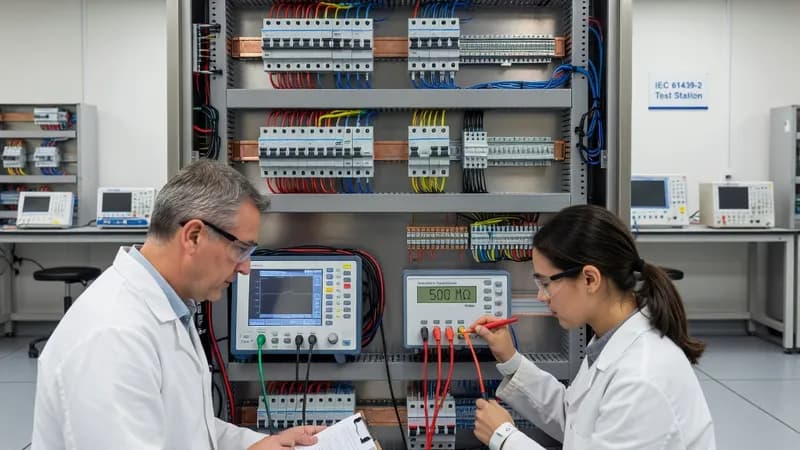
A Main Distribution Board (MDB) designed to IEC 61439-2 is a power switchgear and controlgear assembly (PSC assembly) intended to receive an incoming utility or generator supply and distribute power to downstream switchboards, MCCs, capacitor banks, ATS panels, UPS incomers, and critical process loads. For electrical engineers and EPC contractors, the key compliance issue is not only the selection of reputable components, but the verified performance of the complete assembly under defined service conditions. Typical MDB architectures use ACBs for incomers and bus couplers, high-frame MCCBs for sub-incomers and outgoing feeders, and auxiliary devices such as multifunction meters, protection relays, CTs, shunt releases, motor operators, surge protection devices, and control transformers. Depending on project duty, assemblies are often specified for rated currents from 800 A up to 6300 A, with short-circuit withstand ratings commonly in the range of 25 kA, 36 kA, 50 kA, 65 kA, 85 kA, or 100 kA for 1 second or 3 seconds, subject to the declared conditional ratings and upstream protection coordination. IEC 61439-2 must be applied together with IEC 61439-1, which defines the general rules and design verification framework. Compliance requires design verification by test, comparison with a verified reference design, calculation, or a combination of these methods. The verification package must demonstrate temperature-rise performance, dielectric strength, short-circuit withstand strength, protective circuit continuity, clearances and creepage distances, mechanical operation, and degree of protection. In practical MDB engineering, this means validating busbar cross-section and support spacing, cabinet thermal performance, cable compartment segregation, device mounting plate rigidity, and the impact of ventilation or forced cooling on conductor heating. If the MDB includes sections with form of internal separation, such as Form 2, Form 3b, Form 4a, or Form 4b, the partitioning strategy must be matched to the maintenance philosophy and fault containment requirements of the facility. Component selection must also respect IEC 60947, especially for ACBs, MCCBs, contactors, disconnectors, and motor starters used within the MDB. For feeder circuits supplying VFDs, soft starters, or harmonic mitigation equipment, the designer must consider harmonic current, inrush, overload coordination, and the possibility of derating busbars or neutral conductors. Protection relays and meters should be integrated with CT ratios, communication gateways, and alarm functions without compromising the assembly’s verified thermal and dielectric behavior. Where required by the project, arc fault studies and containment measures may reference IEC 61641, while hazardous-area interfaces may require consideration of IEC 60079. If the MDB connects to busbar trunking systems, IEC 61439-6 may be relevant at the interface point. Routine verification on every manufactured MDB typically includes visual inspection, wiring continuity, protective conductor continuity, functional checks, insulation resistance measurement, dielectric tests where applicable, torque verification, and confirmation of nameplate data against the technical file. A compliant technical file normally contains schematic drawings, GA drawings, busbar calculations, heat dissipation data, short-circuit evidence, device datasheets, test reports, risk assessments, and a declaration of conformity. For project handover, certification may be supplied on request together with routine test records and design verification evidence. Because any change in enclosure dimensions, busbar routing, breaker series, ventilation, or internal separation can invalidate the original verification, compliance must be maintained through controlled engineering change management and re-verification. In industrial plants, hospitals, commercial towers, data centers, wastewater facilities, and infrastructure substations, a PSC-compliant MDB provides the backbone of safe and selective low-voltage distribution. Patrion, based in Turkey, supports panel builders and project teams with IEC 61439-2 MDB engineering, design verification support, compliant manufacturing, and documentation packages tailored to real-world power distribution duties.
Key Features
- IEC 61439-2 (PSC) compliance pathway for Main Distribution Board (MDB)
- Design verification and testing requirements
- Documentation and certification procedures
- Component selection for standard compliance
- Ongoing compliance maintenance and re-certification
Specifications
| Property | Value |
|---|---|
| Panel Type | Main Distribution Board (MDB) |
| Standard | IEC 61439-2 (PSC) |
| Compliance | Design verified |
| Certification | Available on request |
Other Standards for Main Distribution Board (MDB)
Other Panels Certified to IEC 61439-2 (PSC)
High-capacity power distribution for industrial facilities. Controls and distributes incoming power to MCC, APFC, and downstream loads.
Centralized motor control with starters, contactors, overloads, and VFDs in standardized withdrawable/fixed functional units.
Automatic capacitor switching for reactive power compensation. Thyristor or contactor-switched, detuned or standard configurations.
Automatic changeover between mains and generator/UPS. Open or closed transition, with or without bypass.
Enclosed VFD assemblies with input protection, line reactors, EMC filters, output reactors, and bypass options.
Genset start/stop sequencing, synchronization, load sharing, and paralleling controls.
Energy metering, power quality analysis, and multi-circuit monitoring with communication gateways.
Process and machine control panels housing PLCs, I/O modules, relays, HMIs, and communication infrastructure.
Bespoke panel assemblies for non-standard requirements — special ratings, unusual form factors, multi-function combinations.
Enclosed soft starter assemblies for reduced voltage motor starting with torque control, ramp-up/down profiles, and bypass contactor options.
Active or passive harmonic filtering to mitigate THD from non-linear loads. Tuned LC filters, active filters, or hybrid configurations.
DC power distribution for battery systems, solar installations, telecom, and UPS applications. MCCB/fuse-based DC protection.
Fixed or automatic capacitor bank assemblies for bulk reactive power compensation in industrial and utility applications.
Frequently Asked Questions
Ready to Engineer Your Next Panel?
Our team of electrical engineers is ready to design, build, and deliver your custom panel solution — fully compliant with international standards.