Main Distribution Board (MDB) — UL 891 / CSA C22.2
UL 891 / CSA C22.2 compliance requirements, testing procedures, and design considerations for Main Distribution Board (MDB) assemblies.
Overview
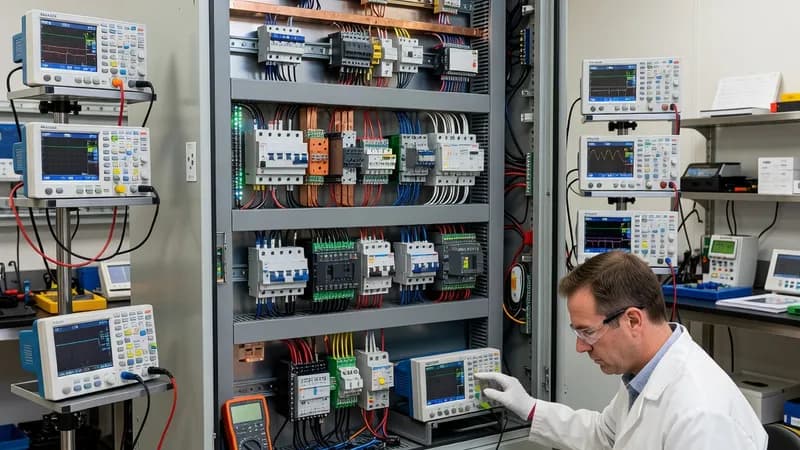
Main Distribution Board (MDB) assemblies built for UL 891 and CSA C22.2 compliance must be engineered as complete, tested low-voltage switchboard systems rather than as a collection of individual components. For panel builders, EPC contractors, and facility owners operating in North America, the compliance pathway typically begins with a defined lineup architecture, a verified busbar system, and a documented short-circuit and temperature-rise performance basis. In practical terms, the MDB may incorporate molded-case circuit breakers (MCCBs), insulated-case circuit breakers (ICCBs), power circuit breakers, meter sections, feeder compartments, and main incomer sections rated for service currents from a few hundred amperes up to several thousand amperes depending on the design and enclosure construction. UL 891 governs switchboards for use in ordinary locations and places strong emphasis on construction integrity, spacing, internal wiring methods, creepage and clearance control, grounding continuity, and accessibility for live parts. CSA C22.2 requirements align closely in concept but introduce Canadian certification and marking expectations that must be addressed in the fabrication and documentation package. A compliant MDB must be designed so that the bus system, supports, insulation barriers, and enclosure withstand the declared short-circuit current rating without unacceptable deformation, flashover, or loss of functionality. The available SCCR or short-circuit withstand rating must be established using tested combinations or approved component pairings, and the final nameplate data must reflect the lowest-rated series element in the assembly. Compliance verification generally includes dielectric withstand testing, temperature-rise evaluation, mechanical endurance checks on operating mechanisms, wiring insulation assessment, and verification of protective bonding. For larger assemblies, thermal performance becomes critical when the board includes densely packed feeders, transformer feeders, surge protective devices, power metering, communication gateways, or PLC interfaces. Cable compartments, busbar chamber segregation, and ventilation strategy must support continuous operation at the declared ambient conditions without violating UL 891 construction limits. When lineups include VFDs, soft starters, or motor control sections, the engineer must confirm whether these loads belong in the MDB or require segregation into a companion MCC or dedicated power control center to preserve compliance and maintainability. Real-world MDB applications include utility service entrances, data centers, hospitals, manufacturing plants, commercial high-rises, water treatment facilities, and infrastructure projects where selective coordination and reliable feeder distribution are essential. A robust compliance package typically includes construction drawings, electrical schematics, component certificates, bill of materials, SCCR calculations, torque and wiring records, routine test reports, and a final inspection file for the certifying agency. Ongoing compliance maintenance is equally important: any substitution of breakers, bus supports, wire types, terminals, or enclosure hardware can invalidate the original certification basis unless re-evaluated under the applicable UL and CSA procedures. Patrion supports MDB development with engineering review, panel fabrication, and documentation control for UL 891 / CSA C22.2 compliant assemblies, helping owners and contractors reduce certification risk and accelerate project approval. For projects requiring verified switchboard compliance, contact our engineering team for a quotation and design review.
Key Features
- UL 891 / CSA C22.2 compliance pathway for Main Distribution Board (MDB)
- Design verification and testing requirements
- Documentation and certification procedures
- Component selection for standard compliance
- Ongoing compliance maintenance and re-certification
Specifications
| Property | Value |
|---|---|
| Panel Type | Main Distribution Board (MDB) |
| Standard | UL 891 / CSA C22.2 |
| Compliance | Design verified |
| Certification | Available on request |
Other Standards for Main Distribution Board (MDB)
Power switchgear and controlgear assemblies — main compliance standard
Ingress protection classification (IP30–IP65+)
Internal arc classification and containment
Earthquake resistance verification for critical facilities
Other Panels Certified to UL 891 / CSA C22.2
High-capacity power distribution for industrial facilities. Controls and distributes incoming power to MCC, APFC, and downstream loads.
Centralized motor control with starters, contactors, overloads, and VFDs in standardized withdrawable/fixed functional units.
Automatic capacitor switching for reactive power compensation. Thyristor or contactor-switched, detuned or standard configurations.
Automatic changeover between mains and generator/UPS. Open or closed transition, with or without bypass.
Genset start/stop sequencing, synchronization, load sharing, and paralleling controls.
Final distribution for lighting and small power. MCB/RCBO-based with DALI or KNX integration options.
Bespoke panel assemblies for non-standard requirements — special ratings, unusual form factors, multi-function combinations.
DC power distribution for battery systems, solar installations, telecom, and UPS applications. MCCB/fuse-based DC protection.
Fixed or automatic capacitor bank assemblies for bulk reactive power compensation in industrial and utility applications.
Frequently Asked Questions
Ready to Engineer Your Next Panel?
Our team of electrical engineers is ready to design, build, and deliver your custom panel solution — fully compliant with international standards.