Main Distribution Board (MDB) — Arc Flash Protection (IEC 61641)
Arc Flash Protection (IEC 61641) compliance requirements, testing procedures, and design considerations for Main Distribution Board (MDB) assemblies.
Overview
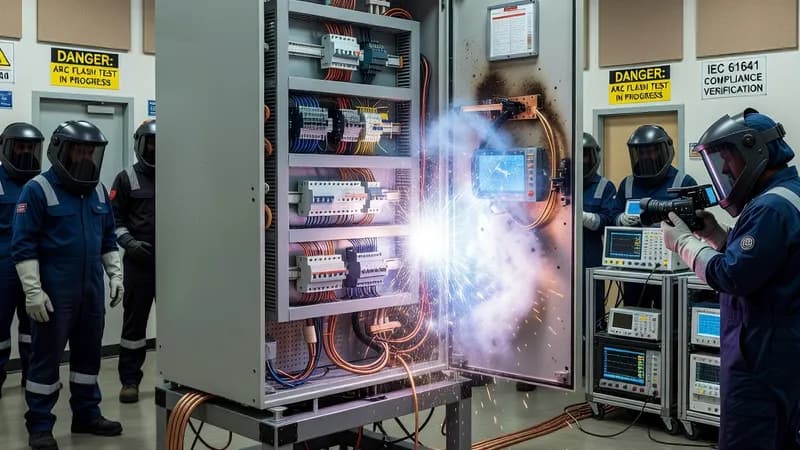
Main Distribution Board (MDB) assemblies designed for Arc Flash Protection under IEC 61641 are intended to limit the hazard to personnel during internal arc faults by controlling pressure relief, thermal effects, and the projection of hot gases and molten particles. For panel builders, EPC contractors, and facility owners, compliance is not a marketing statement but a verified design and test outcome that must align with the declared service conditions, fault levels, and installation environment. In practical terms, an MDB often combines incomer ACBs, outgoing MCCBs, motor feeders, metering blocks, protection relays, busbar systems, and auxiliary control wiring in a metal-enclosed form, and the internal arc performance must be assessed as part of the complete assembly, not just individual devices. IEC 61641 defines the test methods and acceptance criteria for low-voltage switchgear and controlgear assemblies under internal arc conditions. Typical verification covers the enclosure’s ability to withstand and contain an arc without hazardous opening of doors or covers, ejection of fragments, ignition of accessible indicators, or sustained flame propagation outside the enclosure. The standard requires defined test arrangements, electrode positions, prospective fault current, duration, accessibility category, and installation of arc relief channels or flaps where applicable. For MDBs, the design must also consider form of separation per IEC 61439-2, busbar arrangement, feeder compartment partitioning, and the mechanical integrity of door locking and pressure venting systems. Where the assembly includes VFDs, soft starters, multifunction meters, or communication modules, their placement must not compromise arc containment or venting paths. Compliance typically starts with a design-verified configuration using IEC 61439-1/2 rules for temperature rise, dielectric properties, short-circuit withstand strength, clearances, creepage distances, and protective circuit continuity. The declared short-circuit rating of the MDB must match the tested or verified arc containment concept, often in systems with busbar ratings from 630 A to 6300 A and prospective fault levels that may exceed 50 kA for 1 s, depending on site studies. Arc flash mitigation can be improved through arc-resistant compartmentalization, remote racking, arc detection relays, zone selective interlocking, current-limiting MCCBs or fuses, and properly coordinated incomer protection settings. Verification and certification typically require documented test reports, routine inspection records, type-tested or design-verified evidence, and a technical file identifying the exact assembly variants covered. In many projects, clients also request alignment with IEC 61439-6 for busbar trunking interfaces, IEC 60947 device coordination, and IEC 61641 internal arc performance classification for the accessible sides of the MDB. For special environments, additional considerations may apply under IEC 60079 for explosive atmospheres or IEC 61641 supplementary containment measures where installed near critical processes. Patrion’s MDB engineering approach focuses on compliant enclosure design, partition strategy, device selection, and evidence-based documentation for procurement and commissioning. This includes arc-rated layouts, verified cable entry and gland plate design, pressure relief path planning, and maintenance procedures that preserve the original certification status over the equipment lifecycle. For industrial plants, utilities, data centers, hospitals, water treatment facilities, and large commercial complexes, IEC 61641-compliant MDBs provide a structured pathway to reduce arc flash risk while maintaining selective power distribution, operational continuity, and inspectable compliance documentation.
Key Features
- Arc Flash Protection (IEC 61641) compliance pathway for Main Distribution Board (MDB)
- Design verification and testing requirements
- Documentation and certification procedures
- Component selection for standard compliance
- Ongoing compliance maintenance and re-certification
Specifications
| Property | Value |
|---|---|
| Panel Type | Main Distribution Board (MDB) |
| Standard | Arc Flash Protection (IEC 61641) |
| Compliance | Design verified |
| Certification | Available on request |
Other Standards for Main Distribution Board (MDB)
Power switchgear and controlgear assemblies — main compliance standard
North American switchboard safety standards
Ingress protection classification (IP30–IP65+)
Earthquake resistance verification for critical facilities
Other Panels Certified to Arc Flash Protection (IEC 61641)
High-capacity power distribution for industrial facilities. Controls and distributes incoming power to MCC, APFC, and downstream loads.
Centralized motor control with starters, contactors, overloads, and VFDs in standardized withdrawable/fixed functional units.
Automatic changeover between mains and generator/UPS. Open or closed transition, with or without bypass.
Prefabricated busbar distribution per IEC 61439-6. Sandwich or air-insulated, aluminum or copper.
Bespoke panel assemblies for non-standard requirements — special ratings, unusual form factors, multi-function combinations.
Frequently Asked Questions
Ready to Engineer Your Next Panel?
Our team of electrical engineers is ready to design, build, and deliver your custom panel solution — fully compliant with international standards.