PLC & Automation Control Panel
Process and machine control panels housing PLCs, I/O modules, relays, HMIs, and communication infrastructure.
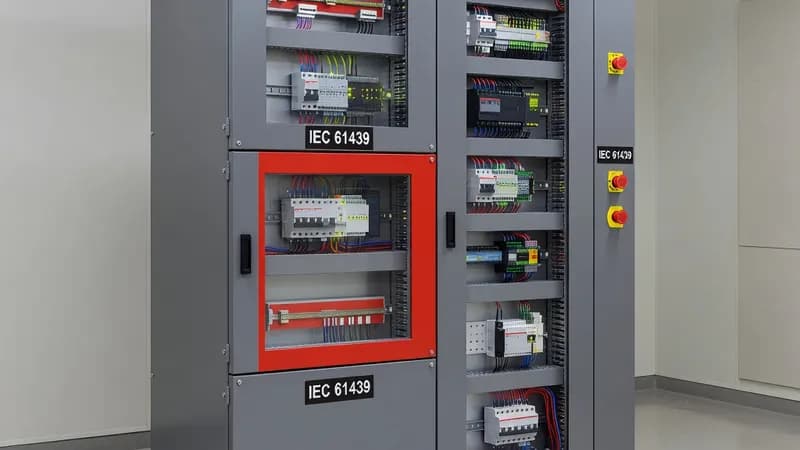
A PLC & Automation Control Panel is a low-voltage power and control assembly built to IEC 61439-2 for process automation, machine control, and distributed I/O supervision in industrial plants. It typically integrates PLC CPU racks, remote I/O modules, safety relays, interposing relays, signal conditioning devices, 24 VDC power supplies, UPS modules, managed Ethernet switches, HMI/SCADA interfaces, and auxiliary distribution using MCBs, MCCBs, and control contactors. Where motor control is required, the panel may also include soft starters, VFDs, and motor protection relays, often coordinated with overload relays and contactors in accordance with IEC 60947-4-1 and IEC 60947-2. Designing the enclosure as an IEC 61439 assembly requires verification of temperature rise, dielectric properties, short-circuit withstand strength, and clearances/creepage appropriate to the rated voltage and pollution degree. Typical panel busbar ratings range from 63 A for compact machine panels to 1600 A or more for larger distributed automation switchboards, with prospective short-circuit ratings commonly specified from 25 kA to 50 kA for industrial systems, and higher where upstream fault levels demand it. Internal separation may be implemented as Form 1, Form 2, Form 3, or Form 4 in line with IEC 61439-1/2, depending on maintainability, service continuity, and functional segregation requirements. Form 3b or Form 4b arrangements are often selected where PLC, safety, and motor-control sections must remain isolated during maintenance. EMC performance is critical because automation panels contain sensitive electronics, high-frequency drives, and communication networks. Good practice includes segregated wiring ducts, shield termination at the correct entry points, equipotential bonding, screened motor and encoder cables, and filtered power supplies to limit conducted and radiated disturbances under IEC 61000 requirements. In hazardous areas, the panel may require ATEX/IECEx-compatible design considerations, certified components, and correct segregation of intrinsically safe circuits, with enclosures and accessories selected to the application risk profile. For marine, offshore, or corrosive environments, stainless steel or coated mild-steel enclosures with IP54 to IP66 protection are common, and additional vibration resistance may be necessary. Real-world applications include packaging lines, conveyor automation, batching systems, water treatment plants, pump stations, wind turbine auxiliaries, HVAC plants, and process skids in oil and gas and pharmaceuticals. In these installations, the PLC panel acts as the communication and control hub, exchanging data via PROFINET, EtherNet/IP, Modbus TCP, PROFIBUS, or industrial Ethernet to drives, field instruments, and supervisory systems. Proper thermal design, internal layout, and wire management are essential to ensure long-term reliability, especially where VFD heat dissipation, 24/7 duty cycles, and mission-critical uptime are involved. IEC 61439 verification, combined with IEC 60204-1 machine wiring practices where applicable, ensures the assembly is robust, maintainable, and suitable for demanding automation environments.
Components for This Panel
PLCs & I/O Modules selection, integration, and best practices for PLC & Automation Control Panel assemblies compliant with IEC 61439.
HMI & SCADA Systems selection, integration, and best practices for PLC & Automation Control Panel assemblies compliant with IEC 61439.
Protection Relays selection, integration, and best practices for PLC & Automation Control Panel assemblies compliant with IEC 61439.
Contactors & Motor Starters selection, integration, and best practices for PLC & Automation Control Panel assemblies compliant with IEC 61439.
Moulded Case Circuit Breakers (MCCB) selection, integration, and best practices for PLC & Automation Control Panel assemblies compliant with IEC 61439.
Applicable Standards
IEC 61439-2 (PSC) compliance requirements, testing procedures, and design considerations for PLC & Automation Control Panel assemblies.
EMC Compliance (IEC 61000) compliance requirements, testing procedures, and design considerations for PLC & Automation Control Panel assemblies.
ATEX / IECEx Certification compliance requirements, testing procedures, and design considerations for PLC & Automation Control Panel assemblies.
IP Protection Ratings compliance requirements, testing procedures, and design considerations for PLC & Automation Control Panel assemblies.
Industries Using This Panel
PLC & Automation Control Panel assemblies engineered for Industrial Manufacturing applications, addressing industry-specific requirements and compliance standards.
PLC & Automation Control Panel assemblies engineered for Oil & Gas applications, addressing industry-specific requirements and compliance standards.
PLC & Automation Control Panel assemblies engineered for Water & Wastewater applications, addressing industry-specific requirements and compliance standards.
PLC & Automation Control Panel assemblies engineered for Renewable Energy applications, addressing industry-specific requirements and compliance standards.
PLC & Automation Control Panel assemblies engineered for Marine & Offshore applications, addressing industry-specific requirements and compliance standards.
PLC & Automation Control Panel assemblies engineered for Food & Beverage applications, addressing industry-specific requirements and compliance standards.
PLC & Automation Control Panel assemblies engineered for Pharmaceuticals applications, addressing industry-specific requirements and compliance standards.
Related Knowledge Articles
Connecting panels to cloud and IIoT platforms.
Optimizing panel layouts for operation and maintenance.
Implementing intelligent panel monitoring and energy optimization.
Comprehensive overview of all IEC 61439 parts, their scope, and how they apply to different panel types.
Frequently Asked Questions
Ready to Engineer Your Next Panel?
Our team of electrical engineers is ready to design, build, and deliver your custom panel solution — fully compliant with international standards.