PLC & Automation Control Panel for Industrial Manufacturing
PLC & Automation Control Panel assemblies engineered for Industrial Manufacturing applications, addressing industry-specific requirements and compliance standards.
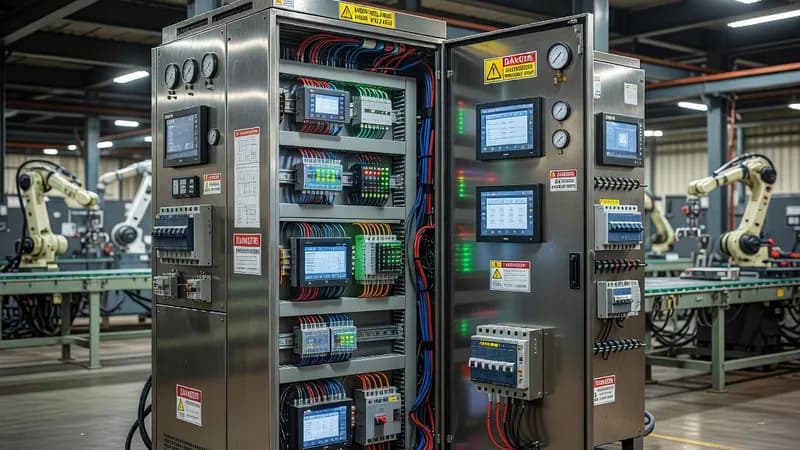
Overview
PLC & Automation Control Panel assemblies for industrial manufacturing are the backbone of machine control, process sequencing, and plant-wide integration across discrete and continuous production lines. Designed under IEC 61439-2 as low-voltage switchgear and controlgear assemblies, these panels are typically built around PLCs, remote I/O, industrial Ethernet switches, HMI terminals, safety relays, and 24 VDC power supplies, with coordination to MCCB, MCB, and fused protection devices for feeder and branch circuits. Where motor control is required, the assembly may include DOL starters, reversing starters, star-delta starters, soft starters, VFDs, and feeder MCCs for conveyors, pumps, compressors, mixers, extruders, packaging machines, and robotics cells. Depending on the plant architecture, integration with power distribution can extend to ACB incomers, busbar trunking, APFC banks, and harmonic mitigation systems to maintain power quality and reduce nuisance tripping. Industrial manufacturing environments impose demanding conditions on enclosure selection, wiring practices, and thermal design. Panels are commonly specified to IP54, IP55, or higher, with corrosion-resistant powder-coated steel or stainless-steel enclosures where washdown, oil mist, dust, or coolant vapors are present. Internal separation forms in accordance with IEC 61439-2 are selected to improve maintainability and reduce fault propagation, typically Form 1, Form 2, Form 3b, or Form 4a/4b depending on accessibility and segregation requirements. Thermal management is critical when VFDs, servo drives, and 24/7 PLC loads are installed; engineers may use forced ventilation, air-to-air heat exchangers, panel coolers, or NEMA-style climate control packages to keep internal temperatures within component derating limits. Compliance is driven not only by IEC 61439-1 and 61439-2, but also by the product standards governing the installed devices, including IEC 60947 for breakers, contactors, motor starters, and switching devices. In hazardous or dusty process areas, additional design considerations may reference IEC 60079 for explosive atmospheres and IEC 61641 for arc-fault containment testing where applicable. Short-circuit withstand ratings must be verified at assembly level, commonly at 25 kA, 36 kA, 50 kA, or higher depending on the prospective fault level, with conditional short-circuit current ratings defined by the selected protective devices and busbar system. Functional safety requirements may also influence the use of safety PLCs, dual-channel E-stops, light curtain interfaces, and category-rated safety circuits. Typical industrial manufacturing automation panels are configured as standalone machine control cabinets, multi-line process skids, or centralized line-control panels. They often include ethernet/IP, Profinet, Modbus TCP, or OPC UA communications for SCADA and MES integration, enabling real-time monitoring, recipe management, traceability, and predictive maintenance. For EPC contractors and plant owners, the most important engineering outputs are a robust bill of materials, verified heat rise performance, coordinated protection, wiring diagrams, terminal schedules, and FAT-ready documentation. When correctly engineered, PLC & Automation Control Panel assemblies reduce downtime, improve throughput, and provide scalable control architecture for modern manufacturing facilities.
Key Features
- PLC & Automation Control Panel configured for Industrial Manufacturing requirements
- Industry-specific environmental ratings and protections
- Compliance with sector-specific standards and regulations
- Optimized component selection for industry applications
- Integration with industry-standard control and monitoring systems
Specifications
| Property | Value |
|---|---|
| Panel Type | PLC & Automation Control Panel |
| Industry | Industrial Manufacturing |
| Base Standard | IEC 61439-2 |
| Environment | Industry-specific ratings |
Other Panels for Industrial Manufacturing
Primary power distribution from transformer to sub-circuits. Rated up to 6300A. Houses main incoming breaker, bus-section, and outgoing feeders.
High-capacity power distribution for industrial facilities. Controls and distributes incoming power to MCC, APFC, and downstream loads.
Centralized motor control with starters, contactors, overloads, and VFDs in standardized withdrawable/fixed functional units.
Automatic capacitor switching for reactive power compensation. Thyristor or contactor-switched, detuned or standard configurations.
Automatic changeover between mains and generator/UPS. Open or closed transition, with or without bypass.
Enclosed VFD assemblies with input protection, line reactors, EMC filters, output reactors, and bypass options.
Energy metering, power quality analysis, and multi-circuit monitoring with communication gateways.
Prefabricated busbar distribution per IEC 61439-6. Sandwich or air-insulated, aluminum or copper.
Enclosed soft starter assemblies for reduced voltage motor starting with torque control, ramp-up/down profiles, and bypass contactor options.
Active or passive harmonic filtering to mitigate THD from non-linear loads. Tuned LC filters, active filters, or hybrid configurations.
Fixed or automatic capacitor bank assemblies for bulk reactive power compensation in industrial and utility applications.
Bespoke panel assemblies for non-standard requirements — special ratings, unusual form factors, multi-function combinations.
Other Industries Using PLC & Automation Control Panel
Ex-rated panels, MCC, PCC, VFD, generator control, soft starters, ATEX/IECEx compliance
MCC, VFD panels, PLC automation, APFC, generator control, soft starters
MDB, metering, APFC, ATS, PLC, DC distribution, capacitor banks
Marine-certified panels, MCC, generator sync, ATS, PLC, classification society compliance
Washdown-rated panels (IP65+), MCC, VFD, APFC, PLC, soft starters, harmonic filters
Cleanroom-compatible panels, MCC, VFD, APFC, PLC, soft starters, harmonic filters
Frequently Asked Questions
Ready to Engineer Your Next Panel?
Our team of electrical engineers is ready to design, build, and deliver your custom panel solution — fully compliant with international standards.