Power Control Center (PCC) — EMC Compliance (IEC 61000)
EMC Compliance (IEC 61000) compliance requirements, testing procedures, and design considerations for Power Control Center (PCC) assemblies.
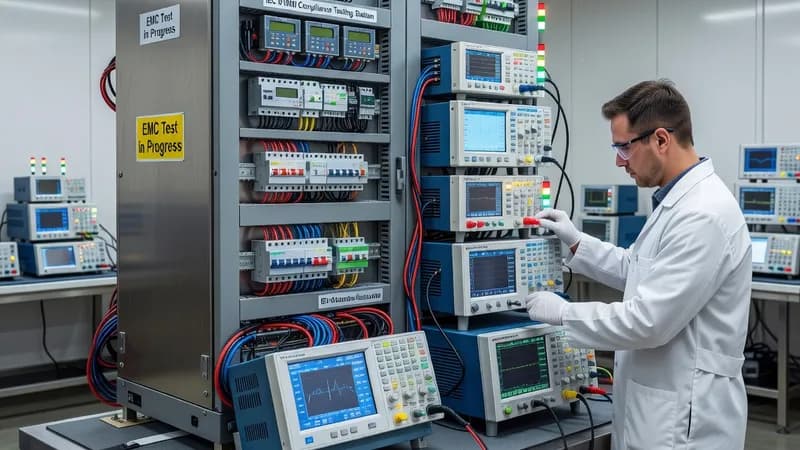
Overview
Power Control Center (PCC) assemblies intended for EMC Compliance under the IEC 61000 series must be engineered so that high-current switching, harmonic-rich loads, and control electronics can coexist without unacceptable emissions or susceptibility. In practice, this means treating the PCC not only as a power distribution system, but as an electromagnetic environment that must be controlled through layout, bonding, filtering, segregation, and verification. For industrial switchboards, the most relevant family of documents is IEC 61000, especially immunity and emission test methods such as IEC 61000-6-2, IEC 61000-6-4, IEC 61000-4-2, 4-3, 4-4, 4-5, 4-6, and 4-8, depending on the end-use environment and the installation category. Where variable frequency drives, soft starters, DC power supplies, or PLC-based control are integrated into the PCC, the electromagnetic performance of the complete assembly must be considered as a system, not as isolated devices. A compliant PCC design typically combines ACBs and MCCBs for incoming and outgoing feeders, motor feeders with contactors or VFDs, protection relays, metering, and auxiliary control circuits. EMC performance is heavily influenced by busbar routing, cable segregation, earthing topology, and enclosure continuity. High di/dt switching devices should be physically separated from sensitive instruments, communication gateways, and relay logic. Shielded control cabling, 360-degree shield termination, dedicated PE bars, low-impedance bonding straps, and metallic gland plates are common measures used to reduce both conducted and radiated disturbances. For VFD-fed motors, line reactors, EMC filters, dv/dt filters, and correctly grounded motor cable screens are often necessary to meet site-specific emission limits and to maintain immunity of adjacent equipment. Although IEC 61000 is not a panel-construction standard in the same sense as IEC 61439-1/2, EMC compliance must be coordinated with the assembly requirements of IEC 61439 for temperature rise, dielectric properties, clearances, creepage, and short-circuit withstand. This is especially important when the PCC is rated at 630 A, 1600 A, 3200 A, 4000 A, or higher, with prospective short-circuit currents commonly reaching 25 kA, 36 kA, 50 kA, 65 kA, or 100 kA depending on site conditions. The design team must ensure that EMC measures do not compromise accessibility, protection coordination, or verified performance under fault conditions. In hazardous locations or special installations, additional considerations may apply from IEC 60079 for explosive atmospheres and IEC 61641 for arc fault testing of low-voltage switchgear assemblies. Verification for EMC Compliance typically includes a documented design review, evidence of component conformity, wiring and layout inspection, and, where required by the client or EPC specification, type testing or site acceptance testing. Test plans may address electrostatic discharge, radiated RF immunity, electrical fast transients, surge, conducted RF disturbances, voltage dips and interruptions, and emissions from switching equipment. Manufacturers such as Patrion in Turkey can support the engineering of EMC-conscious PCC panels by selecting suitable enclosure systems, filtered control power supplies, industrial communication components, and properly segregated power sections. The result is a robust Power Control Center that supports uptime in data-sensitive, process-critical, and automation-heavy facilities such as water treatment plants, manufacturing plants, oil and gas utilities, infrastructure substations, and large commercial buildings.
Key Features
- EMC Compliance (IEC 61000) compliance pathway for Power Control Center (PCC)
- Design verification and testing requirements
- Documentation and certification procedures
- Component selection for standard compliance
- Ongoing compliance maintenance and re-certification
Specifications
| Property | Value |
|---|---|
| Panel Type | Power Control Center (PCC) |
| Standard | EMC Compliance (IEC 61000) |
| Compliance | Design verified |
| Certification | Available on request |
Other Standards for Power Control Center (PCC)
Power switchgear and controlgear assemblies — main compliance standard
Internal arc classification and containment
Earthquake resistance verification for critical facilities
North American switchboard safety standards
Other Panels Certified to EMC Compliance (IEC 61000)
Automatic capacitor switching for reactive power compensation. Thyristor or contactor-switched, detuned or standard configurations.
Enclosed VFD assemblies with input protection, line reactors, EMC filters, output reactors, and bypass options.
Energy metering, power quality analysis, and multi-circuit monitoring with communication gateways.
Process and machine control panels housing PLCs, I/O modules, relays, HMIs, and communication infrastructure.
Bespoke panel assemblies for non-standard requirements — special ratings, unusual form factors, multi-function combinations.
Enclosed soft starter assemblies for reduced voltage motor starting with torque control, ramp-up/down profiles, and bypass contactor options.
Active or passive harmonic filtering to mitigate THD from non-linear loads. Tuned LC filters, active filters, or hybrid configurations.
DC power distribution for battery systems, solar installations, telecom, and UPS applications. MCCB/fuse-based DC protection.
Fixed or automatic capacitor bank assemblies for bulk reactive power compensation in industrial and utility applications.
Frequently Asked Questions
Ready to Engineer Your Next Panel?
Our team of electrical engineers is ready to design, build, and deliver your custom panel solution — fully compliant with international standards.