Power Control Center (PCC) — UL 891 / CSA C22.2
UL 891 / CSA C22.2 compliance requirements, testing procedures, and design considerations for Power Control Center (PCC) assemblies.
Overview
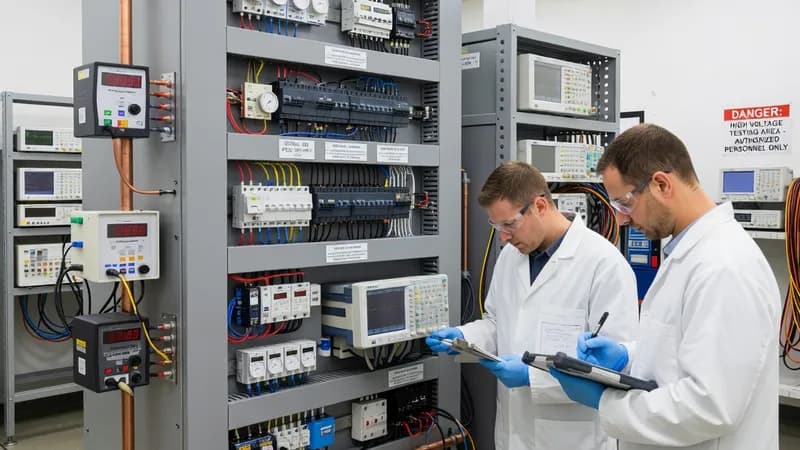
Power Control Center (PCC) assemblies built to UL 891 and CSA C22.2 requirements are expected to function as fully evaluated North American switchboard systems, not as collections of independent components. For panel builders, EPC contractors, and facility owners, compliance begins with the enclosure, bus structure, protective devices, internal wiring, temperature rise performance, dielectric withstand capability, short-circuit integrity, and clear identification of field-wiring terminals. UL 891 governs switchboards intended for 600 V and below, while CSA C22.2 requirements align the assembly for Canadian installations and certification pathways. In practice, this means the PCC must be engineered as a coordinated system with verified busbar sizing, spacings, creepage and clearance distances, grounding continuity, and protective device coordination suitable for the available fault current at the installation point. A compliant PCC commonly includes molded case circuit breakers (MCCBs), air circuit breakers (ACBs), fused disconnects, meter sections, control relays, motor starters, VFD feeders, soft starters, surge protective devices, and metering packages. Where required, electronic trip units, protection relays, and communication gateways may be incorporated for feeder monitoring and load management. Component selection must be based on evaluated ratings, including voltage class, continuous current, interrupting capacity, and short-circuit current rating of the complete assembly. Typical PCCs range from 100 A distribution sections to high-capacity mains in the 4000 A to 6000 A class, but the limiting factor is always the verified assembly rating, not the nominal device ratings alone. Design verification is central to UL 891 / CSA C22.2 compliance. The manufacturer must document conductor and bus insulation systems, verify enclosure robustness, confirm temperature rise limits under full-load conditions, and demonstrate that protective devices operate within their published ratings. Short-circuit testing or accepted analytical evaluation must prove that the PCC withstands prospective fault currents without unacceptable deformation, insulation failure, or loss of protection. Internal separation forms, where used, must be clearly defined to show segregation between bus, functional units, and terminal compartments. For industrial and critical-power applications, this is especially important in MCC-style load sections, generator tie arrangements, pump stations, water treatment plants, petrochemical facilities, and large commercial campuses. Documentation is as important as hardware. A compliant PCC package should include wiring diagrams, bill of materials, component certification files, nameplate data, assembly drawings, torque records, and test reports showing conformance with the applicable clauses of UL 891 and CSA C22.2. Where the installation involves hazardous areas or special environments, additional requirements may apply under IEC 60079 for explosive atmospheres, while filtering and EMC considerations for VFD feeders may reference IEC 61641 and the relevant product standards. Although UL 891 is the primary North American basis, many projects also require harmonization with IEC 61439 design principles for engineering discipline, particularly when exported projects or multinational owner specifications are involved. For manufacturing teams, compliance is not a one-time event. Changes to bus material, breaker frame size, enclosure geometry, ventilation strategy, or component substitution can trigger re-evaluation and re-certification. A robust compliance maintenance process includes incoming inspection, periodic calibration of test equipment, traceable component sourcing, and controlled revision management. Patrion, based in Turkey, supports PCC engineering and panel manufacturing with compliance-oriented design reviews, documentation packages, and assembly workflows suitable for export projects and North American market requirements.
Key Features
- UL 891 / CSA C22.2 compliance pathway for Power Control Center (PCC)
- Design verification and testing requirements
- Documentation and certification procedures
- Component selection for standard compliance
- Ongoing compliance maintenance and re-certification
Specifications
| Property | Value |
|---|---|
| Panel Type | Power Control Center (PCC) |
| Standard | UL 891 / CSA C22.2 |
| Compliance | Design verified |
| Certification | Available on request |
Other Standards for Power Control Center (PCC)
Power switchgear and controlgear assemblies — main compliance standard
Internal arc classification and containment
Earthquake resistance verification for critical facilities
Electromagnetic compatibility for sensitive environments
Other Panels Certified to UL 891 / CSA C22.2
Primary power distribution from transformer to sub-circuits. Rated up to 6300A. Houses main incoming breaker, bus-section, and outgoing feeders.
Centralized motor control with starters, contactors, overloads, and VFDs in standardized withdrawable/fixed functional units.
Automatic capacitor switching for reactive power compensation. Thyristor or contactor-switched, detuned or standard configurations.
Automatic changeover between mains and generator/UPS. Open or closed transition, with or without bypass.
Genset start/stop sequencing, synchronization, load sharing, and paralleling controls.
Final distribution for lighting and small power. MCB/RCBO-based with DALI or KNX integration options.
Bespoke panel assemblies for non-standard requirements — special ratings, unusual form factors, multi-function combinations.
DC power distribution for battery systems, solar installations, telecom, and UPS applications. MCCB/fuse-based DC protection.
Fixed or automatic capacitor bank assemblies for bulk reactive power compensation in industrial and utility applications.
Frequently Asked Questions
Ready to Engineer Your Next Panel?
Our team of electrical engineers is ready to design, build, and deliver your custom panel solution — fully compliant with international standards.