Power Control Center (PCC) — Seismic Qualification (IEEE 693/IBC)
Seismic Qualification (IEEE 693/IBC) compliance requirements, testing procedures, and design considerations for Power Control Center (PCC) assemblies.
Overview
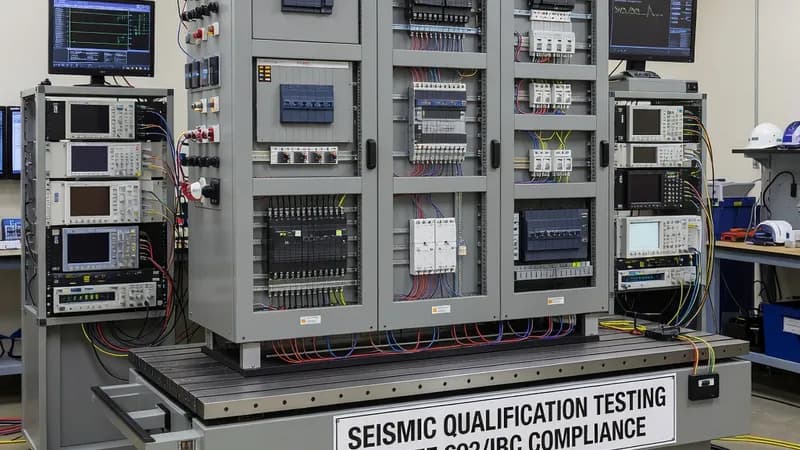
Power Control Center (PCC) assemblies designed for Seismic Qualification under IEEE 693 and the International Building Code (IBC) must be engineered to remain mechanically stable, electrically functional, and serviceable after a seismic event. Unlike a generic low-voltage switchboard, a compliant PCC is treated as a critical infrastructure assembly, typically built around incomer and feeder sections populated with air circuit breakers (ACBs), molded case circuit breakers (MCCBs), busbar systems, protection relays, metering, control wiring, and often auxiliary equipment such as VFDs, soft starters, and PLC-based control interfaces. The seismic strategy begins at the design stage with verified anchor bolt sizing, frame stiffness, bracing of vertical and horizontal busbars, restraint of heavy devices, and control of the center of gravity to reduce amplification during earthquake motion. IEEE 693 defines seismic performance levels and qualification methods for electrical equipment used in substations and power distribution environments. For PCC assemblies, qualification commonly combines shake-table testing, design verification, and documented similarity assessment. The assembly must be evaluated for the required seismic level, with evidence that critical functions are maintained during and after testing. IBC adoption typically requires that nonstructural electrical equipment be anchored and braced in accordance with building code requirements and project-specific seismic design categories. In practice, EPC contractors and facility owners often request certification packages that reference the applicable seismic category, test acceleration, mounting orientation, and installation constraints. A compliant PCC design also needs careful component selection. ACBs and MCCBs must be mounted to withstand inertial forces without nuisance tripping or loss of mechanical integrity. Protective relays, digital meters, communication gateways, and PLC modules should be fixed with vibration-tolerant mounting practices and cable supports. Busbar chambers require rigid supports, anti-loosening hardware, and adequate clearances to avoid flashover or contact separation. If the PCC contains arc-flash mitigation features or internal segregation, the enclosure design must still maintain integrity under seismic loading. Where relevant, the enclosure may also be evaluated against IEC 61439 structural requirements for low-voltage switchgear assemblies, with coordination to IEC 60947 for breaker performance and IEC 61641 for internal arc considerations, because seismic robustness cannot compromise electrical safety or short-circuit withstand capability. Testing and documentation are central to compliance. Typical deliverables include seismic design calculations, finite element analysis where applicable, bill of materials traceability, anchoring details, installation instructions, and a qualification report from a recognized test laboratory or engineering authority. For project acceptance, buyers often specify a minimum short-circuit withstand rating, such as 50 kA, 65 kA, or higher depending on the system, along with proof that the PCC retains alignment, access, insulation coordination, and busbar integrity after qualification. Maintenance obligations may include inspection of anchor torque, verification of transport locks, reassessment after any field modifications, and re-certification if major components or structural details change. For substations, utility plants, hospitals, data centers, water treatment facilities, and industrial campuses in seismic regions, a properly qualified PCC improves operational resilience and reduces post-earthquake outage risk. Patrion, through mccpanels.com, supports engineered compliance pathways for PCC assemblies with project-specific seismic qualification documentation, design verification packages, and manufacturing controls aligned to the required IEEE 693 and IBC criteria.
Key Features
- Seismic Qualification (IEEE 693/IBC) compliance pathway for Power Control Center (PCC)
- Design verification and testing requirements
- Documentation and certification procedures
- Component selection for standard compliance
- Ongoing compliance maintenance and re-certification
Specifications
| Property | Value |
|---|---|
| Panel Type | Power Control Center (PCC) |
| Standard | Seismic Qualification (IEEE 693/IBC) |
| Compliance | Design verified |
| Certification | Available on request |
Other Standards for Power Control Center (PCC)
Power switchgear and controlgear assemblies — main compliance standard
Internal arc classification and containment
North American switchboard safety standards
Electromagnetic compatibility for sensitive environments
Other Panels Certified to Seismic Qualification (IEEE 693/IBC)
Primary power distribution from transformer to sub-circuits. Rated up to 6300A. Houses main incoming breaker, bus-section, and outgoing feeders.
Centralized motor control with starters, contactors, overloads, and VFDs in standardized withdrawable/fixed functional units.
Automatic changeover between mains and generator/UPS. Open or closed transition, with or without bypass.
Genset start/stop sequencing, synchronization, load sharing, and paralleling controls.
Prefabricated busbar distribution per IEC 61439-6. Sandwich or air-insulated, aluminum or copper.
Bespoke panel assemblies for non-standard requirements — special ratings, unusual form factors, multi-function combinations.
Frequently Asked Questions
Ready to Engineer Your Next Panel?
Our team of electrical engineers is ready to design, build, and deliver your custom panel solution — fully compliant with international standards.