Power Control Center (PCC) — IEC 61439-2 (PSC)
IEC 61439-2 (PSC) compliance requirements, testing procedures, and design considerations for Power Control Center (PCC) assemblies.
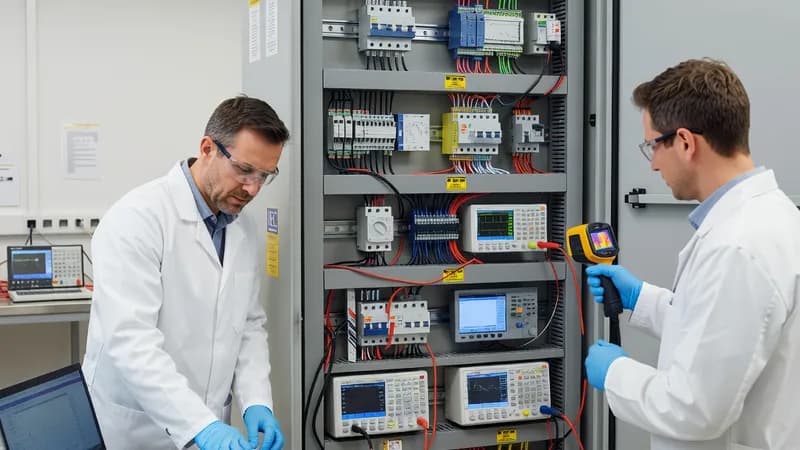
Overview
A Power Control Center (PCC) designed for IEC 61439-2 compliance is a low-voltage power switchgear and controlgear assembly intended for the distribution, isolation, switching, and protection of power feeders in industrial, commercial, and infrastructure installations. Under IEC 61439-2, a PCC is classified as a power switchgear and controlgear assembly (PSC), which means compliance is demonstrated at the complete assembly level through design verification and routine verification, not by relying on the conformity of individual components alone. In practice, this governs the enclosure system, busbar arrangement, internal separation, thermal performance, short-circuit withstand capability, protective circuits, and the coordination of all installed devices. Typical PCC architectures include incoming ACBs up to 6300 A, bus couplers, feeder MCCBs, outgoing switch disconnectors, fused switches, metering sections, protection relays, current transformers, and interface modules for automation and energy management. Depending on process requirements, PCCs may also feed VFDs, soft starters, capacitor bank controllers, transformer incomers, HVAC plant, pumps, compressors, and large mechanical drives. Device coordination must align with IEC 60947 series requirements, particularly for circuit-breakers, contactors, motor starters, and switch-disconnectors. Where motor feeder integration is extensive, selective coordination and discrimination studies become critical to maintain uptime during downstream faults. IEC 61439-1 and IEC 61439-2 define the design verification route for rated current, temperature rise, dielectric performance, short-circuit withstand, and mechanical functionality. Verification may be completed by testing, comparison with a verified reference design, or assessment using design rules, depending on the parameter involved. For a PCC, common verified data points include rated operational current, rated diversity factor, busbar thermal capability, Icw and Ipk withstand levels, internal arc containment strategy where specified, and creepage and clearance distances suited to the operating voltage and pollution degree. Forms of internal separation are selected according to service continuity and safety requirements, from Form 1 through Form 4, with Form 3b and Form 4 often preferred for critical process feeders and maintenance-friendly compartmentalization. Routine verification at the manufacturing stage includes inspection of conductor terminations, torque checks, dielectric testing where applicable, protective circuit continuity, functional operation of devices, wiring verification, and confirmation of nameplates, schematics, and documentation. For EPC contractors and facility managers, a complete compliance dossier should include single-line diagrams, GA drawings, busbar sizing calculations, heat-rise assumptions, fault-level studies, protection coordination data, and a Declaration of Conformity. When the PCC includes auxiliary automation, the documentation should also capture PLC I/O lists, metering architecture, communication protocols, and interlocking logic. In higher-risk environments, additional standards may apply. IEC 61641 is relevant where internal arc fault mitigation is required, while IEC 60079 considerations may be needed if the PCC interfaces with hazardous-area equipment or is installed near explosive atmospheres. For corrosive, humid, or dust-prone environments, enclosure selection, IP degree, anti-condensation measures, and ventilation strategy must be engineered alongside the compliance process. Real-world PCC applications include manufacturing plants, water and wastewater treatment facilities, district energy systems, hospitals, airports, data centers, commercial towers, and utility substations. Patrion, based in Turkey, supports IEC 61439-2 PCC projects with enclosure fabrication, copper busbar manufacturing, ACB and MCCB integration, protection relay and metering integration, and factory documentation aligned to IEC 61439-1/2 expectations. For projects requiring witness testing, third-party certification, or repeatable lifecycle maintenance, the compliance route should be fixed early so the final PCC is delivered with validated ratings, traceable components, and maintainable design documentation.
Key Features
- IEC 61439-2 (PSC) compliance pathway for Power Control Center (PCC)
- Design verification and testing requirements
- Documentation and certification procedures
- Component selection for standard compliance
- Ongoing compliance maintenance and re-certification
Specifications
| Property | Value |
|---|---|
| Panel Type | Power Control Center (PCC) |
| Standard | IEC 61439-2 (PSC) |
| Compliance | Design verified |
| Certification | Available on request |
Other Standards for Power Control Center (PCC)
Internal arc classification and containment
Earthquake resistance verification for critical facilities
North American switchboard safety standards
Electromagnetic compatibility for sensitive environments
Other Panels Certified to IEC 61439-2 (PSC)
Primary power distribution from transformer to sub-circuits. Rated up to 6300A. Houses main incoming breaker, bus-section, and outgoing feeders.
Centralized motor control with starters, contactors, overloads, and VFDs in standardized withdrawable/fixed functional units.
Automatic capacitor switching for reactive power compensation. Thyristor or contactor-switched, detuned or standard configurations.
Automatic changeover between mains and generator/UPS. Open or closed transition, with or without bypass.
Enclosed VFD assemblies with input protection, line reactors, EMC filters, output reactors, and bypass options.
Genset start/stop sequencing, synchronization, load sharing, and paralleling controls.
Energy metering, power quality analysis, and multi-circuit monitoring with communication gateways.
Process and machine control panels housing PLCs, I/O modules, relays, HMIs, and communication infrastructure.
Bespoke panel assemblies for non-standard requirements — special ratings, unusual form factors, multi-function combinations.
Enclosed soft starter assemblies for reduced voltage motor starting with torque control, ramp-up/down profiles, and bypass contactor options.
Active or passive harmonic filtering to mitigate THD from non-linear loads. Tuned LC filters, active filters, or hybrid configurations.
DC power distribution for battery systems, solar installations, telecom, and UPS applications. MCCB/fuse-based DC protection.
Fixed or automatic capacitor bank assemblies for bulk reactive power compensation in industrial and utility applications.
Frequently Asked Questions
Ready to Engineer Your Next Panel?
Our team of electrical engineers is ready to design, build, and deliver your custom panel solution — fully compliant with international standards.