EMC Compliance (IEC 61000)
Electromagnetic compatibility for sensitive environments
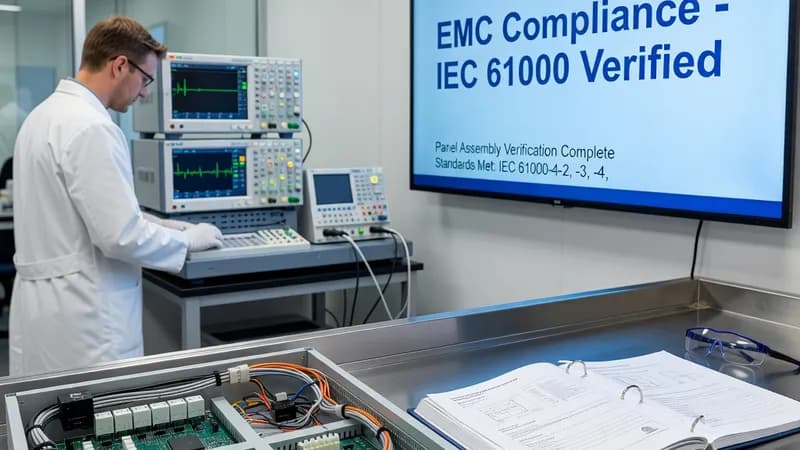
EMC Compliance under the IEC 61000 series is a critical design and verification requirement for low-voltage switchgear and controlgear assemblies built to IEC 61439-1 and IEC 61439-2, especially when panels contain variable-frequency drives, soft starters, PLCs, protection relays, metering devices, harmonic filters, and capacitor banks. In practical panel engineering, EMC is not a single test but a system-level discipline that addresses conducted and radiated emissions, electrostatic discharge, fast transients, surge immunity, voltage dips, and harmonic distortion so that the assembly performs reliably in sensitive or noisy electrical environments. For power-control-center, variable-frequency-drive, soft-starter, and harmonic-filter panels, emission control is often the first priority. Switching devices and power electronics can generate high-frequency noise that couples into auxiliary circuits, communication networks, and measurement systems. Compliance is typically demonstrated by combining IEC 61000-6-4 emission requirements for industrial environments with IEC 61000-6-2 immunity requirements, while applying product-specific tests from IEC 61000-4-2, -4-3, -4-4, -4-5, -4-6, and -4-11 as applicable. In healthcare, pharmaceuticals, and data centers, the objective is to maintain uninterrupted operation of sensitive equipment, SCADA networks, BMS systems, and instrumentation. Effective EMC design starts with segregation of power and control wiring, correct enclosure bonding, and low-impedance earthing. Engineers typically specify shielded motor cables with 360-degree shield termination at the drive end, EMC cable glands, segregated cable ducts, metallized gland plates, and filtered ventilation where required. For VFD panels, input line reactors, dV/dt filters, sine filters, and EMC/RFI filters are commonly used to reduce conducted emissions and improve immunity. In PLC-automation panels and metering panels, attention must be paid to analog signal routing, twisted-pair cabling, ferrite suppression, and the separation of clean and dirty circuits. Capacitor-bank panels and DC-distribution panels may also require mitigation of switching transients and coordination of surge protective devices. IEC 61439-1 Clause 10 and related verification principles require that the panel builder demonstrate performance under expected service conditions, while EMC-specific testing is often validated through design review, component qualification, and, where necessary, factory testing or third-party laboratory assessment. Typical verification includes functional checks under electrical disturbance, continuity of protective bonding circuits, insulation coordination, and assessment of enclosure integrity. For severe industrial environments, panels may also need to consider IEC 61641 internal arc fault conditions, IEC 60079 if installed in hazardous areas, and coordination with short-circuit ratings up to 50 kA, 65 kA, or higher depending on the assembly design and incoming protection devices such as ACBs and MCCBs. For EPC contractors and facility managers, EMC compliance reduces nuisance tripping, communication failures, sensor drift, unexplained resets, and downtime. For mccpanels.com by Patrion, EMC-compliant panel engineering means integrating the right enclosure architecture, component selection, wiring topology, and verification pathway from the earliest design stage, ensuring that the finished IEC 61439 assembly is both electrically robust and fit for mission-critical applications.
Panels Certified to This Standard
High-capacity power distribution for industrial facilities. Controls and distributes incoming power to MCC, APFC, and downstream loads.
Automatic capacitor switching for reactive power compensation. Thyristor or contactor-switched, detuned or standard configurations.
Enclosed VFD assemblies with input protection, line reactors, EMC filters, output reactors, and bypass options.
Energy metering, power quality analysis, and multi-circuit monitoring with communication gateways.
Process and machine control panels housing PLCs, I/O modules, relays, HMIs, and communication infrastructure.
Bespoke panel assemblies for non-standard requirements — special ratings, unusual form factors, multi-function combinations.
Enclosed soft starter assemblies for reduced voltage motor starting with torque control, ramp-up/down profiles, and bypass contactor options.
Active or passive harmonic filtering to mitigate THD from non-linear loads. Tuned LC filters, active filters, or hybrid configurations.
DC power distribution for battery systems, solar installations, telecom, and UPS applications. MCCB/fuse-based DC protection.
Fixed or automatic capacitor bank assemblies for bulk reactive power compensation in industrial and utility applications.
Related Industries
High-reliability MDB, PCC, ATS (STS), metering, APFC, BTS, DC distribution
ATS (critical power), MDB, generator control, lighting, metering, APFC
Cleanroom-compatible panels, MCC, VFD, APFC, PLC, soft starters, harmonic filters
MDB, metering, APFC, ATS, PLC, DC distribution, capacitor banks
Related Knowledge Articles
Frequently Asked Questions
Ready to Engineer Your Next Panel?
Our team of electrical engineers is ready to design, build, and deliver your custom panel solution — fully compliant with international standards.