Power Control Center (PCC) — Arc Flash Protection (IEC 61641)
Arc Flash Protection (IEC 61641) compliance requirements, testing procedures, and design considerations for Power Control Center (PCC) assemblies.
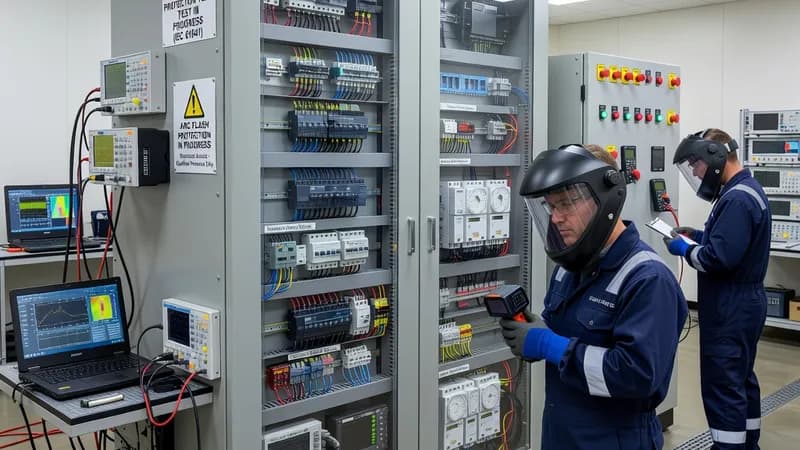
Overview
Power Control Center (PCC) assemblies designed for arc flash protection under IEC 61641 are intended to limit the effects of internal arc faults by providing a validated degree of personnel protection, compartment integrity, and pressure containment. For industrial plants, utilities, water treatment stations, mining facilities, and heavy process industries, this compliance pathway is especially relevant where low-voltage switchboards operate large incomers and feeders with high prospective short-circuit currents. A compliant PCC typically incorporates air circuit breakers (ACBs), molded case circuit breakers (MCCBs), contactors, protection relays, metering devices, motor starters, VFDs, and soft starters arranged in segregated compartments to reduce incident energy transfer and improve maintenance safety. IEC 61641 is applied to low-voltage switchgear and controlgear assemblies tested for protection against internal arc faults. It is used alongside IEC 61439-1 and IEC 61439-2 for design verification of assemblies, while the individual components remain governed by IEC 60947 series requirements. In practice, arc-resistance is demonstrated by type testing or design verification on representative assemblies, using defined test criteria such as accessible sides, fault initiation points, fault current magnitude, arcing duration, and acceptance limits for flame propagation, enclosure deformation, and ejection of hot gases or parts. Depending on the installation concept, arc classification may be requested for front, lateral, or rear accessibility, and manufacturers must document the exact test configuration, panel width, depth, busbar arrangement, and functional unit layout. A PCC engineered for IEC 61641 compliance often includes reinforced busbar chambers, pressure-relief channels, arc exhaust ducting, arc detection relays, and fast tripping schemes coordinated with upstream ACBs or feeder MCCBs. In some applications, current-limiting devices, zone-selective interlocking, and differential protection are used to shorten clearing time and reduce let-through energy. The assembly design also considers form of separation under IEC 61439, commonly Form 3b or Form 4 for improved segregation of busbars, functional units, and terminals, although the final choice must be coordinated with thermal limits, accessibility requirements, and maintainability. Rated operational currents for PCCs frequently range from 800 A to 6300 A, with short-circuit withstand ratings often specified from 50 kA to 100 kA or higher, depending on system fault level and test evidence. Certification for IEC 61641 compliance is not a generic label; it depends on documented test results, verified construction details, and traceable conformity between the tested sample and the delivered PCC. Key documentation includes test reports, arc classification statements, GA drawings, busbar calculations, temperature-rise data, dielectric verification, short-circuit withstand evidence, and component declarations from recognized manufacturers such as Schneider Electric, ABB, Siemens, Eaton, and LS Electric. For installations in hazardous locations or oil and gas facilities, arc fault protection may also need to be assessed in conjunction with IEC 60079 requirements, while fire-risk and smoke management considerations can be relevant where panels interface with critical infrastructure or enclosed plant rooms. Ongoing compliance requires control of design changes, periodic inspection of door interlocks, shutters, earthing continuity, torque verification, and recertification whenever the assembly architecture, fault level, or protective device coordination is altered.
Key Features
- Arc Flash Protection (IEC 61641) compliance pathway for Power Control Center (PCC)
- Design verification and testing requirements
- Documentation and certification procedures
- Component selection for standard compliance
- Ongoing compliance maintenance and re-certification
Specifications
| Property | Value |
|---|---|
| Panel Type | Power Control Center (PCC) |
| Standard | Arc Flash Protection (IEC 61641) |
| Compliance | Design verified |
| Certification | Available on request |
Other Standards for Power Control Center (PCC)
Power switchgear and controlgear assemblies — main compliance standard
Earthquake resistance verification for critical facilities
North American switchboard safety standards
Electromagnetic compatibility for sensitive environments
Other Panels Certified to Arc Flash Protection (IEC 61641)
Primary power distribution from transformer to sub-circuits. Rated up to 6300A. Houses main incoming breaker, bus-section, and outgoing feeders.
Centralized motor control with starters, contactors, overloads, and VFDs in standardized withdrawable/fixed functional units.
Automatic changeover between mains and generator/UPS. Open or closed transition, with or without bypass.
Prefabricated busbar distribution per IEC 61439-6. Sandwich or air-insulated, aluminum or copper.
Bespoke panel assemblies for non-standard requirements — special ratings, unusual form factors, multi-function combinations.
Frequently Asked Questions
Ready to Engineer Your Next Panel?
Our team of electrical engineers is ready to design, build, and deliver your custom panel solution — fully compliant with international standards.