Variable Frequency Drive (VFD) Panel for Industrial Manufacturing
Variable Frequency Drive (VFD) Panel assemblies engineered for Industrial Manufacturing applications, addressing industry-specific requirements and compliance standards.
Overview
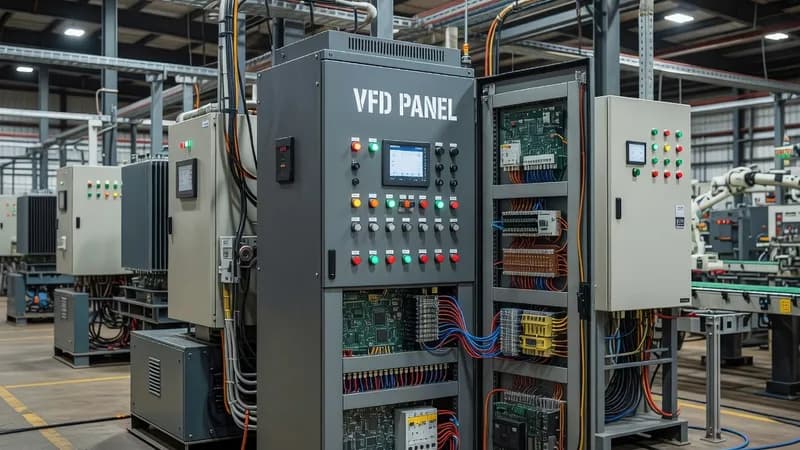
Variable Frequency Drive (VFD) Panel assemblies for Industrial Manufacturing are engineered to deliver precise motor speed control, process stability, and energy optimization across conveyors, mixers, pumps, fans, extruders, compressors, and automated production lines. Built as IEC 61439-2 low-voltage switchgear and controlgear assemblies, these panels are typically designed around withdrawable or fixed VFD feeders, incomer protection, and robust thermal management to maintain performance in dusty, humid, high-vibration, or chemically aggressive plant environments. Depending on the application, the assembly may incorporate ACBs or MCCBs as the main incomer, feeder MCCBs or switch-disconnectors, line reactors, dv/dt filters, sine filters, EMC filters, braking resistors, and bypass contactor arrangements for critical continuity of service. Industrial Manufacturing VFD panels are commonly rated from 400/415 V, 50 Hz up to 690 V systems, with busbar ratings from 630 A to 6300 A and short-circuit withstand ratings typically specified from 25 kA to 100 kA for 1 second or as validated by design verification. The selected VFDs are often IEC 61800-compliant drives from leading industrial platforms, integrated with protection relays, motor overload functions, phase-loss monitoring, earth-fault detection, and communication interfaces such as Modbus RTU, Modbus TCP, Profinet, Profibus, EtherNet/IP, or OPC UA for plant SCADA and MES integration. Where process reliability is critical, panels may include redundant fans, anti-condensation heaters, temperature-controlled ventilation, and segregated air channels to protect drive modules from hot-spot accumulation. For manufacturing plants with multiple motor centers, the panel may be built as a modular MCC-style VFD lineup with Form 2, Form 3b, or Form 4 internal separation in accordance with IEC 61439-2, improving serviceability and fault containment. In hazardous or classified areas adjacent to solvent, dust, or vapor risks, complementary design considerations may reference IEC 60079, while arc-flash mitigation and internal fault resilience can be evaluated with IEC 61641. Control circuits, emergency-stop loops, safety relays, and functional safety interfaces should be coordinated with IEC 60204-1 and the machine builder’s risk assessment requirements. Typical industrial manufacturing configurations include centralized drive panels feeding multiple motors, decentralized process skids with local drive sections, and hybrid cabinets combining VFDs with soft starters, protection relays, metering, and power factor correction where network harmonics and reactive power management must be controlled carefully. For high-duty applications, the enclosure protection degree is often IP54, IP55, or higher, with corrosion-resistant finishes, gasketed doors, segregated cable compartments, and gland plates sized for power and instrumentation segregation. Heat dissipation is verified through thermal design calculations and, where necessary, forced ventilation or air-conditioning. Each assembly is documented with type-tested design verification, routine tests, wiring schedules, protection settings, and nameplate data, ensuring compliance, maintainability, and long-term operational reliability in Industrial Manufacturing environments.
Key Features
- Variable Frequency Drive (VFD) Panel configured for Industrial Manufacturing requirements
- Industry-specific environmental ratings and protections
- Compliance with sector-specific standards and regulations
- Optimized component selection for industry applications
- Integration with industry-standard control and monitoring systems
Specifications
| Property | Value |
|---|---|
| Panel Type | Variable Frequency Drive (VFD) Panel |
| Industry | Industrial Manufacturing |
| Base Standard | IEC 61439-2 |
| Environment | Industry-specific ratings |
Other Panels for Industrial Manufacturing
Primary power distribution from transformer to sub-circuits. Rated up to 6300A. Houses main incoming breaker, bus-section, and outgoing feeders.
High-capacity power distribution for industrial facilities. Controls and distributes incoming power to MCC, APFC, and downstream loads.
Centralized motor control with starters, contactors, overloads, and VFDs in standardized withdrawable/fixed functional units.
Automatic capacitor switching for reactive power compensation. Thyristor or contactor-switched, detuned or standard configurations.
Automatic changeover between mains and generator/UPS. Open or closed transition, with or without bypass.
Energy metering, power quality analysis, and multi-circuit monitoring with communication gateways.
Process and machine control panels housing PLCs, I/O modules, relays, HMIs, and communication infrastructure.
Prefabricated busbar distribution per IEC 61439-6. Sandwich or air-insulated, aluminum or copper.
Enclosed soft starter assemblies for reduced voltage motor starting with torque control, ramp-up/down profiles, and bypass contactor options.
Active or passive harmonic filtering to mitigate THD from non-linear loads. Tuned LC filters, active filters, or hybrid configurations.
Fixed or automatic capacitor bank assemblies for bulk reactive power compensation in industrial and utility applications.
Bespoke panel assemblies for non-standard requirements — special ratings, unusual form factors, multi-function combinations.
Other Industries Using Variable Frequency Drive (VFD) Panel
Ex-rated panels, MCC, PCC, VFD, generator control, soft starters, ATEX/IECEx compliance
MCC, VFD panels, PLC automation, APFC, generator control, soft starters
Rugged MCC, PCC, VFD panels, generator panels, soft starters, harmonic filters
Washdown-rated panels (IP65+), MCC, VFD, APFC, PLC, soft starters, harmonic filters
Cleanroom-compatible panels, MCC, VFD, APFC, PLC, soft starters, harmonic filters
Frequently Asked Questions
Ready to Engineer Your Next Panel?
Our team of electrical engineers is ready to design, build, and deliver your custom panel solution — fully compliant with international standards.