Capacitor Banks & Reactors
Power factor correction, detuned reactors, thyristor switching
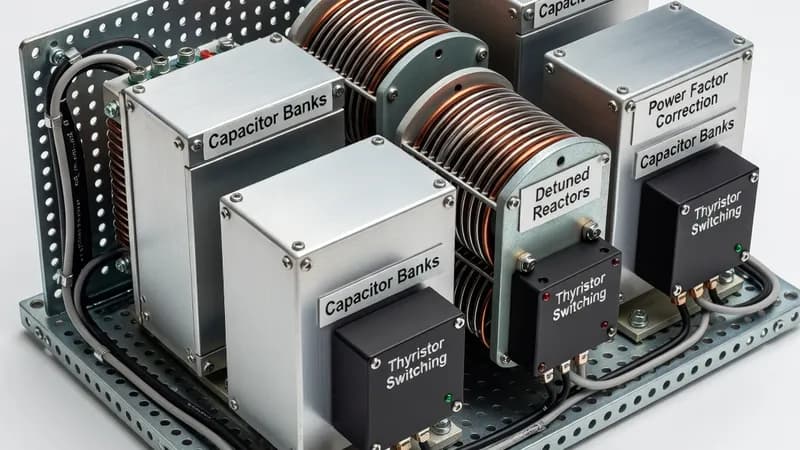
Capacitor Banks & Reactors are essential components in low-voltage power factor correction and harmonic mitigation systems built into IEC 61439 panel assemblies. In practical applications, they are installed in capacitor-bank panels, harmonic-filter panels, and custom-engineered power distribution panels to reduce reactive power demand, stabilize bus voltage, and improve transformer and feeder utilization. Typical capacitor steps use dry-type, metallized polypropylene self-healing capacitors in ratings from 2.5 kVAr to 50 kVAr per unit, assembled into banks from 50 kVAr up to 5000 kVAr and beyond. For industrial plants with fluctuating loads such as welding lines, injection molding, HVAC chillers, pumping stations, and variable-speed drives, automatic power factor correction panels provide stepwise compensation using capacitor-duty contactors or thyristor switching modules for fast, transient-free response. Detuned reactors are critical where VFDs, UPS systems, rectifiers, or nonlinear process loads create harmonic distortion. Series reactors are selected with detuning factors such as 5.67%, 7%, or 14% to shift the capacitor-resonance point below dominant harmonics and prevent resonance amplification, capacitor overcurrent, and premature dielectric stress. Reactor construction typically follows IEC 60076-6 principles for dry-type reactor thermal performance and insulation coordination, while the complete panel assembly is designed and verified to IEC 61439-1 and IEC 61439-2 for assemblies up to 1000 V AC. Where the panel is used for distribution, outgoing feeder sections may also be built to IEC 61439-3 for DBs or IEC 61439-6 for busbar trunking interfaces. Selection depends on network parameters, including short-circuit level, total harmonic distortion, transformer size, load profile, and target power factor, usually 0.95 to 0.99. Panels may incorporate protection relays, power factor controllers, current transformers, thermal monitoring, fan control, discharge resistors, and surge protection devices. Short-circuit withstand ratings must be coordinated with upstream protection, commonly 25 kA, 36 kA, 50 kA, or higher depending on the site fault level and the assembly design. Internal separation may be configured as Form 1, Form 2, Form 3, or Form 4 to improve serviceability and reduce arc propagation risk between capacitor steps, reactors, and control compartments. Component families from major manufacturers often used in these systems include ABB, Siemens, Schneider Electric, Eaton, EPCOS/TDK, and DUCATI Energia for capacitors; ABB, Siemens, and Schneider for contactors, MCCBs, ACBs, and control gear; and reactors from TDK/EPCOS, Detuned Reactors, and similar industrial-grade suppliers. In hazardous or dusty environments, enclosure design may also consider IEC 60079 for explosive atmospheres and IEC 61641 for arc fault containment testing where applicable. The result is a robust, low-loss, and maintainable solution that improves energy efficiency, reduces penalties from utilities, and extends the life of transformers, cables, and switchgear across manufacturing plants, commercial buildings, water treatment facilities, and infrastructure projects.
Panels Using This Component
Automatic capacitor switching for reactive power compensation. Thyristor or contactor-switched, detuned or standard configurations.
Bespoke panel assemblies for non-standard requirements — special ratings, unusual form factors, multi-function combinations.
Active or passive harmonic filtering to mitigate THD from non-linear loads. Tuned LC filters, active filters, or hybrid configurations.
Fixed or automatic capacitor bank assemblies for bulk reactive power compensation in industrial and utility applications.
Related Knowledge Articles
Sizing power factor correction equipment for LV installations.
Designing and sizing APFC panels for optimal reactive power compensation.
Designing panels to minimize electrical losses.
Frequently Asked Questions
Ready to Engineer Your Next Panel?
Our team of electrical engineers is ready to design, build, and deliver your custom panel solution — fully compliant with international standards.