PLCs & I/O Modules
Programmable logic controllers, remote I/O, fieldbus communication
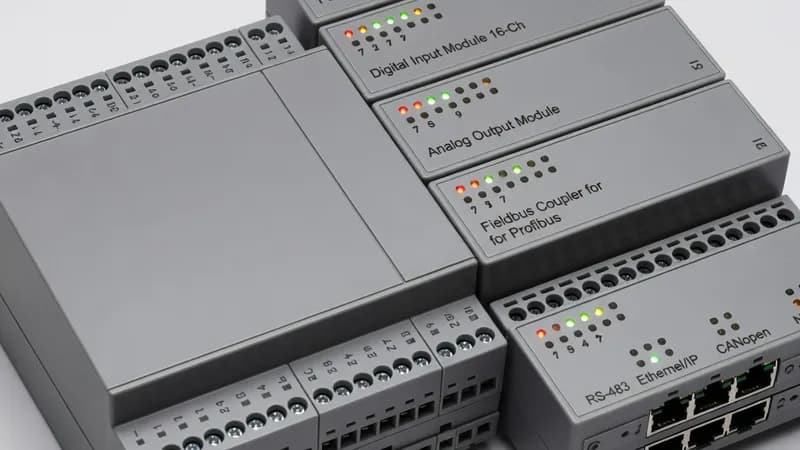
PLCs and I/O modules are the control core of modern low-voltage automation panels, converting field signals into deterministic machine, process, and energy-management actions. In IEC 61439 panel assemblies, they are typically installed in dedicated control compartments with segregated 24 VDC control wiring, network infrastructure, and marshalling terminals to maintain serviceability and EMC performance. A typical architecture may include compact PLCs for standalone equipment, modular rack systems for plant-wide control, remote I/O islands mounted near field devices, and safety PLCs for functions such as emergency stop, guard interlock, or burner permissive logic. Major product families commonly used include Siemens SIMATIC S7-1200/S7-1500 and ET 200 remote I/O, Schneider Electric Modicon M221/M241/M262 and TM3/TM5 I/O, Allen-Bradley CompactLogix and POINT I/O, WAGO 750, Beckhoff EtherCAT terminals, and Omron NX/NJ controllers. Selection is driven by I/O count, scan time, network topology, environmental conditions, and required diagnostics. Digital modules are commonly 24 VDC sourcing/sinking, while relay outputs are used for interposing contactors, lamps, and annunciation. Analog modules handle 4-20 mA, 0-10 V, RTD, thermocouple, load-cell, and pulse inputs; high-speed counter and encoder modules support motion, batching, and turbine metering. Remote I/O is frequently deployed over PROFINET, EtherNet/IP, Modbus TCP, EtherCAT, PROFIBUS, or CANopen, reducing copper runs and improving signal integrity in large MCCs, generator control panels, water treatment plants, and distributed skid systems. Within motor-control-center applications, PLCs coordinate MCCBs, ACBs, contactors, soft starters, VFDs, and protection relays, often exchanging status and measurements with intelligent devices that comply with IEC 60947 and communicating trip/alarm data to SCADA. In generator control panels, the PLC supervises start/stop logic, synchronizing sequences, load sharing, breaker control, and alarms from engine controllers and protection relays. In custom-engineered panels and PLC automation panels, the same platform may also manage PID loops, interlocks, recipes, energy meters, and historian communication. Panel integration must respect IEC 61439-1/2 assembly requirements for temperature rise, creepage and clearance, wiring separation, and access to maintenance points. For hazardous-area or harsh-environment projects, related design practices may also reference IEC 60079, while EMC robustness and resistance to internal arcing consequences can be evaluated alongside IEC 61641 where applicable. Control power design typically uses 24 VDC power supplies with battery-backed UPS or redundant supplies for critical systems, while network switches, managed Ethernet, fiber media converters, and industrial firewalls support segmentation and cybersecurity. Engineered properly, PLC and I/O architecture improves maintainability, reduces wiring density, enables predictive diagnostics, and supports expansion from small machine skids to multi-bay switchboard systems. For EPC contractors and panel builders, the key is to match the controller platform, communication protocol, and I/O density to the required function, then package it inside an IEC 61439-compliant enclosure with clear segregation, labeling, and documentation for commissioning and lifecycle support.
Panels Using This Component
Centralized motor control with starters, contactors, overloads, and VFDs in standardized withdrawable/fixed functional units.
Genset start/stop sequencing, synchronization, load sharing, and paralleling controls.
Process and machine control panels housing PLCs, I/O modules, relays, HMIs, and communication infrastructure.
Bespoke panel assemblies for non-standard requirements — special ratings, unusual form factors, multi-function combinations.
Related Knowledge Articles
Frequently Asked Questions
Ready to Engineer Your Next Panel?
Our team of electrical engineers is ready to design, build, and deliver your custom panel solution — fully compliant with international standards.