Busbar Trunking System (BTS) for Commercial Buildings
Busbar Trunking System (BTS) assemblies engineered for Commercial Buildings applications, addressing industry-specific requirements and compliance standards.
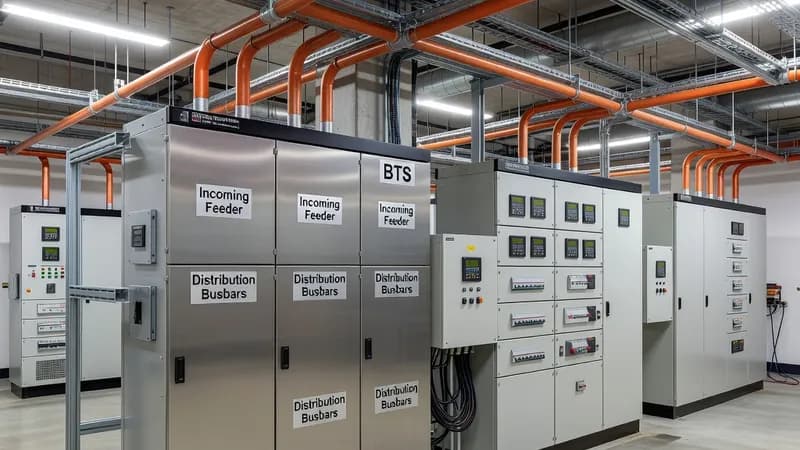
Overview
Busbar Trunking System (BTS) assemblies for commercial buildings are engineered to deliver compact, scalable, and low-loss power distribution from the main LV switchboard to floor distribution boards, tenant panels, HVAC plant, lighting transformers, data room feeders, and mechanical services. In high-rise offices, malls, hospitals, airports, and mixed-use complexes, BTS is often preferred over large cable risers because it simplifies installation, reduces voltage drop, improves fire compartment management, and allows safe tap-off points at strategic locations. Typical systems are designed in accordance with IEC 61439-1 and IEC 61439-6, with the overall assembly coordinated to the short-circuit withstand requirements of the site, often in the 25 kA to 100 kA range depending on upstream transformer size and fault level studies. Rated currents commonly range from 160 A up to 6300 A, with copper or aluminum conductors selected based on efficiency, thermal performance, and project economics. For commercial buildings, the BTS route must be coordinated with architecture, fire strategy, and maintainability. Segregation of routes across basement, risers, technical floors, and roof plant must consider fire stopping, expansion joints, and access for inspection. Tap-off units are frequently used to feed MCCBs, MCBs, fused switches, metering devices, VFDs for pumps and fans, and soft starters for chilled water or smoke extraction equipment. Where critical loads are present, BTS can support dual-feed arrangements with ATSs, protection relays, and monitoring interfaces integrated into the building management system. In office towers and retail centers, metering tap-off sections help tenants track submetered consumption and support energy management strategies under IEC 61557-12 and modern digital power monitoring practices. Mechanical and environmental design is essential. Enclosures and busbar chambers are selected to achieve appropriate ingress protection, commonly IP40 to IP55 indoors and higher for exposed or plantroom routes, with corrosion resistance suited to humid basements, rooftop exposure, or coastal urban environments. Thermal rise, conductor spacing, joint integrity, and expansion compensation must be verified by routine design checks and type-tested evidence. For emergency and life-safety circuits, coordination with IEC 60364, fire alarm interface requirements, and smoke control system philosophy is critical. In some projects, BTS sections may also be evaluated for resistance to fire effects in accordance with IEC 61641 where applicable to enclosed low-voltage assemblies. A well-engineered BTS solution for commercial buildings improves space utilization, reduces installation labor, and enables future load growth through modular tap-off additions without major shutdowns. Patrion supplies engineered BTS solutions for commercial towers, shopping centers, hotels, hospitals, and campus-style developments, integrating protection devices, metering, and control interfaces to suit EPC specifications and owner operational targets. The result is a maintainable, standards-based distribution backbone that supports reliable power delivery throughout the full lifecycle of the building.
Key Features
- Busbar Trunking System (BTS) configured for Commercial Buildings requirements
- Industry-specific environmental ratings and protections
- Compliance with sector-specific standards and regulations
- Optimized component selection for industry applications
- Integration with industry-standard control and monitoring systems
Specifications
| Property | Value |
|---|---|
| Panel Type | Busbar Trunking System (BTS) |
| Industry | Commercial Buildings |
| Base Standard | IEC 61439-2 |
| Environment | Industry-specific ratings |
Other Panels for Commercial Buildings
Primary power distribution from transformer to sub-circuits. Rated up to 6300A. Houses main incoming breaker, bus-section, and outgoing feeders.
Final distribution for lighting and small power. MCB/RCBO-based with DALI or KNX integration options.
Automatic capacitor switching for reactive power compensation. Thyristor or contactor-switched, detuned or standard configurations.
Automatic changeover between mains and generator/UPS. Open or closed transition, with or without bypass.
Energy metering, power quality analysis, and multi-circuit monitoring with communication gateways.
Fixed or automatic capacitor bank assemblies for bulk reactive power compensation in industrial and utility applications.
Bespoke panel assemblies for non-standard requirements — special ratings, unusual form factors, multi-function combinations.
Other Industries Using Busbar Trunking System (BTS)
MCC, PCC, VFD panels, MDB, APFC, automation panels, soft starters, harmonic filters, capacitor banks — full range
High-reliability MDB, PCC, ATS (STS), metering, APFC, BTS, DC distribution
MDB, ATS, metering, BTS, lighting distribution, DC distribution
Frequently Asked Questions
Ready to Engineer Your Next Panel?
Our team of electrical engineers is ready to design, build, and deliver your custom panel solution — fully compliant with international standards.