Busbar Trunking System (BTS) for Industrial Manufacturing
Busbar Trunking System (BTS) assemblies engineered for Industrial Manufacturing applications, addressing industry-specific requirements and compliance standards.
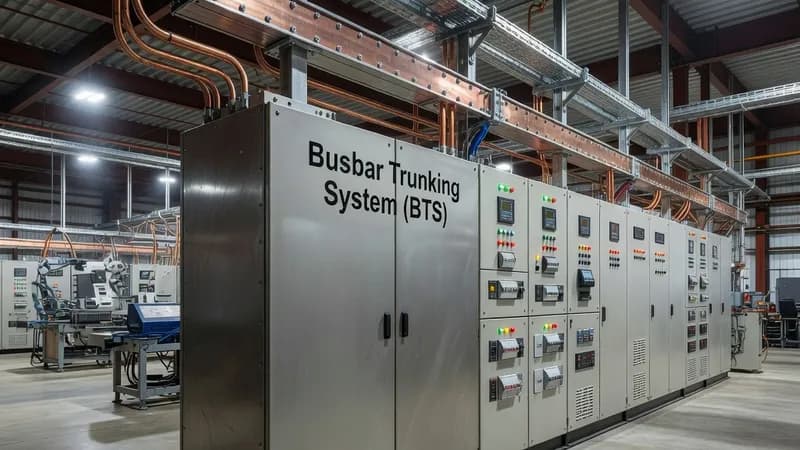
Overview
Busbar Trunking System (BTS) assemblies for industrial manufacturing facilities are engineered to distribute large currents safely and efficiently across production halls, machine lines, process utilities, and utility buildings. In modern plants, BTS is often selected over extensive cable runs because it reduces installation time, minimizes voltage drop, improves maintainability, and simplifies future line expansions. Typical applications include feeder distribution to MCCs, PCCs, VFD lineups, soft starter panels, transformer secondary distribution, welding shops, CNC machining areas, and compressed air or HVAC auxiliaries. Depending on the process profile, systems are commonly specified from 160 A up to 6300 A, with short-circuit withstand ratings aligned to the upstream source and fault level, such as 25 kA, 50 kA, 65 kA, or higher when verified by type test and coordination studies. For industrial manufacturing, BTS design must be evaluated under IEC 61439-6 for busbar trunking systems, together with IEC 61439-1 and IEC 61439-2 for the overall assembly concept, temperature-rise verification, dielectric performance, and internal arc considerations where applicable. Incoming and outgoing equipment interfacing frequently includes ACBs, MCCBs, molded-case switch-disconnectors, protection relays, metering, and load monitoring devices compliant with IEC 60947. When BTS supplies variable frequency drives, soft starters, or harmonic-sensitive loads, the engineering team should assess conductor sizing, neutral loading, harmonic distortion, and coordination with APFC capacitor banks and harmonic filters. In corrosive or dusty production environments, enclosure and joint protection may require higher ingress protection ratings, anti-condensation measures, and maintenance-friendly access points. Industrial manufacturing plants often require separation of critical and noncritical feeders, and BTS routes should be coordinated with process zoning, equipment redundancy, and planned shutdown philosophy. Busbar systems can be installed in horizontal or vertical runs, overhead or wall-mounted, and distributed with tap-off boxes that feed machine groups, automation skids, panelboards, or sub-distribution boards. Depending on the site, tap-offs can be equipped with MCCBs, fused switches, surge protective devices, energy meters, or direct connections to PLC/SCADA monitoring gateways. Where manufacturing areas include hazardous atmospheres from solvents, powders, or paint processes, nearby equipment must be reviewed against IEC 60079 requirements, while fire and smoke performance of cables and accessories may be assessed per IEC 61641 where relevant to enclosed low-voltage assemblies. From a design standpoint, the most important BTS parameters are rated current, busbar material, short-circuit rating, temperature rise, IP rating, form of separation at connected equipment, and expansion capability. Copper busbar systems are often chosen for compactness and lower impedance, while aluminum may be used for cost-optimized long runs with proper joint design. Reliable industrial BTS solutions should also support digital metering, condition monitoring, and integration with power management platforms for load profiling, energy accounting, and predictive maintenance. For EPC contractors and plant owners, a correctly engineered BTS improves uptime, eases future capacity additions, and supports safer, standardized distribution architecture across the manufacturing site. Patrion designs and manufactures BTS-based low-voltage distribution solutions in Turkey for industrial plants that demand robust performance, compliant documentation, and application-specific engineering. Each system can be coordinated with MDBs, PCCs, MCCs, VFD panels, soft starter panels, APFC panels, and automation panels to create a scalable and maintainable power distribution backbone for industrial manufacturing operations.
Key Features
- Busbar Trunking System (BTS) configured for Industrial Manufacturing requirements
- Industry-specific environmental ratings and protections
- Compliance with sector-specific standards and regulations
- Optimized component selection for industry applications
- Integration with industry-standard control and monitoring systems
Specifications
| Property | Value |
|---|---|
| Panel Type | Busbar Trunking System (BTS) |
| Industry | Industrial Manufacturing |
| Base Standard | IEC 61439-2 |
| Environment | Industry-specific ratings |
Other Panels for Industrial Manufacturing
Primary power distribution from transformer to sub-circuits. Rated up to 6300A. Houses main incoming breaker, bus-section, and outgoing feeders.
High-capacity power distribution for industrial facilities. Controls and distributes incoming power to MCC, APFC, and downstream loads.
Centralized motor control with starters, contactors, overloads, and VFDs in standardized withdrawable/fixed functional units.
Automatic capacitor switching for reactive power compensation. Thyristor or contactor-switched, detuned or standard configurations.
Automatic changeover between mains and generator/UPS. Open or closed transition, with or without bypass.
Enclosed VFD assemblies with input protection, line reactors, EMC filters, output reactors, and bypass options.
Energy metering, power quality analysis, and multi-circuit monitoring with communication gateways.
Process and machine control panels housing PLCs, I/O modules, relays, HMIs, and communication infrastructure.
Enclosed soft starter assemblies for reduced voltage motor starting with torque control, ramp-up/down profiles, and bypass contactor options.
Active or passive harmonic filtering to mitigate THD from non-linear loads. Tuned LC filters, active filters, or hybrid configurations.
Fixed or automatic capacitor bank assemblies for bulk reactive power compensation in industrial and utility applications.
Bespoke panel assemblies for non-standard requirements — special ratings, unusual form factors, multi-function combinations.
Other Industries Using Busbar Trunking System (BTS)
Frequently Asked Questions
Ready to Engineer Your Next Panel?
Our team of electrical engineers is ready to design, build, and deliver your custom panel solution — fully compliant with international standards.