UL 891 / CSA C22.2
North American switchboard safety standards
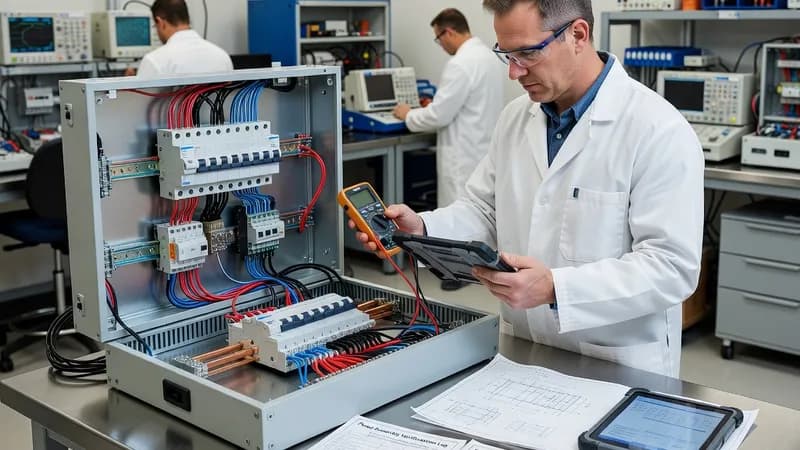
UL 891 and CSA C22.2 No. 286 define the core safety and construction framework for dead-front switchboards used in North America, with UL 891 governing the U.S. market and CSA C22.2 applying in Canada. For panel builders working on IEC 61439-based assemblies, these standards are critical when a project must be accepted by Authorities Having Jurisdiction, utilities, or NRTL certification bodies such as UL, CSA, or Intertek ETL. The standards address enclosure construction, bus-bar support and bracing, internal wiring, spacings, accessibility, temperature rise, dielectric performance, and short-circuit withstand behavior for low-voltage assemblies typically fed at 208/120 V, 480/277 V, or 600 V systems and rated from a few hundred amperes up to several thousand amperes depending on the switchboard design. Unlike IEC 61439-1/2, which relies heavily on verified design and routine verification of assemblies using recognized component coordination, UL 891 places strong emphasis on listed components, dead-front architecture, and fault testing performed to North American criteria. In practical engineering terms, that means incoming devices such as ACBs, MCCBs, fused disconnects, and molded-case branches must be selected from UL-listed product families with appropriate interrupting ratings, while power-control-center lineups, main-distribution-board sections, and generator paralleling gear must be evaluated for bus bracing, main bus short-circuit rating, and feeder protection coordination. For motor-control-center applications, UL 845 is often paired with or referenced alongside UL 891 considerations, especially where contactors, overload relays, soft starters, and VFDs are integrated into a common lineup. For power-factor-correction boards and capacitor-bank-panel solutions, the assembly must also address inrush current, discharge resistor arrangement, contactor duty, and thermal management. Compliance testing typically includes dielectric withstand, temperature rise validation, mechanical endurance of operating mechanisms, and short-circuit testing or application of tested combinations at the prescribed fault current level. Depending on the design, short-circuit ratings may range from 25 kA, 42 kA, 65 kA, 100 kA, or higher, provided the assembly and its protective devices are documented and labeled accordingly. Forms of separation are not defined in the same way as IEC Form 1 through Form 4; instead, UL 891 focuses on dead-front barriers, compartmentalization, and safe accessibility to live parts. Where industrial process or utility projects demand environmental resilience, additional requirements may apply under IEC 60079 for hazardous areas or IEC 61641 for arc-fault mitigation in low-voltage switchgear. In global projects, engineers often map IEC 61439-1/2 design verification data to a UL 891 compliance pathway, then verify component listings, wire insulation ratings, enclosure type, and labeling to satisfy both North American and international procurement specifications. This makes UL 891 / CSA C22.2 especially important for main-distribution-board, automatic-transfer-switch, generator-control-panel, lighting-distribution-board, dc-distribution-panel, and custom-engineered-panel packages serving commercial buildings, healthcare facilities, data centers, and infrastructure utilities where code acceptance, reliability, and documented short-circuit performance are non-negotiable.
Panels Certified to This Standard
Primary power distribution from transformer to sub-circuits. Rated up to 6300A. Houses main incoming breaker, bus-section, and outgoing feeders.
High-capacity power distribution for industrial facilities. Controls and distributes incoming power to MCC, APFC, and downstream loads.
Centralized motor control with starters, contactors, overloads, and VFDs in standardized withdrawable/fixed functional units.
Automatic capacitor switching for reactive power compensation. Thyristor or contactor-switched, detuned or standard configurations.
Automatic changeover between mains and generator/UPS. Open or closed transition, with or without bypass.
Genset start/stop sequencing, synchronization, load sharing, and paralleling controls.
Final distribution for lighting and small power. MCB/RCBO-based with DALI or KNX integration options.
Bespoke panel assemblies for non-standard requirements — special ratings, unusual form factors, multi-function combinations.
DC power distribution for battery systems, solar installations, telecom, and UPS applications. MCCB/fuse-based DC protection.
Fixed or automatic capacitor bank assemblies for bulk reactive power compensation in industrial and utility applications.
Related Industries
MDB, lighting distribution, APFC, ATS, metering, BTS, capacitor bank, BMS integration
High-reliability MDB, PCC, ATS (STS), metering, APFC, BTS, DC distribution
ATS (critical power), MDB, generator control, lighting, metering, APFC
MDB, ATS, metering, BTS, lighting distribution, DC distribution
Related Knowledge Articles
Frequently Asked Questions
Ready to Engineer Your Next Panel?
Our team of electrical engineers is ready to design, build, and deliver your custom panel solution — fully compliant with international standards.