Metering & Monitoring Panel for Industrial Manufacturing
Metering & Monitoring Panel assemblies engineered for Industrial Manufacturing applications, addressing industry-specific requirements and compliance standards.
Overview
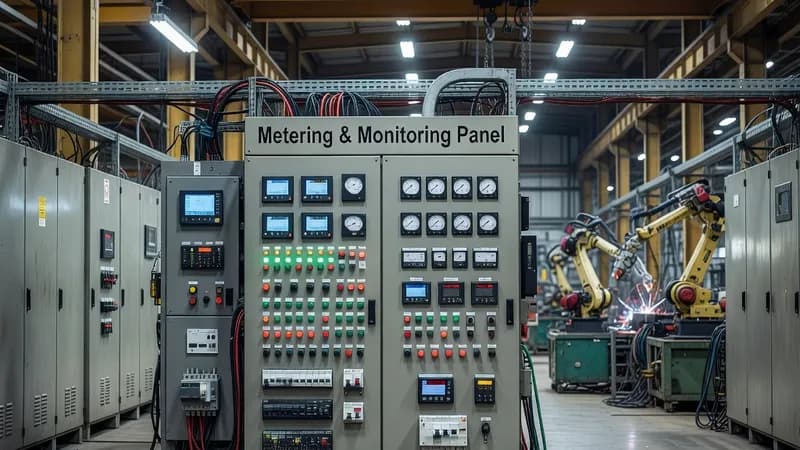
Metering & Monitoring Panel assemblies for industrial manufacturing plants are engineered to deliver continuous energy visibility, load profiling, and power quality diagnostics across utilities, process lines, and plant auxiliaries. For EPC contractors, panel builders, and facility managers, these assemblies are typically designed as IEC 61439-2 verified low-voltage switchgear and controlgear assemblies, with construction, temperature-rise performance, dielectric coordination, and short-circuit withstand capability documented for the project’s prospective fault level. In industrial plants, incomers are commonly based on ACBs up to 6300 A for main bus coupling or utility intake duties, MCCBs for feeder distribution, and fused switch-disconnectors for metering transformers or auxiliary circuits. Where production assets include variable-speed drives, the panel may also interface with VFDs, soft starters, motor protection relays, and contactor feeders to correlate energy consumption with machine duty cycles and process states. A well-engineered metering panel does more than display kW and kWh. It enables multi-point monitoring at transformer secondaries, main LV switchboards, MCC sections, compressor houses, HVAC substations, and critical process loads. Typical instrument packages include multifunction power meters, revenue or sub-billing energy analyzers, current transformers, voltage transformers, transducers, PLC interfaces, and communication gateways. Industrial protocols such as Modbus RTU/TCP, Profinet, Profibus, Ethernet/IP, and IEC 61850 integration are frequently used to connect the panel to SCADA, EMS, BMS, and plant historian platforms. Proper CT class selection, burden calculation, polarity verification, and terminal segregation are essential to maintain metering accuracy and avoid false demand alarms or misallocated utility costs. Industrial manufacturing environments place strong demands on enclosure design. Panels may be installed in production halls with elevated ambient temperatures, conductive dust, vibration, oil mist, or periodic washdown, so enclosure selection is typically based on the site-specific ingress protection requirement, commonly IP31, IP42, IP54, or higher. Thermal management may include filtered ventilation, thermostatic fans, anti-condensation heaters, and partitioned cable chambers to preserve meter accuracy and communication stability. Where the installation is adjacent to hazardous process areas, design considerations may also reference IEC 60079 for explosive atmospheres. For arc-related safety and containment planning, IEC/TR 61641 practices are often applied alongside tested assembly arrangements to reduce operator exposure during internal arcing events. Internal arrangement is equally important. Forms of separation under IEC 61439-2, such as Form 2, Form 3, or Form 4, are selected to isolate incoming devices, outgoing feeders, and functional units so maintenance can be performed with limited shutdown scope. This is especially valuable in plants with 24/7 production, where downtime is expensive and energy data must remain available during maintenance windows. Short-circuit ratings are commonly engineered at 25 kA, 36 kA, 50 kA, or higher, depending on the network study, with busbar systems and outgoing devices coordinated under IEC 60947 to ensure selectivity and protective device discrimination. For related distribution architectures, design verification may also reference IEC 61439-1, IEC 61439-3 for distribution boards, and IEC 61439-6 for busbar trunking interfaces. In real-world industrial manufacturing applications, these panels support metal fabrication shops, food and beverage plants, packaging lines, automotive suppliers, plastics processing, textile facilities, and general discrete manufacturing sites. By combining metering accuracy, protection coordination, communications readiness, and robust mechanical design, Patrion’s Metering & Monitoring Panel solutions help customers reduce energy waste, improve load management, support preventive maintenance, and strengthen operational traceability across the facility.
Key Features
- Metering & Monitoring Panel configured for Industrial Manufacturing requirements
- Industry-specific environmental ratings and protections
- Compliance with sector-specific standards and regulations
- Optimized component selection for industry applications
- Integration with industry-standard control and monitoring systems
Specifications
| Property | Value |
|---|---|
| Panel Type | Metering & Monitoring Panel |
| Industry | Industrial Manufacturing |
| Base Standard | IEC 61439-2 |
| Environment | Industry-specific ratings |
Other Panels for Industrial Manufacturing
Primary power distribution from transformer to sub-circuits. Rated up to 6300A. Houses main incoming breaker, bus-section, and outgoing feeders.
High-capacity power distribution for industrial facilities. Controls and distributes incoming power to MCC, APFC, and downstream loads.
Centralized motor control with starters, contactors, overloads, and VFDs in standardized withdrawable/fixed functional units.
Automatic capacitor switching for reactive power compensation. Thyristor or contactor-switched, detuned or standard configurations.
Automatic changeover between mains and generator/UPS. Open or closed transition, with or without bypass.
Enclosed VFD assemblies with input protection, line reactors, EMC filters, output reactors, and bypass options.
Process and machine control panels housing PLCs, I/O modules, relays, HMIs, and communication infrastructure.
Prefabricated busbar distribution per IEC 61439-6. Sandwich or air-insulated, aluminum or copper.
Enclosed soft starter assemblies for reduced voltage motor starting with torque control, ramp-up/down profiles, and bypass contactor options.
Active or passive harmonic filtering to mitigate THD from non-linear loads. Tuned LC filters, active filters, or hybrid configurations.
Fixed or automatic capacitor bank assemblies for bulk reactive power compensation in industrial and utility applications.
Bespoke panel assemblies for non-standard requirements — special ratings, unusual form factors, multi-function combinations.
Other Industries Using Metering & Monitoring Panel
MDB, lighting distribution, APFC, ATS, metering, BTS, capacitor bank, BMS integration
High-reliability MDB, PCC, ATS (STS), metering, APFC, BTS, DC distribution
ATS (critical power), MDB, generator control, lighting, metering, APFC
Ex-rated panels, MCC, PCC, VFD, generator control, soft starters, ATEX/IECEx compliance
MCC, VFD panels, PLC automation, APFC, generator control, soft starters
MDB, metering, APFC, ATS, PLC, DC distribution, capacitor banks
MDB, ATS, metering, BTS, lighting distribution, DC distribution
Washdown-rated panels (IP65+), MCC, VFD, APFC, PLC, soft starters, harmonic filters
Cleanroom-compatible panels, MCC, VFD, APFC, PLC, soft starters, harmonic filters
Frequently Asked Questions
Ready to Engineer Your Next Panel?
Our team of electrical engineers is ready to design, build, and deliver your custom panel solution — fully compliant with international standards.