Metering & Monitoring Panel for Commercial Buildings
Metering & Monitoring Panel assemblies engineered for Commercial Buildings applications, addressing industry-specific requirements and compliance standards.
Overview
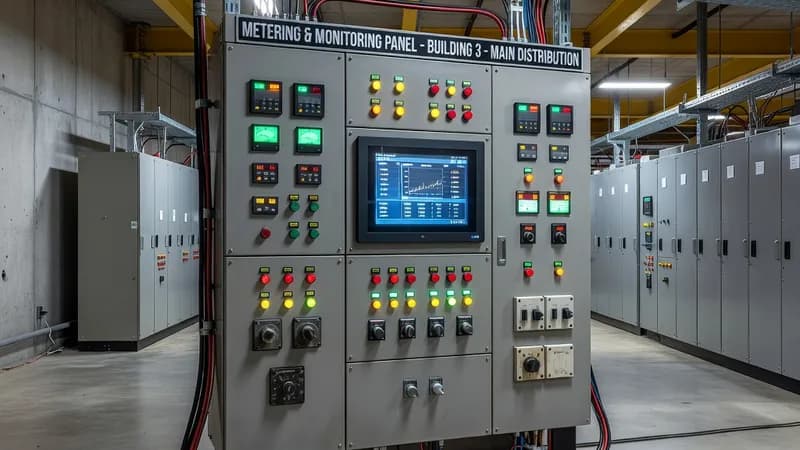
Metering & Monitoring Panel assemblies for commercial buildings are built to provide accurate energy measurement, resilient distribution, and high-visibility system supervision across offices, shopping malls, hospitals, hotels, airports, data centers, and mixed-use developments. In practice, these panels often serve as the interface between the utility incomer, the main distribution board (MDB), sub-distribution boards, automatic transfer switch (ATS) systems, capacitor banks, photovoltaic interfaces, and building management systems (BMS). Depending on the project, the assembly may include direct-connected or CT-operated meters, multifunction power analyzers, protection relays, communication gateways, and networked transducers for voltage, current, frequency, power factor, demand, and harmonic analysis. Engineering should start with IEC 61439-1 and IEC 61439-2 for low-voltage switchgear and controlgear assemblies, including verification of temperature rise, dielectric properties, short-circuit withstand, clearances and creepage, and protective circuit integrity. For final distribution applications inside buildings, IEC 61439-3 is relevant where the panel forms part of a distribution board intended for operation by ordinary persons. Where the metering cubicle is used in utility-facing or energy-accounting applications, IEC 61439-6 may apply for busbar trunking interfaces. Component selection typically follows IEC 60947 series requirements for ACBs, MCCBs, switch-disconnectors, contactors, motor starters, and protection devices. In commercial sites with critical loads, ACB incomers up to 6300 A, MCCB feeders in the 100 to 1600 A range, and busbar systems with short-circuit ratings from 25 kA to 100 kA are common, subject to the project fault level and verified combination ratings. Typical metering and monitoring architectures include multifunction meters with Modbus RTU, Modbus TCP, BACnet/IP, or BACnet MS/TP communication, often integrated with VFDs, soft starters, APFC controllers, and protection relays for utility and tenant load segregation. For power quality-sensitive buildings, the panel may incorporate harmonic meters, THD monitoring, surge protective devices, and capacitor bank detuning reactors to mitigate resonance. In premium applications, dual-source metering, peak-demand logging, kWh sub-billing, and zone-level energy dashboards support ISO 50001 energy management strategies and operational cost allocation. Environmental design is equally important. Commercial building panels may be installed in electrical rooms, basement plant areas, rooftop enclosures, or parking structures, so enclosure selection often targets IP31, IP42, IP54, or higher, with corrosion-resistant coatings where humidity or polluted air is present. Ventilation, forced cooling, anti-condensation heaters, and internal segregation are used to maintain component life and compliance. For internal separation, forms of separation 1 to 4 are selected based on maintenance philosophy and continuity of service, with Form 3b or Form 4 commonly used where tenant circuits must remain energized during servicing. In special areas such as fuel handling rooms or hazardous service zones adjacent to commercial facilities, IEC 60079 considerations may be necessary; for fire resistance or smoke-exposed plantrooms, IEC 61641 can be relevant for verification of behavior under internal arcing and fire conditions where specified by the project. A well-designed Metering & Monitoring Panel improves billing accuracy, supports predictive maintenance, and gives facility managers real-time visibility into power quality, load profiles, and abnormal events. Patrion manufactures IEC-compliant assemblies in Turkey for EPC contractors and building operators who require dependable metering architecture, coordinated protection, and seamless BMS integration in demanding commercial building projects.
Key Features
- Metering & Monitoring Panel configured for Commercial Buildings requirements
- Industry-specific environmental ratings and protections
- Compliance with sector-specific standards and regulations
- Optimized component selection for industry applications
- Integration with industry-standard control and monitoring systems
Specifications
| Property | Value |
|---|---|
| Panel Type | Metering & Monitoring Panel |
| Industry | Commercial Buildings |
| Base Standard | IEC 61439-2 |
| Environment | Industry-specific ratings |
Other Panels for Commercial Buildings
Primary power distribution from transformer to sub-circuits. Rated up to 6300A. Houses main incoming breaker, bus-section, and outgoing feeders.
Final distribution for lighting and small power. MCB/RCBO-based with DALI or KNX integration options.
Automatic capacitor switching for reactive power compensation. Thyristor or contactor-switched, detuned or standard configurations.
Automatic changeover between mains and generator/UPS. Open or closed transition, with or without bypass.
Prefabricated busbar distribution per IEC 61439-6. Sandwich or air-insulated, aluminum or copper.
Fixed or automatic capacitor bank assemblies for bulk reactive power compensation in industrial and utility applications.
Bespoke panel assemblies for non-standard requirements — special ratings, unusual form factors, multi-function combinations.
Other Industries Using Metering & Monitoring Panel
MCC, PCC, VFD panels, MDB, APFC, automation panels, soft starters, harmonic filters, capacitor banks — full range
High-reliability MDB, PCC, ATS (STS), metering, APFC, BTS, DC distribution
ATS (critical power), MDB, generator control, lighting, metering, APFC
Ex-rated panels, MCC, PCC, VFD, generator control, soft starters, ATEX/IECEx compliance
MCC, VFD panels, PLC automation, APFC, generator control, soft starters
MDB, metering, APFC, ATS, PLC, DC distribution, capacitor banks
MDB, ATS, metering, BTS, lighting distribution, DC distribution
Washdown-rated panels (IP65+), MCC, VFD, APFC, PLC, soft starters, harmonic filters
Cleanroom-compatible panels, MCC, VFD, APFC, PLC, soft starters, harmonic filters
Frequently Asked Questions
Ready to Engineer Your Next Panel?
Our team of electrical engineers is ready to design, build, and deliver your custom panel solution — fully compliant with international standards.