Custom Engineered Panel for Commercial Buildings
Custom Engineered Panel assemblies engineered for Commercial Buildings applications, addressing industry-specific requirements and compliance standards.
Overview
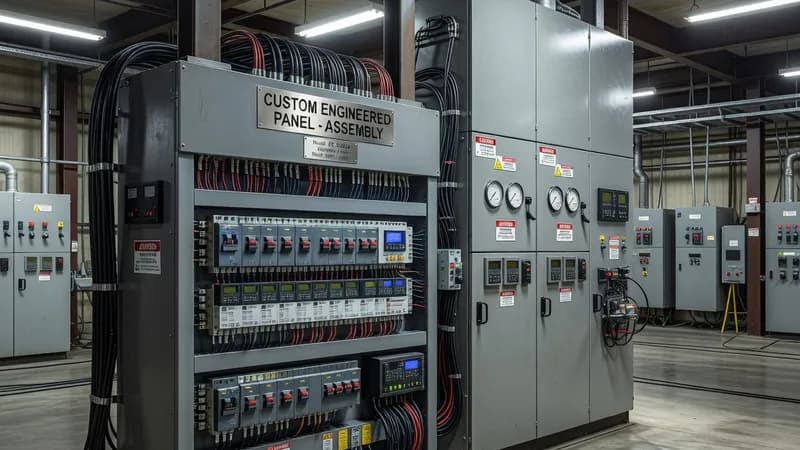
Custom Engineered Panel assemblies for commercial buildings are designed around the real operating profile of offices, malls, hospitals, hotels, airports, education campuses, and mixed-use developments where continuity of supply, selective coordination, metering accuracy, and maintainability are critical. These assemblies are typically built to IEC 61439-2 for power switchgear and controlgear assemblies, with associated verification of temperature rise, dielectric properties, short-circuit withstand strength, and protective circuit integrity. Depending on the application, engineering may also reference IEC 61439-1 for general requirements, IEC 61439-3 for distribution boards intended for ordinary persons, and IEC 61439-6 for busbar trunking interface and feeder sections. For site installation and commissioning, IEC 60364 practices are often applied alongside local electrical regulations and utility interface requirements. In commercial buildings, common configurations include main distribution boards (MDBs), sub-main distribution boards, final lighting and small power panels, automatic power factor correction (APFC) banks, automatic transfer switches (ATS), metering panels, emergency distribution boards, and BMS integration panels. Incoming protection is usually implemented with air circuit breakers (ACBs) for high-capacity mains up to 6300 A, or molded case circuit breakers (MCCBs) for feeders and submains typically up to 1600 A, selected with appropriate breaking capacity and discrimination margins. Outgoing circuits may use MCBs, MCCBs, contactors, motor starters, protection relays, or residual current devices depending on the load class. Where energy efficiency and occupant comfort matter, variable frequency drives (VFDs) and soft starters are integrated for HVAC pumps, cooling tower fans, smoke control fans, and water booster systems, with coordination to building automation systems. Commercial building panels are often specified with form of separation per IEC 61439-2, commonly Form 2, Form 3b, or Form 4 to improve safety, service continuity, and fault localization. The chosen form depends on maintenance strategy, access restrictions, and whether live maintenance windows are limited. Short-circuit ratings are project-specific and may range from 25 kA to 100 kA or higher at 415 V AC, verified by design or routine testing. Enclosure selection typically targets IP31, IP42, IP54, or higher depending on location, dust exposure, cleaning regime, and plantroom conditions. Indoor plantrooms, basements, roof spaces, and public areas demand different corrosion protection, ventilation, and thermal management approaches. Thermal performance is especially important in dense APFC and metering sections, where harmonic currents from LED drivers, UPS systems, elevators, and VFDs can increase losses and require detuned reactors, harmonic filters, or oversized neutral bars. Safety and compliance may also involve IEC 61641 for internal arc fault mitigation in accessible electrical rooms, IEC 60947 for low-voltage switchgear and controlgear components, and IEC 60079 where panels are installed in hazardous areas within commercial campuses such as fuel depots or specialized service zones. Real-world commercial applications often require intelligent metering, Modbus RTU/TCP, BACnet gateway integration, surge protection devices, and remote trip/close functions for energy management and fault response. Patrion manufactures custom engineered MCC and distribution solutions in Turkey for commercial building applications, supporting EPC contractors, consultants, and facility managers with coordinated layouts, maintainable busbar systems, compartmentalized designs, and documentation aligned with international standards. The result is a panel package optimized for uptime, tenant safety, lifecycle efficiency, and straightforward expansion as building loads evolve.
Key Features
- Custom Engineered Panel configured for Commercial Buildings requirements
- Industry-specific environmental ratings and protections
- Compliance with sector-specific standards and regulations
- Optimized component selection for industry applications
- Integration with industry-standard control and monitoring systems
Specifications
| Property | Value |
|---|---|
| Panel Type | Custom Engineered Panel |
| Industry | Commercial Buildings |
| Base Standard | IEC 61439-2 |
| Environment | Industry-specific ratings |
Other Panels for Commercial Buildings
Primary power distribution from transformer to sub-circuits. Rated up to 6300A. Houses main incoming breaker, bus-section, and outgoing feeders.
Final distribution for lighting and small power. MCB/RCBO-based with DALI or KNX integration options.
Automatic capacitor switching for reactive power compensation. Thyristor or contactor-switched, detuned or standard configurations.
Automatic changeover between mains and generator/UPS. Open or closed transition, with or without bypass.
Energy metering, power quality analysis, and multi-circuit monitoring with communication gateways.
Prefabricated busbar distribution per IEC 61439-6. Sandwich or air-insulated, aluminum or copper.
Fixed or automatic capacitor bank assemblies for bulk reactive power compensation in industrial and utility applications.
Other Industries Using Custom Engineered Panel
MCC, PCC, VFD panels, MDB, APFC, automation panels, soft starters, harmonic filters, capacitor banks — full range
High-reliability MDB, PCC, ATS (STS), metering, APFC, BTS, DC distribution
ATS (critical power), MDB, generator control, lighting, metering, APFC
Ex-rated panels, MCC, PCC, VFD, generator control, soft starters, ATEX/IECEx compliance
Rugged MCC, PCC, VFD panels, generator panels, soft starters, harmonic filters
MDB, metering, APFC, ATS, PLC, DC distribution, capacitor banks
Marine-certified panels, MCC, generator sync, ATS, PLC, classification society compliance
MDB, ATS, metering, BTS, lighting distribution, DC distribution
Washdown-rated panels (IP65+), MCC, VFD, APFC, PLC, soft starters, harmonic filters
Cleanroom-compatible panels, MCC, VFD, APFC, PLC, soft starters, harmonic filters
Frequently Asked Questions
Ready to Engineer Your Next Panel?
Our team of electrical engineers is ready to design, build, and deliver your custom panel solution — fully compliant with international standards.