MCC Panels

Air Circuit Breakers (ACB) in Main Distribution Board (MDB)

Air Circuit Breakers (ACB) selection, integration, and best practices for Main Distribution Board (MDB) assemblies compliant with IEC 61439.
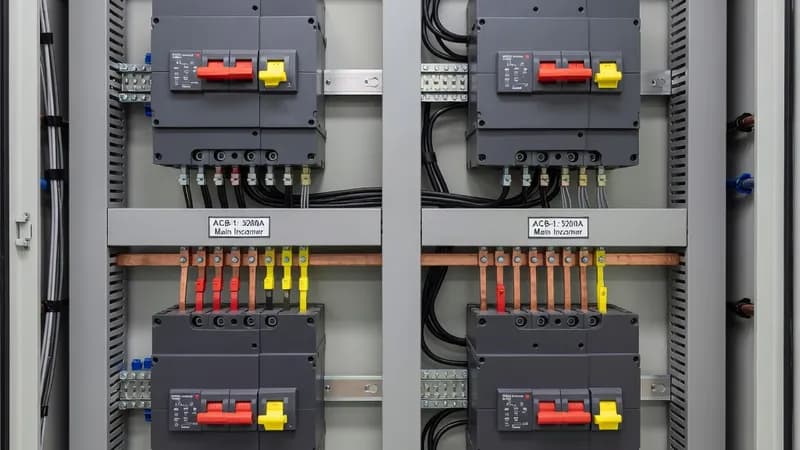
Air Circuit Breakers (ACB) in Main Distribution Board (MDB)

Overview

Air Circuit Breakers (ACB) in a Main Distribution Board (MDB) are the primary switching and protection devices for high-current low-voltage power distribution, typically serving utility incomers, generator incomers, bus couplers, and large outgoing feeders. In IEC 61439-2 assemblies, ACBs are selected not only for their rated operational current, but for their full contribution to the MDB’s verified performance: temperature-rise limits, short-circuit withstand, dielectric coordination, and protective device compatibility. In practice, MDBs commonly use 630 A to 6300 A ACBs in fixed or draw-out execution, with breaking capacities matched to prospective fault levels at the installation point and coordinated with the busbar system, neutral sizing, and earthing arrangement. Modern ACBs from leading IEC 60947-2 families include electronic trip units with LSI or LSIG functions, adjustable long-time and short-time delays, instantaneous protection, ground fault protection, and metering for current, voltage, power, and energy. For MDB applications, selection starts with the system architecture. Main incomers may be 3P or 4P ACBs depending on neutral treatment and harmonic loading, while bus couplers are used to segment the board and maintain continuity during maintenance or contingencies. Draw-out ACBs are preferred in critical facilities because they support isolation, inspection, and replacement without disturbing busbar terminations. Coordination must be verified with upstream transformers, generator sets, and downstream MCCBs, MCBs, and motor starters to achieve selective tripping and cascading where permitted. This is especially important when the MDB feeds VFDs, soft starters, UPS systems, HVAC plant, process loads, and mission-critical services in data centers, hospitals, airports, and industrial plants. A compliant MDB design also addresses thermal and mechanical constraints. ACB heat dissipation, busbar losses, cable termination methods, and enclosure ventilation must be evaluated under IEC 61439-1/2 temperature-rise verification principles. High-current assemblies may require compartmentalization, forced ventilation, or optimized vertical busbar layouts to maintain safe internal temperatures and preserve protective device performance. Forms of separation, such as Form 2, Form 3, or Form 4 segregation, are applied to improve personnel safety, reduce fault propagation, and facilitate maintenance, although the chosen form must be verified against the complete assembly design. For digitally managed electrical infrastructure, ACBs are often equipped with Modbus, Profibus, Ethernet, or gateway-enabled communication modules for SCADA and BMS integration. This supports remote status, alarms, trip histories, energy monitoring, and predictive maintenance. In hazardous environments, MDB coordination may also require awareness of IEC 60079 requirements for explosive atmospheres, while arc-related containment and worker protection may involve IEC/TR 61641 guidance for low-voltage switchgear and controlgear assemblies under internal arc conditions, where applicable. The result is a robust, standards-aligned MDB architecture in which the ACB is not just a breaker, but a fully engineered protection and control asset matched to the assembly’s rated current, short-circuit rating, and operational duty. Patrion engineers and manufactures MDB panels with ACB solutions tailored to project-specific fault levels, load diversity, and maintainability targets, ensuring IEC 61439 documentation, coordination studies, and practical field performance align from design to commissioning.

Key Features

  • Air Circuit Breakers (ACB) rated for Main Distribution Board (MDB) operating conditions
  • IEC 61439 compliant integration and coordination
  • Thermal management within panel enclosure limits
  • Communication-ready for SCADA/BMS integration
  • Coordination with upstream and downstream protection devices

Specifications

PropertyValue
Panel TypeMain Distribution Board (MDB)
ComponentAir Circuit Breakers (ACB)
StandardIEC 61439-2
IntegrationType-tested coordination

Other Components for Main Distribution Board (MDB)

Other Panels Using Air Circuit Breakers (ACB)

Frequently Asked Questions

MDB ACBs are commonly specified from 630 A up to 6300 A, depending on transformer size, load diversity, and busbar rating. The selection must align with the assembly’s rated current, rated diversity factor, and short-circuit withstand capability under IEC 61439-2. In practice, the breaker’s rated operational current (In), ultimate breaking capacity, and service breaking capacity must be coordinated with the prospective fault current at the MDB incomer. For high-demand facilities, draw-out ACBs are often preferred because they allow maintenance without disturbing the busbars or cable terminations. Engineering verification should also confirm temperature-rise limits, neutral sizing, and compatibility with upstream transformer impedance and downstream protective devices such as MCCBs and feeder ACBs.
The choice between 3P and 4P depends on the earthing system, neutral loading, harmonic content, and operational requirements. A 4-pole ACB is often used when the neutral must be switched or isolated, such as in TN-S systems with significant single-phase loading, generator changeover schemes, or where neutral continuity must be controlled for maintenance. A 3-pole ACB may be suitable when the neutral is solidly connected and not required to be switched. Under IEC 60947-2 and IEC 61439-2, the decision should be based on system studies, including fault analysis and load flow. In MDBs feeding VFDs, UPS systems, and IT loads, harmonic currents can increase neutral stress, making 4P configurations more attractive.
ACB coordination with the busbar system is critical because the breaker must not only interrupt the fault, but also withstand the mechanical and thermal stresses until clearing occurs. Under IEC 61439-1/2, the MDB assembly must have a verified short-circuit withstand rating, typically expressed in kA for 1 second or as a peak withstand value. The ACB’s short-time withstand current (Icw), making capacity, and breaking capacity must be equal to or greater than the installation’s prospective fault current, subject to selectivity strategy. Busbar cross-section, support spacing, and phase segregation must also be checked. In many projects, Patrion engineers validate the entire assembly using verified design rules or testing, ensuring the ACB, busbars, and enclosure all share compatible ratings.
Yes. Modern ACBs are frequently supplied with electronic trip units and communication modules that provide status, metering, alarms, trip history, and remote control interfaces. Common integrations include Modbus RTU, Modbus TCP, Profibus, and Ethernet-based gateways for SCADA and BMS platforms. This is particularly valuable in hospitals, data centers, shopping malls, and industrial plants where energy visibility and remote diagnostics improve uptime. Communication does not replace protection; it complements it by enabling monitoring and maintenance planning. When specifying the MDB, the communication architecture should be matched to the plant network standard, the required points list, and the breaker family chosen under IEC 60947-2. Panel design should also accommodate auxiliary wiring segregation and EMC best practices.
For most MDB applications, electronic trip units with long-time, short-time, and instantaneous protection are the baseline. Where downstream selectivity or earth fault management is needed, LSIG functionality is preferred. Long-time protection guards against overloads, short-time delay improves coordination with feeder breakers, instantaneous protects against severe faults, and ground fault protection reduces damage in TN or TT systems. Advanced ACBs also include thermal memory, alarm functions, event logging, and adjustable pickup values. Selection should be based on load profile, transformer rating, and coordination study results. IEC 60947-2 governs the breaker performance, while the MDB assembly performance remains subject to IEC 61439-2 verification for temperature rise, dielectric clearances, and short-circuit capability.
Draw-out ACBs are generally preferred in critical MDBs because they improve maintainability, inspection, and replacement speed. A draw-out mechanism allows the breaker to be racked between connected, test, and isolated positions, reducing downtime and improving personnel safety during maintenance. This is especially useful in facilities with continuous operation such as utilities, process plants, and data centers. Fixed ACBs can be cost-effective and compact, but they make replacement and servicing more intrusive. The choice should consider space, maintenance strategy, and outage tolerance. Under IEC 61439-2, the assembly must still be verified for temperature rise, dielectric performance, and short-circuit withstand regardless of mounting style. Patrion often specifies draw-out ACBs for critical incomers and bus couplers in high-reliability MDBs.
Coordination is achieved through time-current selectivity and correct setting of the ACB electronic trip unit. The MDB incomer ACB should allow downstream MCCBs, motor protective circuit breakers, contactors, soft starters, and VFD feeders to clear faults locally whenever possible. This minimizes outage propagation and preserves service continuity. Selectivity studies typically evaluate long-time, short-time, and instantaneous settings, plus energy let-through where cascading is used. In motor-rich installations, feeder protection may also need to account for inrush currents and starting profiles. IEC 60947-2 and IEC 61439-2 provide the device and assembly framework, but the actual coordination depends on manufacturer curves and verified combination data. A proper study is essential before finalizing the MDB design.
ACBs generate heat through current flow and contact resistance, so thermal management is a key design issue in large MDB panels. High-current incomers, busbar losses, cable lugs, and adjacent devices can push the enclosure toward its temperature-rise limits. Under IEC 61439-1/2, the complete assembly must be verified so terminals, conductors, and devices remain within permissible temperature rise values. Engineers may use ventilated enclosures, larger compartment volumes, optimized busbar placement, forced cooling, or reduced density layouts. Separation forms such as Form 3 or Form 4 can also influence heat distribution and maintenance access. Thermal modeling or testing is often used for MDBs with high ambient temperatures, dense outgoing feeders, or continuous-duty industrial loads.
Air Circuit Breakers in Main Distribution Boards are selected to match the assembly’s rated current, short-circuit level, and operating duty. Patrion designs IEC 61439-compliant MDBs with ACB incomers, bus couplers, and feeders coordinated for selectivity, temperature rise, and SCADA integration. Request a quote or contact our engineering team for a project-specific design.

Ready to Engineer Your Next Panel?

Our team of electrical engineers is ready to design, build, and deliver your custom panel solution — fully compliant with international standards.