Metering & Power Analyzers in Main Distribution Board (MDB)
Metering & Power Analyzers selection, integration, and best practices for Main Distribution Board (MDB) assemblies compliant with IEC 61439.
Overview
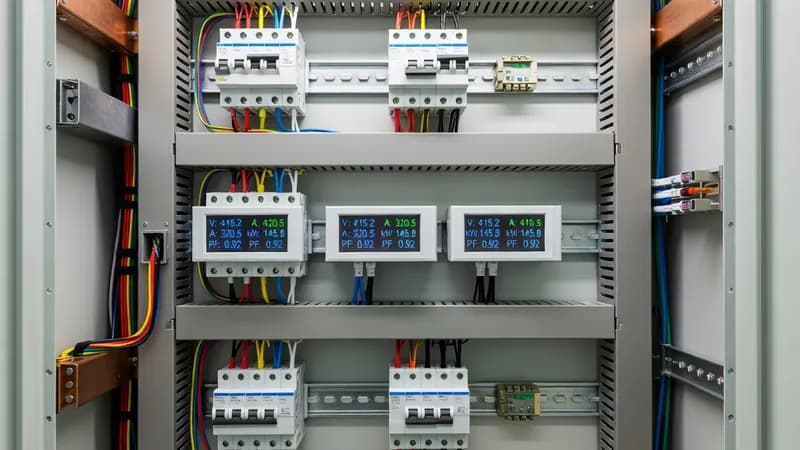
Metering and power analyzers in a Main Distribution Board (MDB) are the core of energy visibility, load management, and power quality control for LV distribution systems. In IEC 61439-1/2 assemblies, these devices are typically installed in the functional metering section of the MDB, either as door-mounted multifunction meters, DIN-rail power analyzers, or embedded HMI-class meters with RS-485, Modbus RTU/TCP, or Ethernet communication. For critical facilities, they are often paired with current transformers (CTs) of 1 A or 5 A secondary, voltage sensing via fused voltage tapping, and optional auxiliary voltage inputs for loss-of-supply diagnostics. Typical applications include utility incomer monitoring, generator-parallel boards, data centers, industrial plants, hospitals, airports, and commercial buildings where demand control and tariff optimization are essential. Selection must be based on the MDB rated current, busbar arrangement, short-circuit withstand capability, and the metering philosophy of the installation. In large boards with ACB incomers up to 6300 A and busbar systems with Icw values in the 65 kA to 100 kA range, the metering circuit must be segregated and protected in accordance with IEC 60947-2 and the panel’s verified design. Where multiple feeders are monitored, the design may include feeder meters for MCCBs, protection relays for transformer incomers, and power quality analyzers capable of recording harmonics, unbalance, flicker, THD, and voltage events. Instruments should be selected with accuracy classes suitable for the objective: class 0.5S or better for billing-grade energy metering, and class 1 or 2 for operational monitoring. Integration into the MDB must preserve the declared forms of internal separation, commonly Form 2b, Form 3b, or Form 4b depending on maintenance strategy and continuity requirements. Metering circuits should not compromise live-part segregation, creepage distances, or access safety. CT shorting terminals, fused voltage circuits, and dedicated test blocks are strongly recommended to enable safe commissioning and maintenance. For IEC 61439 temperature-rise compliance, devices with low self-heating, compact profiles, and suitable ambient ratings should be chosen, especially in dense sections where proximity to VFDs, soft starters, protection relays, PLC interfaces, or communication gateways can elevate internal temperatures. A well-designed MDB metering package also supports system coordination. By combining power analyzers with ACB and MCCB trip units, event logs, and digital communications, operators can correlate load profiles with protective device operations and identify overloads, inrush events, and harmonic distortion caused by nonlinear loads. In mixed-use installations, metering data is used to supervise capacitor banks, filter reactors, ATS/STS systems, and generator sets. For harsh environments, enclosure selection and internal wiring practices should also consider IEC 61439 environmental constraints, IEC 61641 arc fault performance expectations where applicable, and IEC 60079 requirements for adjacent hazardous-area interfaces when the MDB feeds explosive atmospheres through approved barriers. Patrion designs and manufactures MDBs in Turkey with metering architectures tailored to project requirements, whether the objective is utility-grade energy accounting, predictive maintenance, or full SCADA/BMS integration. Properly engineered metering and power analyzers improve operational transparency, reduce downtime, and provide the data backbone for modern smart distribution boards.
Key Features
- Metering & Power Analyzers rated for Main Distribution Board (MDB) operating conditions
- IEC 61439 compliant integration and coordination
- Thermal management within panel enclosure limits
- Communication-ready for SCADA/BMS integration
- Coordination with upstream and downstream protection devices
Specifications
| Property | Value |
|---|---|
| Panel Type | Main Distribution Board (MDB) |
| Component | Metering & Power Analyzers |
| Standard | IEC 61439-2 |
| Integration | Type-tested coordination |
Other Components for Main Distribution Board (MDB)
Main incoming/outgoing protection, 630A–6300A, draw-out mounting
Branch protection 16A–1600A, thermal-magnetic or electronic trip
Copper/aluminum busbars, busbar supports, tap-off units
Type 1/2/3 surge arresters, coordination, monitoring
Overcurrent, earth fault, differential, generator protection relays
Other Panels Using Metering & Power Analyzers
High-capacity power distribution for industrial facilities. Controls and distributes incoming power to MCC, APFC, and downstream loads.
Automatic capacitor switching for reactive power compensation. Thyristor or contactor-switched, detuned or standard configurations.
Automatic changeover between mains and generator/UPS. Open or closed transition, with or without bypass.
Genset start/stop sequencing, synchronization, load sharing, and paralleling controls.
Energy metering, power quality analysis, and multi-circuit monitoring with communication gateways.
Final distribution for lighting and small power. MCB/RCBO-based with DALI or KNX integration options.
Prefabricated busbar distribution per IEC 61439-6. Sandwich or air-insulated, aluminum or copper.
Bespoke panel assemblies for non-standard requirements — special ratings, unusual form factors, multi-function combinations.
Active or passive harmonic filtering to mitigate THD from non-linear loads. Tuned LC filters, active filters, or hybrid configurations.
DC power distribution for battery systems, solar installations, telecom, and UPS applications. MCCB/fuse-based DC protection.
Fixed or automatic capacitor bank assemblies for bulk reactive power compensation in industrial and utility applications.
Frequently Asked Questions
Ready to Engineer Your Next Panel?
Our team of electrical engineers is ready to design, build, and deliver your custom panel solution — fully compliant with international standards.