Surge Protection Devices (SPD) in Main Distribution Board (MDB)
Surge Protection Devices (SPD) selection, integration, and best practices for Main Distribution Board (MDB) assemblies compliant with IEC 61439.
Overview
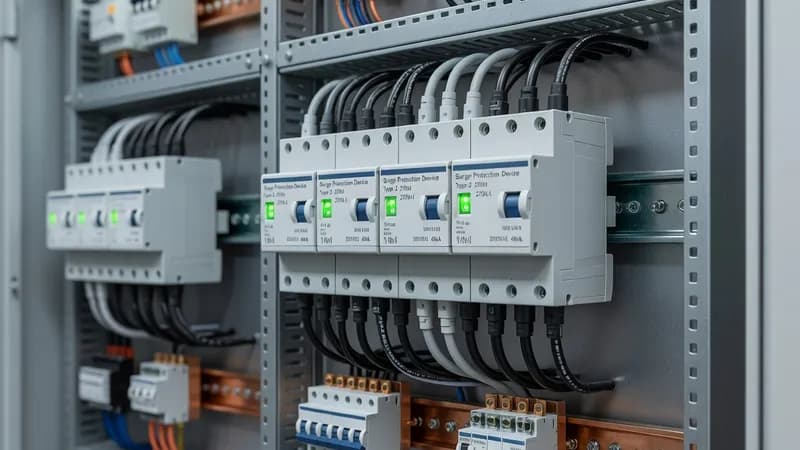
Surge Protection Devices (SPD) in a Main Distribution Board (MDB) are a critical line of defense against transient overvoltages caused by lightning strikes, utility switching, capacitor bank operations, and inductive load disconnection. In IEC 61439-2 assemblies, SPD selection must be coordinated with the MDB’s earthing system, prospective short-circuit current, busbar arrangement, and downstream distribution structure to ensure both protective effectiveness and mechanical/thermal compatibility. In practice, MDBs may incorporate Type 1 SPDs at the service entrance for lightning current discharge, Type 2 SPDs on distribution sections for switching surges, and Type 3 SPDs near sensitive loads where equipment immunity is lower. The correct arrangement depends on the site’s lightning protection system and the separation of incoming feeder, metering, and outgoing sections within the panel. For industrial and commercial MDBs, SPDs are commonly installed with MCCBs or ACB incomers rated from 630 A up to 6300 A, with coordination based on the available fault level and the upstream protective device. IEC 61643-11 governs SPD performance, while IEC 60364-5-534 is used widely for selection and installation practices. Within the MDB, the SPD connection leads must be kept short and direct to minimize let-through voltage, and the protective conductor bonding must be sized to handle surge discharge currents. Coordination with upstream fuses, MCCBs, or ACBs is essential to avoid nuisance tripping and to preserve the SPD’s surge withstand capability. In systems using TN-S, TN-C-S, TT, or IT earthing, the wiring topology changes the required SPD configuration, such as 3+1 arrangements for TT systems. The SPD’s integration into an IEC 61439 assembly must also consider temperature-rise limits, internal segregation, and enclosure ventilation. Since SPDs dissipate heat during operation and may contain status indicators, auxiliary contacts, or remote monitoring modules, they should be mounted in a way that preserves the panel’s IP rating and maintains safe clearances to busbars, cable terminals, and electronic relays. Form of separation 2, 3a, 3b, or 4 may be used in MDB compartments depending on maintainability and service continuity requirements. Where communication is required, SPDs with dry contacts, Modbus gateways, or BMS/SCADA interfaces can provide alarm reporting for end-of-life indication and module degradation. In real-world applications, SPDs in MDBs protect VFDs, soft starters, PLC panels, metering systems, fire alarm panels, and BMS controllers from voltage spikes that can cause downtime or irreversible damage. For sites with critical loads such as hospitals, data rooms, water treatment plants, airports, and manufacturing lines, the MDB should be engineered with a coordinated surge protection strategy and verified short-circuit rating, typically 25 kA, 36 kA, 50 kA, or higher depending on the installation. Patrion designs and manufactures MDB solutions in Turkey with IEC 61439-1/2 compliance, ensuring that SPD integration is validated as part of the complete assembly, not treated as an isolated accessory.
Key Features
- Surge Protection Devices (SPD) rated for Main Distribution Board (MDB) operating conditions
- IEC 61439 compliant integration and coordination
- Thermal management within panel enclosure limits
- Communication-ready for SCADA/BMS integration
- Coordination with upstream and downstream protection devices
Specifications
| Property | Value |
|---|---|
| Panel Type | Main Distribution Board (MDB) |
| Component | Surge Protection Devices (SPD) |
| Standard | IEC 61439-2 |
| Integration | Type-tested coordination |
Other Components for Main Distribution Board (MDB)
Main incoming/outgoing protection, 630A–6300A, draw-out mounting
Branch protection 16A–1600A, thermal-magnetic or electronic trip
Copper/aluminum busbars, busbar supports, tap-off units
Energy meters, power quality analyzers, CT/VT, communication gateways
Overcurrent, earth fault, differential, generator protection relays
Other Panels Using Surge Protection Devices (SPD)
High-capacity power distribution for industrial facilities. Controls and distributes incoming power to MCC, APFC, and downstream loads.
Enclosed VFD assemblies with input protection, line reactors, EMC filters, output reactors, and bypass options.
Energy metering, power quality analysis, and multi-circuit monitoring with communication gateways.
Final distribution for lighting and small power. MCB/RCBO-based with DALI or KNX integration options.
Prefabricated busbar distribution per IEC 61439-6. Sandwich or air-insulated, aluminum or copper.
Bespoke panel assemblies for non-standard requirements — special ratings, unusual form factors, multi-function combinations.
DC power distribution for battery systems, solar installations, telecom, and UPS applications. MCCB/fuse-based DC protection.
Frequently Asked Questions
Ready to Engineer Your Next Panel?
Our team of electrical engineers is ready to design, build, and deliver your custom panel solution — fully compliant with international standards.