Busbar Systems in Main Distribution Board (MDB)
Busbar Systems selection, integration, and best practices for Main Distribution Board (MDB) assemblies compliant with IEC 61439.
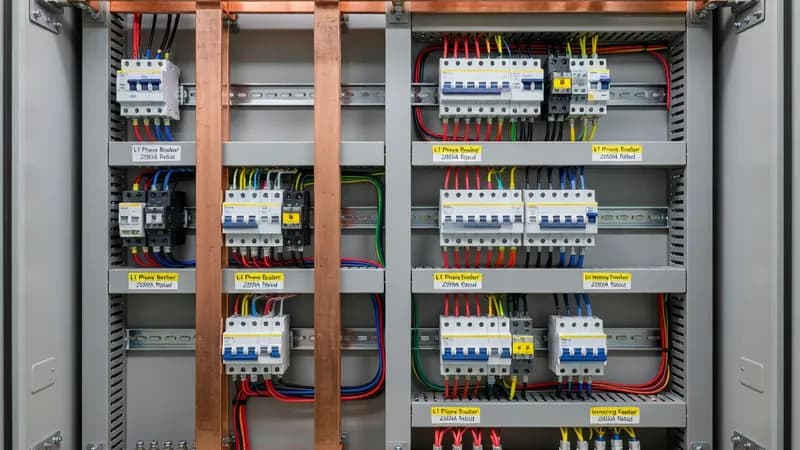
Overview
Busbar systems are the backbone of a Main Distribution Board (MDB), carrying incoming and outgoing power with minimum losses while maintaining the thermal and short-circuit integrity required by IEC 61439-1 and IEC 61439-2. In modern MDBs, the busbar assembly is typically built from high-conductivity electrolytic copper, with aluminum used in cost-sensitive designs where joint integrity, cross-sectional sizing, and plating are carefully controlled. Selection starts with rated operational current, often in the 630 A to 6300 A range for utility, industrial, and large commercial boards, then extends to short-time withstand current Icw, peak withstand current Ipk, and the fault level available at the incomer. A correctly engineered busbar system must be coordinated with ACBs, MCCBs, switch-disconnectors, fuse-switch units, and protection relays so that the assembly meets the declared conditional short-circuit performance and temperature-rise limits defined by the manufacturer’s verified design. For MDB applications, busbar arrangement is usually three-pole or four-pole, with separate neutral and PE bars selected according to harmonic loading, transformer earthing, and site distribution philosophy. Four-pole systems are common where neutral switching is required or where the neutral carries significant current due to non-linear loads such as VFDs, UPS systems, LED lighting, and IT loads. Busbar supports, insulation materials, and spacings must be sized for the declared pollution degree, impulse withstand voltage, and dielectric strength. Form of separation in the board, such as Form 2, Form 3b, or Form 4, affects how busbars are compartmentalized from functional units and outgoing cables, influencing maintainability, arc containment, and service continuity. Thermal performance is a major design driver. Busbar sizing must account for enclosure ventilation, ambient temperature, derating due to adjacent VFDs or soft starters, and heat generated by protection devices, metering, power quality equipment, and communication modules. In high-density MDBs, busbar chambers may use ventilated vertical risers, insulated shrouds, or laminated busbar sections to improve heat dissipation and reduce inductive reactance. Where arc fault energy is a concern, the MDB enclosure and internal partitions should be evaluated with IEC 61641 for arc resistance practices, particularly in critical infrastructure and industrial plants. Busbar systems in MDBs are commonly integrated with multifunction meters, power analyzers, trip units, earth-fault protection, and SCADA/BMS gateways to provide real-time load monitoring, demand control, and predictive maintenance. For special environments, compliance may also involve IEC 60079 for hazardous areas or IEC 61439-6 when the MDB interfaces with busbar trunking systems. The result is a robust distribution backbone suitable for data centers, hospitals, process plants, commercial towers, airports, and infrastructure projects where uptime, selectivity, and safe maintenance are essential. Patrion engineering can design and manufacture IEC 61439-verified MDB busbar assemblies with coordinated protective devices and application-specific current, fault, and enclosure ratings. FAQ 1: How do I size busbars for an MDB under IEC 61439? FAQ 2: What short-circuit ratings should an MDB busbar system have? FAQ 3: Should my MDB use copper or aluminum busbars? FAQ 4: When is a 4-pole busbar system required in an MDB? FAQ 5: How does busbar separation form affect maintenance and safety? FAQ 6: Can busbar systems in MDBs support VFDs and harmonic loads? FAQ 7: What tests verify an IEC 61439 busbar assembly? FAQ 8: Can MDB busbar systems be integrated with SCADA and power metering?
Key Features
- Busbar Systems rated for Main Distribution Board (MDB) operating conditions
- IEC 61439 compliant integration and coordination
- Thermal management within panel enclosure limits
- Communication-ready for SCADA/BMS integration
- Coordination with upstream and downstream protection devices
Specifications
| Property | Value |
|---|---|
| Panel Type | Main Distribution Board (MDB) |
| Component | Busbar Systems |
| Standard | IEC 61439-2 |
| Integration | Type-tested coordination |
Other Components for Main Distribution Board (MDB)
Main incoming/outgoing protection, 630A–6300A, draw-out mounting
Branch protection 16A–1600A, thermal-magnetic or electronic trip
Energy meters, power quality analyzers, CT/VT, communication gateways
Type 1/2/3 surge arresters, coordination, monitoring
Overcurrent, earth fault, differential, generator protection relays
Other Panels Using Busbar Systems
High-capacity power distribution for industrial facilities. Controls and distributes incoming power to MCC, APFC, and downstream loads.
Centralized motor control with starters, contactors, overloads, and VFDs in standardized withdrawable/fixed functional units.
Enclosed VFD assemblies with input protection, line reactors, EMC filters, output reactors, and bypass options.
Energy metering, power quality analysis, and multi-circuit monitoring with communication gateways.
Final distribution for lighting and small power. MCB/RCBO-based with DALI or KNX integration options.
Prefabricated busbar distribution per IEC 61439-6. Sandwich or air-insulated, aluminum or copper.
Bespoke panel assemblies for non-standard requirements — special ratings, unusual form factors, multi-function combinations.
Enclosed soft starter assemblies for reduced voltage motor starting with torque control, ramp-up/down profiles, and bypass contactor options.
DC power distribution for battery systems, solar installations, telecom, and UPS applications. MCCB/fuse-based DC protection.
Fixed or automatic capacitor bank assemblies for bulk reactive power compensation in industrial and utility applications.
Frequently Asked Questions
Ready to Engineer Your Next Panel?
Our team of electrical engineers is ready to design, build, and deliver your custom panel solution — fully compliant with international standards.