Air Circuit Breakers (ACB) in Power Control Center (PCC)
Air Circuit Breakers (ACB) selection, integration, and best practices for Power Control Center (PCC) assemblies compliant with IEC 61439.
Overview
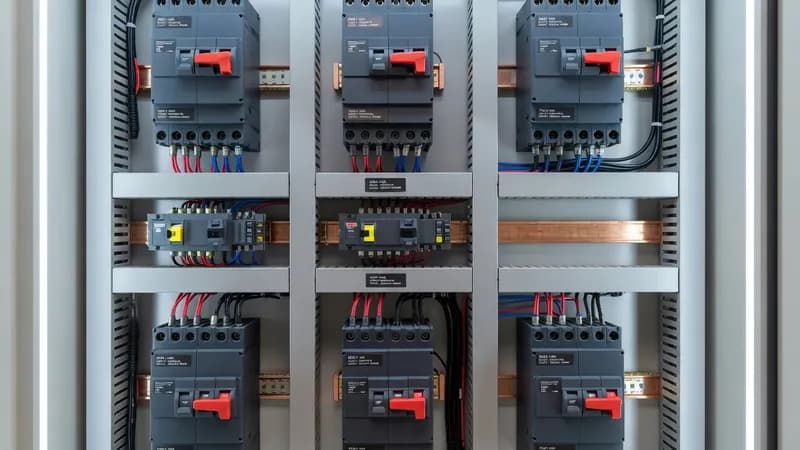
Air Circuit Breakers (ACB) are the primary switching and protection devices used in Power Control Center (PCC) assemblies for LV mains, feeder incomers, bus couplers, and critical outgoing circuits. In IEC 61439-2 compliant PCC systems, ACB selection must be based on the assembly’s rated operational current, diversity, busbar thermal capacity, and short-circuit withstand levels rather than on the breaker catalog rating alone. Typical PCC applications use ACBs from 630 A up to 6300 A, with breaking capacities and short-time withstand ratings coordinated to the prospective fault level at the point of installation, often 50 kA, 65 kA, 80 kA, or higher at 400/415 V AC depending on the utility and transformer impedance. The ACB must be verified together with the enclosure, busbars, terminations, and internal separation arrangement to ensure the complete assembly meets IEC 61439 temperature-rise and dielectric requirements. Modern PCC panels commonly use draw-out ACBs for maintainability and operational continuity, especially in process plants, data centers, hospitals, utility substations, and large commercial buildings. Draw-out withdrawable mechanisms allow safe isolation, testing, and replacement without disturbing the full switchboard. Electronic trip units provide long-time, short-time, instantaneous, and earth-fault protection, with metering functions for current, voltage, power, energy, harmonics, and power quality. Communication-ready ACBs with Modbus, Profibus, Ethernet, or gateway interfaces support SCADA and BMS integration, enabling remote status monitoring, alarms, event logs, and load analytics. In MCC-adjacent PCC architectures, ACB incomers may coordinate with downstream MCCBs, molded-case feeder devices, contactors, soft starters, and VFD panels to achieve selective discrimination and maintain supply continuity. Mechanical and thermal integration is critical. The breaker footprint, phase spacing, terminal orientation, and cable/busbar entry must match the PCC internal design, including Form 2, Form 3, or Form 4 separation as defined by IEC 61439 to limit the impact of internal faults and improve serviceability. ACB heat dissipation, especially from high-current frame sizes and electronic trip modules, must be accounted for in the assembly thermal model to avoid hotspot accumulation above terminal blocks, busbar joints, and instrument compartments. For higher-risk installations, internal arcing considerations should be evaluated using IEC 61641, while hazardous-area installations may require additional enclosure and segregation measures aligned with IEC 60079. Patrion’s PCC engineering approach focuses on verified coordination between the ACB, busbar system, cable lugs, protective relays, and upstream transformer or generator source. For generator incomers and mains-tie-mains schemes, ACBs are often equipped with undervoltage release, shunt trip, motor operator, spring charging motor, and zone-selective interlocking to improve selectivity and automate source transfer. Protective relay settings are coordinated to the application profile, whether for standby power, continuous process loads, or mission-critical infrastructures. A well-designed PCC with ACBs ensures reliable load management, safe isolation, and full compliance with IEC 61439-1 and IEC 61439-2, while supporting future expansion, energy monitoring, and digital plant integration.
Key Features
- Air Circuit Breakers (ACB) rated for Power Control Center (PCC) operating conditions
- IEC 61439 compliant integration and coordination
- Thermal management within panel enclosure limits
- Communication-ready for SCADA/BMS integration
- Coordination with upstream and downstream protection devices
Specifications
| Property | Value |
|---|---|
| Panel Type | Power Control Center (PCC) |
| Component | Air Circuit Breakers (ACB) |
| Standard | IEC 61439-2 |
| Integration | Type-tested coordination |
Other Components for Power Control Center (PCC)
Branch protection 16A–1600A, thermal-magnetic or electronic trip
Copper/aluminum busbars, busbar supports, tap-off units
Energy meters, power quality analyzers, CT/VT, communication gateways
Overcurrent, earth fault, differential, generator protection relays
Type 1/2/3 surge arresters, coordination, monitoring
Other Panels Using Air Circuit Breakers (ACB)
Primary power distribution from transformer to sub-circuits. Rated up to 6300A. Houses main incoming breaker, bus-section, and outgoing feeders.
Automatic changeover between mains and generator/UPS. Open or closed transition, with or without bypass.
Genset start/stop sequencing, synchronization, load sharing, and paralleling controls.
Bespoke panel assemblies for non-standard requirements — special ratings, unusual form factors, multi-function combinations.
Frequently Asked Questions
Ready to Engineer Your Next Panel?
Our team of electrical engineers is ready to design, build, and deliver your custom panel solution — fully compliant with international standards.