Metering & Power Analyzers in Power Control Center (PCC)
Metering & Power Analyzers selection, integration, and best practices for Power Control Center (PCC) assemblies compliant with IEC 61439.
Overview
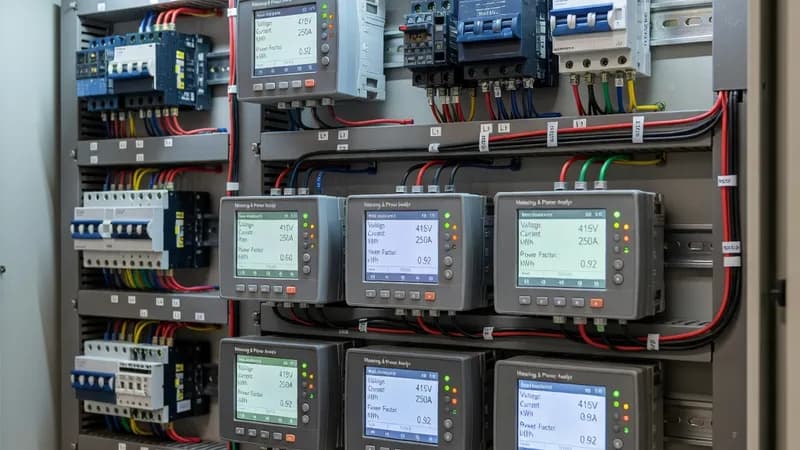
Metering and power analyzers in a Power Control Center (PCC) are not just display devices; they are critical instrumentation elements that define how the low-voltage distribution system is monitored, optimized, and documented. In IEC 61439-2 PCC assemblies, these devices are typically installed in feeder compartments, instrument sections, or door-mounted cutouts to provide continuous measurement of voltage, current, power, energy, harmonics, demand, and power factor. Common implementations include multifunction meters, Class 0.5S or Class 1 energy meters, power quality analyzers with THD and event logging, and communication gateways supporting Modbus RTU/TCP, Profibus, Profinet, Ethernet/IP, and BACnet for integration with SCADA, BMS, and energy management platforms. Selection begins with the panel architecture. In a PCC, the metering system must be coordinated with the main incomer, busbar ratings, and outgoing feeders using appropriately rated CTs and, where required, VT circuits. Current transformers are commonly specified for ratios such as 600/5 A, 1000/5 A, or 2000/5 A, with accuracy classes matched to the application, for example Class 0.5 or 1 for billing-grade monitoring and Class 1 or 3 for process visibility. For higher-voltage measurement, VTs or voltage transducers may be added, but in most LV PCC applications direct phase voltage sensing is preferred up to the instrument’s rated limits. Devices must be selected for the panel’s operating voltage, frequency, and pollution degree, and installed to maintain clearances and creepage distances required by IEC 61439-1. Thermal behavior is a key design constraint. Metering and analyzers add low but non-negligible heat loads, especially when combined with communication modules, display backlighting, gateway units, and auxiliary power supplies. Their dissipation must be included in the PCC temperature-rise assessment, particularly in boards with high busbar loading, ACB incomers, and densely populated MCCB feeder sections. Proper ventilation, partitioning, and wiring layout are necessary to remain within the permissible limits of IEC 61439-1 and to avoid nuisance drift or premature component aging. For high-density installations, auxiliary terminal blocks, fused voltage taps, and shielded communication cabling are used to preserve accuracy and electromagnetic compatibility. Integration with protective devices is equally important. Metering points are usually derived downstream of the ACB or incomer MCCB, with CT placement chosen to reflect the desired measurement boundary and avoid cross-feeding. Where PCCs include active harmonic loads such as VFDs, soft starters, UPS systems, or large rectifier groups, analyzers should support high-order harmonic measurement, transient capture, and power quality alarms. In facilities with generator paralleling, capacitor banks, or load management, metering data is used to coordinate switching logic and improve energy efficiency. From a compliance standpoint, the PCC assembly must be verified for type-tested design principles under IEC 61439-2, while the metering components themselves should conform to relevant IEC 61010, IEC 62053, or manufacturer-specific accuracy and environmental classifications. In industrial environments with hazardous areas or severe contamination, enclosure selection may also require consideration of IEC 60079 practices, and arc-flash resistance testing may be addressed under IEC 61641 where applicable. For engineering teams, the result is a PCC with reliable visibility, auditable energy data, and seamless digital connectivity supporting modern power distribution, maintenance planning, and operational resilience.
Key Features
- Metering & Power Analyzers rated for Power Control Center (PCC) operating conditions
- IEC 61439 compliant integration and coordination
- Thermal management within panel enclosure limits
- Communication-ready for SCADA/BMS integration
- Coordination with upstream and downstream protection devices
Specifications
| Property | Value |
|---|---|
| Panel Type | Power Control Center (PCC) |
| Component | Metering & Power Analyzers |
| Standard | IEC 61439-2 |
| Integration | Type-tested coordination |
Other Components for Power Control Center (PCC)
Main incoming/outgoing protection, 630A–6300A, draw-out mounting
Branch protection 16A–1600A, thermal-magnetic or electronic trip
Copper/aluminum busbars, busbar supports, tap-off units
Overcurrent, earth fault, differential, generator protection relays
Type 1/2/3 surge arresters, coordination, monitoring
Other Panels Using Metering & Power Analyzers
Primary power distribution from transformer to sub-circuits. Rated up to 6300A. Houses main incoming breaker, bus-section, and outgoing feeders.
Automatic capacitor switching for reactive power compensation. Thyristor or contactor-switched, detuned or standard configurations.
Automatic changeover between mains and generator/UPS. Open or closed transition, with or without bypass.
Genset start/stop sequencing, synchronization, load sharing, and paralleling controls.
Energy metering, power quality analysis, and multi-circuit monitoring with communication gateways.
Final distribution for lighting and small power. MCB/RCBO-based with DALI or KNX integration options.
Prefabricated busbar distribution per IEC 61439-6. Sandwich or air-insulated, aluminum or copper.
Bespoke panel assemblies for non-standard requirements — special ratings, unusual form factors, multi-function combinations.
Active or passive harmonic filtering to mitigate THD from non-linear loads. Tuned LC filters, active filters, or hybrid configurations.
DC power distribution for battery systems, solar installations, telecom, and UPS applications. MCCB/fuse-based DC protection.
Fixed or automatic capacitor bank assemblies for bulk reactive power compensation in industrial and utility applications.
Frequently Asked Questions
Ready to Engineer Your Next Panel?
Our team of electrical engineers is ready to design, build, and deliver your custom panel solution — fully compliant with international standards.