Surge Protection Devices (SPD) in Power Control Center (PCC)
Surge Protection Devices (SPD) selection, integration, and best practices for Power Control Center (PCC) assemblies compliant with IEC 61439.
Overview
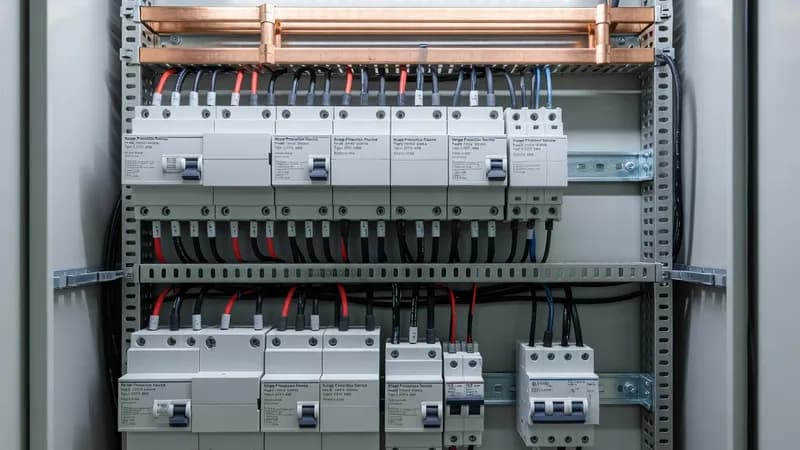
Surge Protection Devices (SPD) in Power Control Center (PCC) assemblies are essential for protecting busbar systems, feeder circuits, control power, metering, PLCs, and communication networks against transient overvoltages caused by lightning, switching operations, and utility disturbances. In a PCC, SPDs are typically coordinated as Type 1, Type 2, or combined Type 1+2 devices at the incoming section, with additional Type 2 or Type 3 protection applied downstream for sensitive control and automation loads. Selection must align with the supply arrangement, earthing system, and prospective lightning current, while also respecting the assembly design principles of IEC 61439-1 and IEC 61439-2. For industrial sites, the SPD coordination philosophy is usually paired with air circuit breakers (ACBs), molded-case circuit breakers (MCCBs), protection relays, metering, and busbar systems rated from 630 A up to 6300 A or higher depending on the PCC architecture. Engineering of SPD integration in a PCC requires attention to impulse current rating, maximum continuous operating voltage (Uc), voltage protection level (Up), short-circuit current rating with the upstream protective device, and the backup protection coordination specified by the manufacturer. In practice, SPDs are selected to withstand the panel’s prospective short-circuit current, often in assemblies with SCCR or conditional short-circuit ratings validated against the main incomer device. Compact modular SPDs with remote indication contacts are favored for modern panels because they support SCADA, BMS, and PLC monitoring through dry contacts or communication gateways. Where harmonic loads, VFDs, soft starters, and capacitor banks are present, the SPD arrangement should be reviewed for transient sources and possible coupling effects across feeder sections. Thermal performance is another critical factor in PCC layouts. IEC 61439 temperature-rise limits must be verified because SPDs dissipate heat during normal operation and after surge events. This is especially important in densely populated sections that also contain ACBs, MCCBs, motor feeder starters, control relays, and multifunction meters. Adequate spacing, terminal selection, and enclosure ventilation must be considered, particularly in floor-standing PCCs with high ingress protection requirements and elevated ambient temperatures. For indoor switchrooms, form-of-separation practices such as Form 3b or Form 4 can help localize maintenance while preserving segregation between incomers, bus couplers, and outgoing feeders. For specialty applications, SPD selection may also be influenced by IEC 61439-3 auxiliary distribution boards, IEC 61439-6 busbar trunking interfaces, and the use of explosion-risk equipment in related facilities where IEC 60079 or arc containment expectations per IEC/TR 61641 apply. In oil and gas, water treatment, data centers, commercial towers, and manufacturing plants, a properly engineered SPD scheme reduces downtime, protects expensive automation hardware, and improves overall power quality resilience. Patrion designs PCC assemblies in Turkey with SPD integration tailored to the incoming fault level, earthing method, and operational continuity requirements of the project, ensuring compliant, maintainable, and communication-ready power distribution solutions.
Key Features
- Surge Protection Devices (SPD) rated for Power Control Center (PCC) operating conditions
- IEC 61439 compliant integration and coordination
- Thermal management within panel enclosure limits
- Communication-ready for SCADA/BMS integration
- Coordination with upstream and downstream protection devices
Specifications
| Property | Value |
|---|---|
| Panel Type | Power Control Center (PCC) |
| Component | Surge Protection Devices (SPD) |
| Standard | IEC 61439-2 |
| Integration | Type-tested coordination |
Other Components for Power Control Center (PCC)
Main incoming/outgoing protection, 630A–6300A, draw-out mounting
Branch protection 16A–1600A, thermal-magnetic or electronic trip
Copper/aluminum busbars, busbar supports, tap-off units
Energy meters, power quality analyzers, CT/VT, communication gateways
Overcurrent, earth fault, differential, generator protection relays
Other Panels Using Surge Protection Devices (SPD)
Primary power distribution from transformer to sub-circuits. Rated up to 6300A. Houses main incoming breaker, bus-section, and outgoing feeders.
Enclosed VFD assemblies with input protection, line reactors, EMC filters, output reactors, and bypass options.
Energy metering, power quality analysis, and multi-circuit monitoring with communication gateways.
Final distribution for lighting and small power. MCB/RCBO-based with DALI or KNX integration options.
Prefabricated busbar distribution per IEC 61439-6. Sandwich or air-insulated, aluminum or copper.
Bespoke panel assemblies for non-standard requirements — special ratings, unusual form factors, multi-function combinations.
DC power distribution for battery systems, solar installations, telecom, and UPS applications. MCCB/fuse-based DC protection.
Frequently Asked Questions
Ready to Engineer Your Next Panel?
Our team of electrical engineers is ready to design, build, and deliver your custom panel solution — fully compliant with international standards.